Race and Vehicle Simulations

Bringing you in depth coverage of Vehicle Simulations

  • Home
  • Index
  • Writers

Forums: A Survival Guide

Posted by Eliot on December 18, 2012
Posted in: General Simming. 3 Comments

I know this guy who says stuff like “racing drivers, you know, they are just like regular people only they have a bit of a weird day-job”. And he’d know because he’s been one and worked with many.

Well, it must follow that sim-racers are just like regular folk too, only with a bit of a weird hobby, right? And I’d know because I am one and so are a lot of my friends.

So why is it we seem unable to share any kind of forum without being utter fools? To ourselves, and everyone else? Wouldn’t you expect some sort of averagely decent level of behaviour and insight, with a few exceptions on either side of average? Like a bell curve, probably.

You’d be wrong.

I have been frequenting race-sim forums since back when they were newsgroups. The only good ones I remember are those where everyone who posts regularly races against each other regularly. Once you get a place where people who never meet on track meet to discuss their hobby, all humanity and decency seem to fly out of the window faster than your little sister’s pet hamster in your radio controlled plane.

What you end up with is a kind of mostly on-topic YouTube comments thread. And everyone knows what that’s like; everyone who has ever read the comments on any YouTube video has felt their brain leaking out through their ears and their IQ lowering, anyone who has ever posted a comment has been for the duration of said posting more thick than your average high street shop’s Saturday staff.

I have been an Admin on a forum with many members who all raced against each other, and of a forum with six members who race against each other every week. I have been a member of iRacing, rFactor and RaceSimCentral forums. There must be some sort of psychological study on group mentality and behaviour on internet forums, and if there is I am probably not smart enough to understand it.

It has been suggested to me by someone who spends far too much time thinking about these things that you only get this sort of mass forum hysteria when The Community is waiting for something to be released. When the new game eventually comes out everyone gets back into their little box and gets down to the serious business of finding any/every exploitable bug in the game’s physics/dynamics engine, and forums become that little bit more sane for a while. Or maybe all the whining is drowned out by a million and one threads started along the lines of “How Do I Turn On The Rear View Mirrors?” and “Which FOV Settings Is Better Again?”

So while we all wait eagerly for every little piece of news about the forthcoming rFactor2 release, ISI’s forum is inundated with the worst signal to noise ratio since forums were ablaze with frantic iRacing speculation.

RACER Online Motorsports had a neat trick. There they required that people sign up with a real name, and somehow that dilutes the utter bellendery that an assumed level of anonymity affords. Maybe people behave better when their real name is on display rather than their amazingly brilliant forum handle like TheRealAyrtonSennaHonest86. Or maybe it was just that the people there raced against each other in a lot of events and series, and learned to respect each other on and off the track, with very few exceptions.

Other of the smaller forums keep things sane in other ways. For instance, AutoSimSport banned the boss for months at a time. Crash Test Dummies raced against each other once a week, and talked about other simulations.

Somehow, the iRacing forums appear to be immune to any kind of attempt at appeasement; the game is out and people on there race against each other. But like RSC before, the iRacing forums seem to be in a state of permanently buckling under their own hate.

So how do you survive the large crazy places without losing your mind? Here’s a few tips:

Watch out for people who end sentences with “lol” or similar, followed by an emoticon. These people are obviously crazy. They probably also think they are funny and better than you.

Watch out for people who shoehorn some idea they have into every possible thread like the world is their own personal soapy box. These people are clearly deluded and don’t understand that if their idea were any good it would have been picked up first time, they probably think that chanting/shouting something makes it more true.

Avoid any thread that appears to be a sensible discussion on the following topics: real life vs sim, assists on or off, cockpit vs any other view, etc. These threads are pits of unrest. Here you will find people who really, really hate each other, and they are going to hate you too.

Remember Godwin’s law at all times.

Read everything you have written before clicking “Send”. Check your spelling and grammar to the best of your ability. It doesn’t have to be perfect, but any mistake you make will be picked up and used to beat you about the head with by someone more stupid than you.

Remember that English isn’t everyone’s first language. Or even second, or third.

But mostly, follow Wil Wheaton’s golden rule: Don’t Be A Dick.

Racing sims: bring on the detail

Posted by spamsac on December 7, 2012
Posted in: General Simming. 9 Comments

After a quick debriefing about his visit to Kunos Simulazioni and hands-on experiences with their Assetto Corsa title, there was one detail that Jon revealed that struck me more than any other. It wasn’t the effective confirmation of a delayed release, nor details about how the team are toying with the introduction of “live track” functionality. It had nothing to do with graphics, sound or UI. It wasn’t even anything about how the title drove, though my appetite is very much whetted. No, what jumped out at me and immediately caused me to send an email demanding confirmation was the inclusion of BMW’s incredible E30 M3 Evo DTM car. The E30 M3 is a car I love, a car I adore, a car that ignites a flutter of passion from merely reading those three numbers punctuated by two letters. I knew of the road car’s inclusion and was excited by that, but a competition version was what I really craved. A childhood spent watching E30s battling away in rallying, rallycross and touring car competitions on the TV, and in the flesh (my father rallied in an ex-Vatanen, ex-Prodrive works M3), has ingrained BMW’s original M3 deeply in my emotional subconscious.

Assetto Corsa (AC) is a title I am very much looking forward to, and have been for a while. Prior to my knowledge of the DTM E30’s inclusion, I saw a solid line up of machinery and accompanying playgrounds to enjoy them in; the road going E30 firmly on top of my “to try” list. But confirmation of the presence of the competition car just a few short days ago has transformed my view and approach to the title. What it has done is stoked the embers, and raging fires of “want” are winning in the battle against my best efforts to temper expectations.

478168_560392423987080_925926798_o

Come here, you…

It stands to reason that a car which holds such emotional appeal would be a warmly welcomed inclusion. Many of AC’s so-far announced cars hold more appeal for me than many of the vehicles that frequent other titles (Pontiac Solstice, I am looking you!), but in the E30 racing machine I see a car that there is every chance I will never want to jump out of. I can very realistically see myself driving nothing else in AC not just for hours or days, but weeks, and months. So, it’s all good, right? Roll on AC and the good times? In many ways, yes. But I foresee that as the weeks and months pass, that a problem will emerge. The problem? I’ll want more.

More? Surely there’s an obvious remedy for this problem: drive the other cars. This has for a long time been the solution to sim racing longevity. There was a time when content needn’t be anywhere near as plentiful as is now deemed necessary. Grand Prix Legends (GPL) gave a smattering of content by today’s standards, yet few can doubt its staying power. Even as included content levels increase with each generation of titles, the baton is soon passed on from developers to modders to appease the community’s desire for more and extend a title’s lifespan. Whilst I don’t imagine many would complain about increasing choice, it’s not just the quantity of content that is increasing with passing titles. Whilst I’d love to say it’s the quality too, I feel this is perhaps not always the case (in relative terms, at least). What has undoubtedly grown is the complexity and detail of the content, and the size of the task involved in getting a vehicle properly implemented within a title.

This increase in level of detail can easily be seen by casting an eye over the screenshots of upcoming titles like AC and PCARS. In terms of visuals, we are seeing orders of magnitude in increased model complexity. What once would have been ignored, and a few years later maybe drawn on in a texture, is now created in full polygonal glory. Nuts and bolts and rivets brought to life by the artists’ loving touch and skilled hands. Ten years ago, West Racing released renders of their in-game models for the never-to-be-released (as yet, at least) Racing Legends. They were greeted with a mixture of sore jaws from impacts with the floor, and laughter and derision for thinking such models could run in real-time. Today we have models running in-game, on our humble home PCs, that show levels of detail that eclipse those on show in those renders (well, sort of).

lotus plan

Racing Legends: poly counts might have sky rocketed since, but has “detail”? No, no it hasn’t. It hasn’t come close.

The noises coming from the mod teams working on content for rFactor2 reflect that it is a big jump from what was involved with content creation for its predecessor. It’s not just the graphics side of things that have moved on; ever more complex tyre and aerodynamic models have had a significant impact on the difficulty, knowledge and understanding encountered and required to get a car working properly. Whilst this undoubtedly has something to do with a new title and a new learning curve (modders have had a long time to get used to the original rF infrastructure), you only have to look at the ongoing troubles experienced by the iRacing boffins in getting the Lotus 49 to work properly to see that there is more going on than simply learning new software.

What would allay my fears for my long-term relationship with the E30 is not more content; I don’t need or even really want more content. Whilst I’m not sure I would go quite as far as to say current titles ship with too many cars, I do think a fundamental shift in the approach taken by racing sims could see (and indeed would likely necessitate) a reduction in quantity, whilst at the same time leaving the player with no less to see and do. What I want is an increase in quality. A big increase in quality.

I don’t look at the beautiful models being produced by any of the major sim teams out there and wish they had higher polygon counts, were better textured, or just somehow better captured the likeness of their real-world counterparts. Kunos Simulazioni, SIMBIN, Reiza, iRacing, SMS, ISI… some may do this or that better than the others, but not a single developer I can think of struggles for talented and competent artists doing a superb job of serving up gorgeous slices of virtual car cake. Whilst on the physics side variability might be a bit more critical to the overall experience, I don’t doubt that each team has their knowledgeable, passionate individuals or teams trying their best to shoehorn the experience of handling a car into numerous lines of code. Whilst we can always wish for better graphics, sounds and physics engines, or more accurate tracks, the fact is the teams are doing their best. Some do better than others, but wishing for more isn’t likely to achieve much. These are things that have continued to evolve and develop over the history of sim racing, and will continue to do so for the foreseeable future. But there are areas where dev teams could improve. There are areas where I think, without fail, every single race sim developer could do more, and do it better. Because, frankly, they aren’t really doing it at all.

My fears for my adventures with AC’s E30 depend not on running out of tracks to drive around. It has nothing to with wanting more power, or a new challenge, or anything that another car could offer. My fear is that as my connection to the car, and my understanding of how it behaves and how it responds, increases, so too will my desire to jump under the bonnet and explore and tinker. I don’t mean adjusting camber levels or tyre pressures. I mean I’ll literally want to explore the car. I’ll want to look after it, to maintain it. I want to care for the car and feel like that care is rewarded with its smooth running. I want to check oil levels. I want to warm her up before thrashing her on track. I want to know her history, what she’s been through, where she’s been. I want her scars and imperfections not to be wiped as I get out of the seat, but to tell the story of our time together, and instead be signs or pride, or hard-fought battles. I don’t just want a simulation of driving a car on track; I want a simulation of a car.

My first car was a Peugeot 205 Rallye; K220 HWX. It was an absolute shitter. It cost far more to run it for the (all too brief) time it remained on the road under my ownership than it did to buy. It leaked, it squeaked, it wouldn’t start. But I loved it. The short ratio gearbox was sweet-as-a-nut, the 1.4l engine might only have packed 75 horses under the bonnet, but it was relatively torquey and the car weighed about as much as a crisp packet. It had shit, cheap tyres on it that offered limited grip, and anyone who has driven a 205 in anger will know why their lift-off oversteer is revered by car journalists the world over.

Getting her going became something of an art form. I eventually learned that the DIY choke pull it came with wasn’t quite set up right. You needed to pull it all the way out, then back in a few millimetres until it gave a slight click. Then with a turn of the key, and an ever so slight squeeze of the throttle, eventually you would be in business. When the old girl would eventually start on a cold morning, the next ten minutes would be spent waiting for the heater to slowly dissipate the condensation from the inside of the windscreen, and often a small pool of water in the passenger foot-well  Once visibility was sorted (often with the assistance of a jumper pulled over the back of the hand), off you’d go. You needed to be careful though; those first five minutes of use were crucial. Watching the engine temperature needle slowly but surely rise, and hearing and feeling the engine’s characteristics slowly evolve, you’d need to carefully feed the choke in. Leave it out and she’d start to run rough and have no go. Push it in too quick and you’d be stalled at the first stop. Oh, and you’d better hope that wasn’t on a hill, as the handbrake didn’t have enough purchase to stop her rolling backwards. Walter Röhrl might be the king of heel and toe, but the two-footed-three-pedalled dancing I used to have to do to keep the old girl running would have made for YouTube gold. Once she was warmed up and the choke fully pushed back into the dash (or at least as far as the ill-fitting, taped-on handle would go), it was shits and giggles aplenty. Except when you touched the brakes in the rain, as water would pour in through the roof lining and down the inside of the windscreen.

But had one day I woke to find a sparkly, as-new 205 waiting outside the house for me to start at the first time of asking, whilst on the one hand I would have been rather pleased (after, you know, I’d gotten over the improbable turn of events), I would also miss and bemoan the passing of my old partner in crime (literal, and metaphorical). Yet this is what happens every time a simulation is started. Your brand new, pristine, faultless car is there waiting for you to bin at the first turn, press Shift+R, and repeat as many times as your desire, or inability to negotiate a turn, demands.

My 205 was a shitter of massive proportions in so many ways, and fantastic in so many more, but she was my shitter. What I had with my little yellow 205 was an emotional connection. It wasn’t just because it was my first car either. Every car I have owned has given me that feeling to some degree or another, even the dullest: a plain old 5 door 1.6 Focus whose lack of overtaking ability was surpassed only by its impressive inability to stop.

What was the last sim title to give me anything even approaching this level of connection? Has there ever even been one? Two examples spring to mind. Well, sort of. The first was the Ferrari in GPL. More than anything, I just loved the sound. I can admit that in all the time I drove GPL (which is nothing compared to many of the old hands in the community, but a reasonable chunk of ‘should-have-been-homework-time’ nonetheless), with the exception of one run out in the Lotus to see how it compared, every single spin, crash, lap, spin, crash, race, spin and crash I ever did was in the Ferrari. Here was a sim with just eight cars, and yet I only ever felt the need or desire to drive one of them (we don’t talk about my time with the Lotus; it was a mistake. A moment of madness that the Ferrari 312 and I put down to stress, put behind us and moved on).

The other title to offer me a glimmer of car love is slightly less highly esteemed in sim circles, Need For Speed: Shift. Shift was a title I reviewed upon release for AutoSimSport, and as a result it was a title I needed to spend some time with and persevere. There were things I didn’t like. There were things I hated. But it also wasn’t, I don’t think, half as bad as some people made out. Indeed, I found things to like. Take the right car and try to remove as much of the “game” as possible, and it offered a fairly fun experience to my mind. But how good or bad Shift was is neither here nor there. The reason Shift provided an increased sense of connection to vehicles could only be attributed to a few simple factors: you chose and bought a car; you could upgrade it; it had a working odometer. I can safely say it must be down to those small, seemingly insignificant things as they are only elements that differentiate the cars in Shift from other PC titles past or present. Of those three elements, you can scrap upgrades from the list too, since I didn’t upgrade my favourite car at all. I chose the colour of Walter (white with black decals), my Porsche 911 GT3 RS, handed over some imaginary cash, and it kept a record of my mileage. Given in-game money was easier to come by than rain in England, I can only conclude that the tiny, simple inclusion of a working odometer was all it took to transform this sim car (in far from the world’s greatest sim), from simply another car in another title, into something personal to me.

In a previous article, I argued that there is a lot of room still left to be explored when simulating the “racing” part of racing sims. I think that there also remains a huge amount to simulate in the “vehicle” part of vehicle sims. But here’s the rub: vehicle sims of the non-racing kind are doing these things already.

OMSI Bus Simulator is a title I expect few of you are likely to be familiar with. It is a title I am only aware of due to Jon picking it up and sending many, many emails about it. In brief, as the title might suggest, it is a bus simulator. More specifically, OMSI sees the player transported back to 1980s West-Berlin, and running the Omnibus line 92 through the Spandau district. Jon bought this during a period of sim experimentation which also saw him dabbling with railway and underground simulators, and when he told me of his latest acquisition, a bus simulator, I was slightly puzzled.

On the surface, OMSI holds no real interest for me. I’m not a particular fan of buses, I have never felt much of an inclination to be a bus driver, and generally don’t particularly enjoy driving in city traffic. I expect, were it well done, that it might hold a level of novelty value for me, but there was very little in the way of incentive to go out and buy it. But as conversations between Jon and I continued over the ensuing months, OMSI kept cropping up over and over. Sometimes it was a simple “Just taken my bus out on the night route; traffic was nice and quiet”, and not a lot more to it. But often, OMSI came into the conversation when talking about racing sims, and specifically where we felt they were lacking.

Bus simulations may hold little obvious interest for me, but what I have learnt from Jon’s experiences with OMSI are that simulators in other areas are taking certain things a lot more seriously than racing sims. OMSI might not have to tackle the same on-the-edge tyre behaviour that every racing sim practically lives (and, sometimes, dies) by, but it is doing things that go way beyond what racing sims do in other areas. Many of these things, if they were announced in a racing sim, would be dismissed by a significant number as gimmicks, not important, inconsequential. But individual fleet numbers on the different buses; fully persistent features like accruing dirt and grime; fully modelled systems like the gearbox, heating system, pneumatics and IBIS (Integrated Board Information System- the thing that tells passenger where you’re going) all contribute massively to the experience of hustling your double-decker around historic Deutschland.

If, after stepping out of a bus in OMSI, you turned your back and had some fictional stationhand park your bus amongst a dozen “identical” vehicles (to clarify, this doesn’t happen; you must park your own bus), you’d be able to identify “your” bus. That shiny E30 in AC? Well, it’s just another shiny E30. You’d have no reason to care if you picked the wrong one, because it would be exactly the same as any other.

SD77 cab

Don’t worry, you’ll be able to find it later.

But it’s not just vehicle identification where these features matter. The IBIS is obviously pretty genre dependent, but whilst the fully modelled heating system might take on bus-simulation-specific importance in some respects (I gather the passengers can get rather cranky if the bus is too hot or too cold; no, I am not joking), it is also essential in that it guarantees your windows are clear to see through as you negotiate the city traffic. Anyone who has watched a reasonable amount of motorsport in their time (or anyone who drove my old 205) will know just how debilitating a critical lack of effective condensation dissipation can be to the pace of a driver. Yet I don’t know of a single racing sim that has modelled misting windows and functioning heaters. Many titles don’t even model a windscreen. Hell, when iRacing finally introduced windscreen dirt build-up (something which was in NR2003) after a number of years it divided the community.

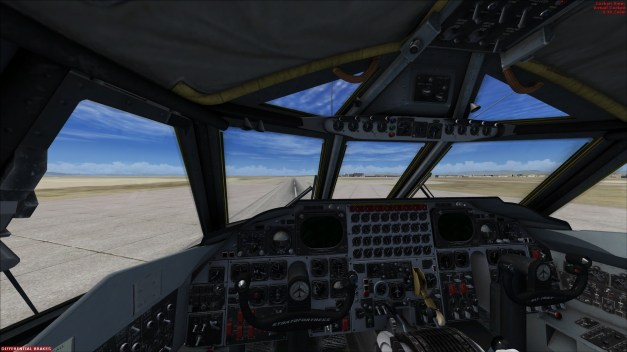
When looking into other simulation genres, flight sims seem to be an area that take a drastically different approach to racing sims. The level of detail and modelling that go into a top quality sim-plane simply dwarfs that of the comparative car model. The fully interactive cockpits, the full system modelling… There is very good reason that these individual planes have been sold, in some cases, at a price far higher than any racing sim. There’s also a reason that these individual planes come with huge manuals and guides: planes and cars are very different things, and so are the arts of pilot and driver. Is there any point drawing parallel between the two? I certainly think there is, and the differences are as important as the similarities.

First of all, the vehicles themselves. Planes, as vehicles, are on a much grander scale than cars, both in a literal physical sense, but also in terms of complexity. Even the most complicated car dash effectively has a relatively meagre smattering of buttons and switches, that typically do relatively easily understood functions. Of course, there are exceptions; I doubt many can look a modern F1 wheel square on without feeling a slight sense of intimidation at the prospect of mastering its numerous functions in the heat of a race. But that is perhaps the extreme, and compared to the myriad of dials, screens, buttons and switches adorning the cockpit of a modern plane, there is no real comparison. There is quite simply a lot more to flying a plane than driving a car, and this brings us onto what you do with these machines.

In a car out on track, the experience is primarily led by the directional inputs of the driver; the throttle, brake and steering. Gears and clutch are just ways of managing acceleration, braking and changes of direction. In a plane, it’s quite the opposite. On a flight of any real distance, you aren’t there making drastic changes of direction. You’re not making split second decisions about throttle and steering adjustments. As much as directing it, you are managing the plane. It makes perfect sense then that racing sims should be so focussed on the immediate, and similarly that flight sims see such a focus on complex underlying details of the aircraft. But to me that doesn’t form an argument for why racing sims can’t and shouldn’t embrace more of this side of things.

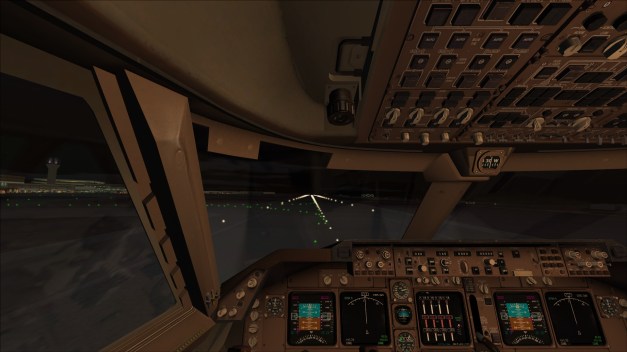
The pilot in a Boeing 747 might have a lot more time on their hands under normal conditions to fiddle around flicking switches on his or her dashboard than the driver grappling with their E30 does, but similarly the 747 pilot has a lot more switches to flick, and a lot more need to flick them. Why can’t a simulated E30 have a working everything that a real E30 has? If flight sims can tackle the complexity, scope and scale of a Concorde or the like, why can’t race sims tackle the simpler (I’m not saying simple!) task of realising the full complexity of a given car? If the flight sim modders and community can achieve such things, offer them at the respective price point, and find a market for them, why can’t cars be recreated in similar levels of detail and sold for prices reflecting the level of work? Perhaps more to the point, why aren’t the community willing to support such an approach?

747-400

Piece of piss. Very complicated piss.

Another “sim” genre seems to also offer an interesting point of comparison. Space sims (yes, something of an oxymoron, so let’s just consider them simulations of what life in space might be like) look set for an interesting future. Not long ago, Star Citizen (from the creator of the Wing Commander franchise) smashed through its Kickstarter campaign target, and Elite: Dangerous, the next instalment of the highly respected Elite series, has at the time of writing secured half of its £1.25 million target with some time yet to go. Further to these, the Minecraft team have 0x10c in the pipeline. Whatever becomes of these titles, the hype and activity around them right now, and the backing they have received, at least demonstrates one thing: there is demand.

Many have for years bemoaned the lack of a modern version of Elite. It isn’t just about having the Elite moniker either, but the type of gameplay and approach. Early feedback and comments I have seen accumulating around each of these titles seems to suggest quite strongly that people want a deep, detailed, full experience. There are requests for full ship modelling; not just graphical, but systems and technical aspects. Here you have a genre “simulating” something that doesn’t exist; there is effectively a blank canvas that, provided they obey the known laws of physics (and of course, who knows what our understanding and technology will enable in thousands of years from now), no one could call unrealistic. And yet people are demanding this level of detail. They positively crave it.

Of course, the world of racing sims has also had its own foray into the world of crowd-sourcing with SMS’s PCARS title. A big difference between the approach taken there and that seen with the aforementioned Kickstarter initiatives is one of the crowd’s involvement beyond putting up the cash. This could have gone either way, and we won’t know until the final product is delivered just how it has turned out. What the PCARS project has successfully shown is that people are willing to put money up front for a non-existent racing sim, in the hope that in return they get the product they want. The “inclusivity” offered to investors, and the way the project seems to be heading, does not, however, provide an answer as to whether or not people are willing to pay for a full depth, no compromise racing simulation (no, this isn’t a slight against PCARS). In the Kickstarter video for Star Citizen, its creator Chris Roberts makes it quite clear the title is aiming itself as a title that simply could not be done on console; a celebration of what the PC is all about as a gaming platform. But conversely, in some ways PC racing sims seem to be moving away from this and towards the console titles.

Today’s simulators seem to be taking increasingly large steps to broaden their appeal. GPL was truly a formidable title. Despite the presence of lower powered cars and variable difficulty levels, GPL didn’t really have a learning curve as such; it had a learning line. That was vertical. Although quite primitive in many respects when compared to the best on offer today, it was an uncompromising title. It was difficult, it was challenging, and it felt pure. Its physics simulations might not have been wholly accurate by today’s standards, but you got the feeling it was trying its best. GPL was not just a benchmark and genre defining simulation, it was also a fantastic game (very much in keeping with the Elite series, which had a very steep learning curve and immersive experience). The (now sadly quite rare) full line-up of cars, tracks and drivers that comprise a full season provided the game with soul and with a narrative. It didn’t need CGI cut-scenes or RPG elements, it just put you in race after race with the same familiar names: your team-mates, your respected peers, and your fiercest adversaries (often not mutually exclusive).

GPL’s AI and league structure (i.e. a proper championship roster of drivers and tracks) was what provided the “game” element. However it might compare to today’s offerings, it was a sim through and through in terms of the driving experience. Flawed and inaccurate? Probably. Tightly focussed on trying to offer the experience of competing in the GP world of yesteryear with little concession to accessibility or crash-bang-wallop fun? Very much so.

AC looks set to be a truly great title, and one I am very much looking forward to. I don’t want there to be any doubt about that. But I look back at some of netKar Pro’s now gone and forgotten features, such as the interactive cockpits and fully modelled start-up procedures, and can’t help but feel sad that there is effectively a backward step going on. AC will no doubt be a big march in the right direction in many areas, and I’m not for a second suggesting it will be an inferior title to its predecessor. But there are features that the devs are not only capable of implementing, they have already implemented them in the past, that may not be making it into an all new sim. This, to me, is a crying shame.

I can sit here and wish the devs would include this or include that, but these things are only going to make it into a title if one of two things happens: you get some devs so focussed and passionate about the subject matter at hand that they won’t rest until they have modelled every little detail they can manage; or the audience makes it clear that this is what they want. The former is something of a difficult stance to adopt. One title springs to mind when I think of such an approach. As I have mentioned many times before, whilst Racing Legends might stand head and shoulders above all others in my mind as the sim of my dreams, the fact it is the sim of my dreams and not a sim on my hard-drive tells its own story. Developers don’t sit in the privileged position of having all of the time and resources their every whim may desire; they are individuals, groups and companies, with mortgages, children and bills to pay like everyone else.

So what do simmers want? I must confess I get confused by the racing sim community. On the one hand, I see no other community so quick and willing to criticise a title for its lack of realism, or for deviating from the well-worn sim path. And yet, with that, I see a community which, on the whole, does not seem to really crave the realism they claim to demand. I don’t really know why this is, but I think people need to consider exactly what it is they do want before being so vocal and vociferous about what it is they do not.

I get the impression that the simulations many in the community wish they could have are those used by the F1 teams. If teams spending hundreds of millions of pounds a year going racing invest time and resources into these simulations, they obviously judge them to be of worth. As such, what better verification of quality and accuracy can you get than that which comes from the people at the cutting edge of automotive design and implementation, running the most tightly monitored and scrutinised cars in history? It would be easy to make an argument that such set-ups are the ultimate vehicle simulators. But I am not convinced they are; the role of the F1 team simulators are not to simulate the experience of driving a car per se, but to provide a tool to help with car and driver development.

F1 drivers in a simulator will not be interested in the simulated form of many of the real aspects of driving. The aim is to work on learning the track, general set up work; they won’t be testing with dirty visors, mechanical frailties and failures, other cars etc. Despite the name, an F1 simulator is, in many ways, not really concerned with simulating. You would expect the physics engine and modelling to be top drawer, but in terms of simulating reality, they only really have to concern themselves with a small subset of the real world’s complexities. In this respect, iRacing’s strive to market itself as a driver training tool does not necessarily mean the product is automatically moving in the right direction in terms of absolute simulation. I agree with the general sentiment within the community that physics are more important that graphics, but I think it’s worth remembering that physics aren’t everything.

Curiously, I seem to detect a sentiment that this stripped back approach is what a racing simulation should be. That anything else is gimmicky; is somehow making the experience a “game”. But I don’t think simulations and games need be mutually exclusive, and indeed think that at times they necessarily overlap. The sims we play are video games, fundamentally.

Whatever a simulation is simulating, the end point is that is needs to be fun for the people “playing” it. What is or isn’t fun is obviously going to vary immensely from person to person, but there seems to be a sometimes strange approach to fun in racing sims. It is quite obvious that for some people, winning is all that matters. iRacing, the title with undoubtedly the best organised, structured approach to assessing performance via numerous metrics, positively thrives on the element of competition. But I’ve heard numerous stories that really make me wonder why people go to the effort. The use of loopholes and exploits provide a case in point, but stories of people deliberately using inferior hardware as a means to obtain a competitive edge seem a particularly striking one. Here people are diminishing the experience, reducing the accuracy of the simulation, for the sake of being “better” at it. It’s not hard to see when simulating a sport that competition comes into it, but I can’t help but ask the question: why bother?

The fun for me comes from the challenge, from the experience. I would rather be slow and off the pace but know I am experiencing something as close to reality as possible, than be winning in the knowledge that I am deliberately diluting the simulation. On a broader scale, I think this behaviour manifests itself in subtler ways, perhaps subconsciously. I think it’s fair to say that some people would rather think they are good at something than face up to the fact that they are not. Many of the people who enjoy bashing around in Gran Turismo, invincible to damage, generally doing a terrible job of race driving would likely not have much fun in the world of netKar Pro. Whilst toning down netKar Pro’s more extreme elements of simulation might make the title have a broader appeal, there are also a number of people for whom such feature reduction diminishes the appeal.

I can very much sympathise with the developer’s position here, and completely understand the AC team’s comments about how “everyone wants to race a 24 hour race, driving at night, under heavy rain, with broken suspension and a puncture. But just one time for a try.“ I get the sentiment, but it seems to me to miss the mark a bit.

I might be in a minority of the whole gaming scale in wishing for more and more intricacy in my racing sims, but I’m also a little disheartened by being told what people do or don’t want; they don’t seem to be speaking for me. Many in the community raised an eyebrow when Codemasters announced they would be dropping cockpit views from some titles as “no one uses them”. But similarly, I raise an eyebrow when I’m told proper that start up procedures, interactive cockpits, deeper vehicle systems simulation, component modelling and management are not being included because it’s not what people want. Of course it won’t appeal to everyone, but that doesn’t mean that it doesn’t appeal to others.

To return to the topic of space simulations, an interesting video recently came to light featuring an interview with David Braben and Chris Roberts about their respective titles in the works. Some of the things they discuss are the issues of trends in genres, and the effect of publishers. Both of their titles are being made publisher free, and in doing so removing the restrictions and demands that accompany going down the traditional development path. Fundamentally, they are taking out the money men who reduce games to the lowest common denominator, and giving themselves the chance to make the games they want to make. In a sense, this is the artist taking back their art. None of the big players in the racing sim market run through the conventional publisher model, but there still seems to be lot of (self-imposed) restrictions on development. Some of this is necessary; it’s called discipline, and it is essential if a title is going be released in a reasonable time frame without the developer going bankrupt in the process. But some of it seems, for want of a better word, a little short-sighted.

elite

As someone with no prior interest in Space sims, the words and conviction of Braben and Roberts regarding their new projects are highly appealing.

I wouldn’t have thought there would be much of a market for a hardcore bus driving simulation. Whilst I don’t know how OMSI has fared in terms of sale figures, the forums are very busy and it certainly seems to be doing ok for itself and gaining plenty of recognition and positive response. How many people want a fully featured racing sim, with as many details modelled and included as can possibly be incorporated? In short, I don’t know. I don’t have an answer to that. But I’m not convinced the devs do either. As people look for what separates one title from another, such a change in approach could at least make a title stand out.

It’s taken decades for Roberts and Braben to put their latest titles forward as propositions for the gaming public, but the millions of pounds being put down as backing show that there is plenty of want and demand. If we can’t have a bit of “Build it and they will come” in the sim racing community, how about a bit of “Show them the architect’s drawings and see if they would like to”?

Assetto Corsa – Autumn development update.

Posted by shrapnel1977 on November 27, 2012
Posted in: Kunos Simulazioni. 25 Comments

As underdog stories go, the conception and development of Kunos Simulazioni as a force in the simracing arena is an emotive one.  The well documented (AutoSimSport December 2011, and here) conception, release and subsequent development of netKar Pro, as a bedroom project turned to reality, is a human story that reflects the sacrifice and passion of a small developer trying to make it in the cut-throat world of video game development.

Many years on, the team are an established business, and working, as is widely known, on a scratch built project to build on their reputation as the class leaders in vehicle dynamics and tyre physics; Assetto Corsa (AC).  netKar Pro, for all its faults, is still regarded by many as the benchmark when it comes to physics in simracing, despite the best efforts of the competition.  This has resulted in a fervent following for AC, with every screenshot on Facebook and every one of Stefano Casillo’s tweets becoming revered as an indication that AC is the sim that everyone in the community is waiting for.

Whether this fervour is realistic is another matter, numbers show that plenty of other sims in development have similarly excited fans, and the consistent user numbers on the iRacing servers leave us in no doubt as to the current top dog.  But, AC is coming on well, so as the proposed release date of “in 2012” is coming to an end, I took a trip out to Vallelunga to see how the sim is coming along.

Over the weekend of the 24rd and 25th of November the Autodromo Vallelunga Piero Taruffi was abuzz with the sights and sounds of the 6 hours of Rome sportscar race, and a busy paddock building belied the quiet, calm, working atmosphere that takes precedence in the Kunos Simulazioni offices.  With Stefano, head buried in some code, and Marco, similarly focussed on his screen, the real fun looked to be being had by Nicola Trivilino from DrivingItalia.net, who was pedalling a Lotus 98T around Imola in the Kunos “Sim-rig.”

Once the pleasantries were over, and discussion about my delayed aircraft was duly laughed about (just a left side engine failure on the ground, nothing to be concerned about, erm!), it was time to level some questions at the team.  So, 2012 is coming to an end, where is AC at now?  “I’d say we’re at about 80% of the way there” Aristotelis Vasilakos offers, “most of the main core of the sim is done now, and so we’re mainly now focussing on the little things, making the GUI right, finishing up setups screens, that sort of thing.”

“It looks like we will be delayed beyond the date we originally aimed for.” Marco Massarutto, Project Director, “There are a few good reasons for this, some of which we can’t really get into, but a lot of it is just a matter of making the sim right.  We’d rather put out the best product we can, a little later than expected – than release something that doesn’t work, on time – I think that’s natural.  As such I think we’re looking at quarter one 2013, sometime around March, for release now. However, we hope to get the ‘tech demo’ out sooner, hopefully this year.”

Software development is always tricky to predict, and arguably, a complete scratch-built product in just under a year seemed an ambitious time line.  Is this due to any nasty surprises along the way?  “Not at all” Marco re-assures, “everything has been going very well, in fact, some things much better than expected.  But the fact is we are a small team, and people can only do so much, and sometimes, when dealing with other companies, timescales are not always in your hands.”

Positivity can be taken from this, but what’s been going so well?  Stefano pipes up “I’ve made some nice breakthroughs on the multiplayer side, and to my surprise it’s really come together.  I don’t need to tell you, I was having nightmares about the multiplayer code, after the trouble I had with netKar, but we’ve brought in some new technology on this side that has really improved the experience.”  This inspired Stefano to throw up a server, on a hosted box somewhere on the internet, and connect two clients to it.  Promptly, Stefano and Aris set to the track in a pair of Pagani Zonda R’s, a car with the sort of speed that would have destroyed netKar’s online code.  It was smooth, defined and cars behaved normally and properly, not a jump in sight.  Both drivers ran each other very close at times, with some real wheel to wheel stuff and at no point did the multiplayer falter.

Marco then pulled up a video of an online race in the Lotus 49 with Kunos employee and track modeller extraordinaire Simone Trevisiol, based in Thailand, and similar levels of smoothness and precision were seen in action.  Good news for those that might have feared for AC on this front. “We’re not done yet, there is still a way to go with finalising and tuning the code, but I am very happy with how it is now, and I hope I can make it even better” Stefano’s confidence on the subject is welcome.

“We’ve really got the physics together a little better too, now, I think” Aris comments. “The last time you tried it, in March; things were quite rough and raw, now we’ve refined a lot.  We’ve taken an engineering and mechanical approach to the cars in the sim.  This has meant sometimes fighting car manufacturers quite a bit to get the information we need to ‘plug it in’ to the sim. Once we have the information, all the data goes into the sim and so every car’s suspension geometry is accurate, every aspect of the car’s layout correct, and this links back to the physics engine. It makes sense really, but in the old days of car modding it hasn’t always been this way for sims.  Fundamentally, if we plug in the correct data for the car into the sim, and it doesn’t drive right, then we have to look at what is wrong with the base physics model that isn’t working right, and not play with the car to make it ‘feel’ the way it should.”

As Nicola steps out of the rig to commence his interview with the Kunos team in Italian, I jump in, strap on the headset, and get into a zone.

The sim now has a clean, clear and stylish HTML based GUI, which makes navigation simple and easy.  The basics are there, this sim is about the driving, and so aside from options and configuration, there are sections detailing the driver profile and stats, online, offline, quick race, practice, blah blah.  We all know what a racing sim does by now I hope, and a GUI is just a transport to get there. This one is pretty, and functional – good news. A welcome addition appeared to be an “achievements” section, which is yet to be fleshed out, but should include some basic “gold star” type in-game awards to aid boast value and potentially help with online matchmaking. However, this section of the GUI is “placeholder” for now.

Once you’re set, it’s a simple choice to select a car and a track to find yourself nestled in the pits in some of the most gorgeous cockpits ever seen.  AC is beautiful, the DX11 graphics engine that we’ve all seen at work in the various screenshots posted is just as pretty when on the move.  From the outside of the car the in-car driver animations look so fluid and accurate that it can be hard to tell it apart from reality at times!

My aim for the visit was to really get into depth with the sim, and do some good, hard, laps.  This meant keeping to tracks I know, and working with cars that I am au fait with the basic engineering of.  So, first things first, I took to a Lotus.  I used to run a Mk1 Exige many years back, and have generally been invited to my preferred Lotus dealership to try out new models whenever they are released.  This has allowed me to keep up with new models on the whole, though I have yet to drive the new Exige S, with its Toyota derived V6.  So naturally I took that out first!  The “progress” of Lotus over the last twelve or so years has been to try to compete with the likes of Porsche in the middle market for sports cars.  The net result of this is that successive Lotuses have become a little more user friendly, and usable as road going cars, at the same time this has brought about technology such as ABS (accurately and delightfully modelled in AC) and a slightly more manageable balance on track.

What this means, of course, is more understeer, and thus driving the Exige S quickly can become an exercise in keeping the front wheels in check, getting her slowed in good time, and turning into the corner with minimal scrub.  This exercise is replicated in AC very accurately, and as the laps tick away, you start to appreciate the balance of the vehicle and adjust your style to match.  On road based tyres, the tyre model continues to feel planted and solid.  While road tyres are not as laser sharp as slicks, and a road going car’s steering rarely as precise; this difference feels very nicely implemented in AC.

One thing I have touched upon in previous articles concerning AC, is the overall approach to the sim that the player has to take.  Unlike many other simracing products, the cars in AC feel very much under your control, and this presents a very different approach for the player.  There is rarely any “what the hell happened there” moments of snap oversteer or understeer, the cars behave in a way that (to a driver) feels very much the way you would expect they should.  This means that keeping the thing on the track is never really very tough, provided you know which way the corners go, and you have a basic understanding of the capabilities of the car in your hands.

The net result of this is that cars almost feel rather easy to drive initially, as they arguably should be.  Not many cars are difficult to drive at reasonable speeds, and as I pedalled the Exige S around the Silverstone GP track I found myself getting closer and closer to the limit as I pushed the braking and turn in phases deeper and deeper into the turn, the feedback from the wheel through the front tyres allowing me to understand their tolerance for exactly how much I could blend longitudinal and lateral loads.  Slowly getting quicker and quicker, the confidence I could maintain in the car continued to grow as I was not getting any nasty surprises.  Brake a bit too late, run wide and understeer through the turn; on the throttle a little too early, the back steps out gently and you can modulate your right foot to keep it in check.  The tyre scrub, however it may be induced, causes a reduction in speed, which, provided there is enough room, will bring the car into check as the excess speed wears off.  You know, general car driving stuff.

Then, that confidence got the better of me, as I threw her into Stowe a little too fast, with a bit too much braking causing a forward weight transfer, the rear broke away.  Like it would in real-life, this made me metaphorically “jump” in my heart as I realised I was committed to the turn with too much speed and this could become an accident.  None of it was unexpected really, I had been building my pace more and more, and this was going to happen soon.  The car, broadside well wide of the apex, slid onto the exit kerb and then the lovely flat green-painted concrete, where my corrections straightened her out, and I was on my way.  A minor moment, in some sims, in fact, sometimes the sort of moment you might have every other corner; in AC your control of the car is so solid and understandable that when this happens it makes your heart leap.  When your brain becomes so immersed in the experience, that genuine, heart leaping “Oh no, I’ve stacked it” feeling can grab you.  When crashes are a regular thing in a sim, you become jaded to them, they are normal.  When a crash only happens once in a blue moon, they can cause much more of a shock to the system because you’d spent so long with everything under control.

With this in mind, Aris sat down with me to suggest I take out a car that I am much more likely to crash: The Pagani Zonda R.  With an AMG derived 6.0 litre V12 borrowed from the Mercedes CLK-GTR, putting out 750 brake horsepower and a monstrous 710Nm of torque at 7500rpm with a kerb weight of 1070Kg, this should be a much trickier beast to keep hold of.  “You’ll be amazed” Aris states “What the Pagani engineers have done with the rear suspension geometry to make this thing drivable is amazing.”  Out of a slight fear I took it to the wide open straights of Monza, and sure enough, I was amazed.  The car has a lot of grip, as cars of this level should have.  No car has a rear tyre profile this huge without being fairly grippy.  Whilst it was easy enough to spin the car around on the throttle if you were trying to, provided you were making some effort to feed the power in, the traction from the car was very nicely controllable.  Once the rears gripped up, would launch you out of a corner with the force of an F15 Eagle.

Keeping the Pagani on the track was not difficult, and at no point did I slide off or lose control.  However, as Aris re-assured, this was a car that could bite you.  As you start to push the performance envelope the car’s awkward balance becomes quite apparent, under hard braking the huge anvil of an engine in the rear tries to get to the front of the queue, and so the back starts to squirm around.  Aris jumped in the driving seat for a few laps of hard running to demonstrate, and as the attached video shows, taking your braking a little too deep into Ascari, or the Lesmos can result in a tricky dose of entry oversteer. Though not necessarily in a “terminal” way.

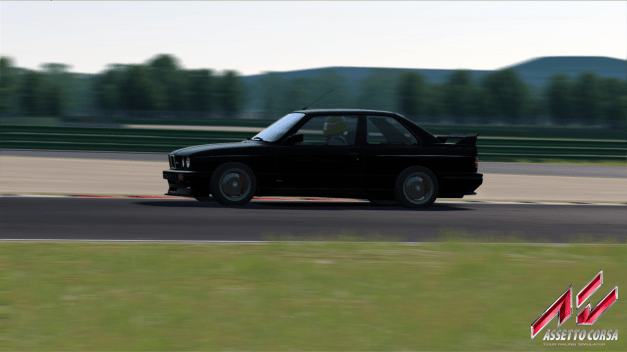
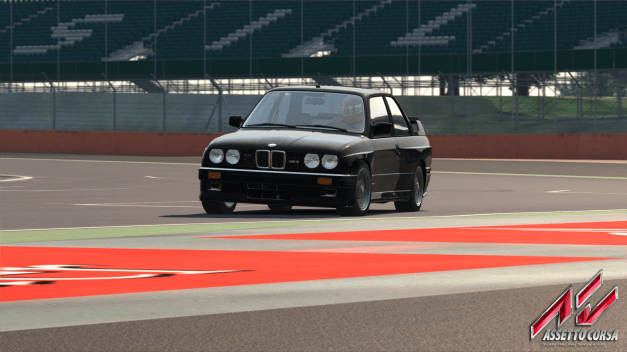
Next we moved back to the Silverstone GP track, and took out the BMW E30 DTM car. Whilst still in early stages of development, still using the road-going E30’s cockpit and bodywork, this car formed the backbone of BMW’s DTM assault in the early 1990’s, and was a homologation special that evolved the basic road car to an extreme level.  With chassis stiffness almost akin to a fast single-seater, the 360hp 2.5 litre 4 cylinder lump can propel this mere 960Kg car to remarkable acceleration.

What was most notable in this car, with such stiffness, was how controllable and usable it was on track.  Positively delightful to drive, pushing the sharp, responsive front-end into a turn would hook the car up into the mid-corner, allowing you to get on the throttle much earlier than you expect, and earlier with every lap.  This car is superbly balanced and capable, its taut chassis allows you to understand what every tyre is doing at each stage, and bouncing the car over the Abbey chicane kerbs felt very much under control, and placing the car where you wanted it became more and more natural with each passing lap.  I mention to Aris that I have to try something else now or else I could drive this car forever!

The next step was the Lotus 49, which I drove on my earlier visit in March.  Much has changed since then, albeit in subtle ways.  On the historic Monza layout the 49 felt so at home but also, in keeping with my experiences so far, very manageable.  No GPL style “deaths” here, I ran several laps, albeit at a track I know well, without incident, and started to really enjoy the gentle powerslides out of the Lesmos, and feeding in power on the exit of Parabolica.  I’ve not driven a real Lotus 49, not many people have, but of the numerous virtual versions I have driven, this is the one that has felt the most like a racing car, like a car designed to win races, to grip, to allow the driver to shine.  It’s another car I feel I could drive forever.

The same can’t really be said of the next on the list, the Lotus 98T.  1985’s Lotus propelled Ayrton Senna to his first win at Estoril in atrocious conditions, and driving this thing makes you wonder about the sheer talent of the man.  The idea of driving it on a wet track sends shivers down the spine; on a dry (modern) Monza the ferocious power delivery, from the 1.5 litre V6, throwing out 1200hp, takes a bit of deft footwork in the first four gears to keeping the back end safe under acceleration!  At only 540Kg, the 98T generates a fairly huge amount of downforce, so corner speeds can be reasonably high, but the turbo lag, and resulting power delivery make for a car that can be very difficult to be confident with when it comes to mid-corner throttle application.  Once again, AC surprises, as the car is never really outside of your control.  But the overall enjoyment of the experience is a little tainted by the reality that this car has just plain has too much power to be usable.  So it’s a case of sitting back and waiting for the car to be safely straight and ready before getting on the throttle and receiving a space shuttle-like punch out of the turn onto the ensuing straight.

It is lunch time, and I still haven’t crashed any of the cars, which is a bonus because it saves me looking like a buffoon.  But that aside, this may be the first sim I have found so easily accessible to drive – Easy to drive, hard to drive fast – pushing the car too far results in time lost, but rarely huge accidents.  The nature of the tracks helps, but at the same time, if you feel things going wrong, the natural response is almost always the right one, and the dynamics of the vehicle respond to inputs exactly as you would expect.  I’d been up since 4am and not eaten a thing, and yet here it was at nearly 2pm and I was asking if I could just stay behind and do more laps. AC had caused me to forget to eat; I doubt it will be the last time.

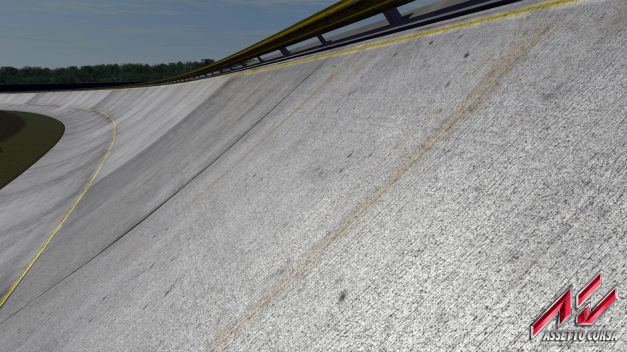
Monza’s original banking has been laser scanned.

After a brief fettuccine al pomodoro and amusing chats about the good days of misspent youth thanks to Geoff Crammond, we returned to the offices and I sat down to some nice, long runs.

Experimenting over a series of cars, such as the Lotus T125, P4/5 Competizione and BMW Z4 GT3, I was permitted to enable debug overlays for tyre temperature, slip, camber, caster, toe, and all that exceedingly fun, real-time telemetry action, and analyse how the tyres held up to differing levels of abuse.

The tyre model is so tightly defined across the surface of the tyre, that running over kerbs can cause a “flick-flak” of heat build-up on the parts of the tyre hitting the leading edge of the kerb, and flatspots will come back and haunt you as they always find their way back to the bottom of the wheel to allow themselves to grow.  All very cool stuff, but how do the tyres themselves stand up?

Well, aside from my protestations to Aris that I needed more pressures all round, there was a very pleasing response to input from the tyres under hard running.  At Silverstone, a track that features lots of fast switch backs, it can be very easy for a driver to overwhelm the front tyres, and witnessing this I could feel a general drop off in performance as the fronts began to overheat.  Quite naturally, this does not involve any serious loss of grip, or terminal understeer, but rather gives you a clear feeling that the fronts are becoming more “gloopy” under load, and the resultant loss of grip is very apparent on balance and laptime.  Scaling back the loads, you can see the temperatures come back down again, into the operating window, and find a good level of “attack” to maintain the temperature needed to achieve optimum cornering pace.  This is easier, or harder, in different cars, depending on downforce levels, weight, layout, etc, but tyre management is a clear skill required in AC to consistently get good times. However, I might add, good tyre management is not the difference between good laptimes, and being in the wall.  An overheating tyre is not going to result in wild drop off in grip, just a mild reduction which you notice as you have to wind in more steering lock, or brake a little deeper to scrub off more speed on turn-in.  No sudden switch to “ice.”

One thing remains “off” at present, and that was the feeling of the tyres at cold, and the speed at which they got up to temperature.  Cold tyres felt too grippy on the whole, and within half a lap or so were up to operating temperature.  Aris, when questioned, confided that this was something that had not been fully worked out as yet, as so far the focus on tyre temperatures was on optimising the heat build-up or deprecation under normal high-speed running.  This makes sense, and at this stage I would say the latter is looking very well sorted.  Currently, also, the tracks are quite static, aside from varied grip from differing surface materials. It is expected that by release variable track temperature will be modelled, possibly even down to differing times of day and shadows, and there are plans for a dynamic “rubbering up” of the track to take place, though that is currently a feature somewhat in its infancy.

By this time I had been lapping constantly for nearly ninety minutes, and despite the efforts of Marco with his stethoscope to try to distract me, I wasn’t stopping!  But the darkness beckoned and with it my return flight.  So I finally stepped out of the chair, at which point Aris demonstrated the “drift mode”.  A feature that a “purist” like me finds rather silly, but it does really show off the deftness of the tyre model, that lets a driver literally drive around like a raving maniac and stay alive.  Scoring points for “time spent sideways” is something I’d never thought of for a sim, but it certain raises a smile.

Heading home, via a lengthy plane, train, bus run, I had plenty of time to think about the sim that I had driven, and where AC is really heading to fit into the marketplace.  There’s no huge-scale online matchmaking and race series to compete with iRacing, and I don’t think Kunos expect to do so.  But when it comes to the sheer pleasure of just plain driving, AC scores huge points, and will pull in the discerning simracer with its addictive driving model and varied cars.  My advice: book off the month of March.

Unravelling the realness of the road.

Posted by shrapnel1977 on November 9, 2012
Posted in: ISI Simulators. 19 Comments

I wrote some time back in detail on the variance in track conditions that can prevail in on-track sessions in rFactor 2 (here), but that piece only touched on what is probably the biggest new addition to ISI’s new sim, that is, the variance in track grip afforded by cars leaving rubber behind on track.  Or, as it is now named “Realroad.”

Build 118 of the rFactor 2 beta inaugurated this name and provided new functionality to manipulate the technology.  Pleasing features, but one has to wonder if this is an area where a lack of education led many to turn away from early beta builds.

You see, when things started out with this technology, every time you started a new session, or dived into a quick race, the track was green.  As fresh as the driven snow (though slightly more grippy) and lacking in the usual visual cues that many a simracer had come to appreciate.  Since the days of Papyrus’ Indycar Racing (which was 1993 for those of you not quite as old and grey as me) we’ve been treated to hints painted on our race tracks in the form of skidmarks.  Not dynamic, in those days, but usually enough to tell you that it was about time you stepped off the loud pedal and jumped on the brake pedal before you end up completely crashed and dead.

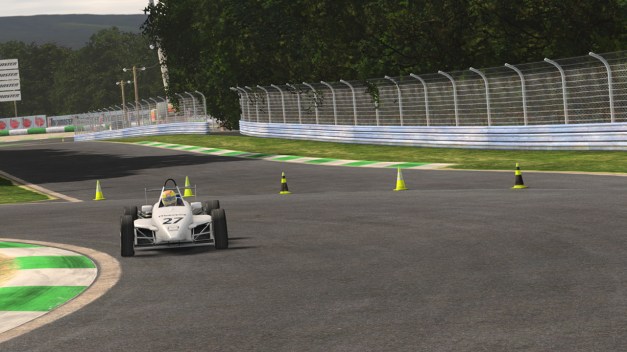
The Skip Barber 2000 slides on a green track

These cues were very useful.  I was running IndyCar Racing at a resolution of 640 by 480, this made corner entries, braking zones, anything at all, largely impossible to make out.  Without those black marks it wasn’t that easy to even know there was a corner coming along, not until you’d done seven hundred and nineteen laps and disregarded a term’s worth of homework, anyway.

However, these days racing sims are realised in resolutions higher than the eye can see, with more colours than a Mantis Shrimp can see; so a few missing skidmarks should not mean the end of the world.

What happens with RealRoad is that as one does lap, after lap, after-lap-after-“what happened to October?”-lap the rubber from your virtual tyres departs the carcass and drops itself onto the track.  Every skidmark is left behind, and, slowly, but surely, those visual cues arrive based on your own driving.  This process, naturally, is accelerated if there are more cars on track, and if there are twenty or so AI cars punting round, the track can be rubbered up within half an hour’s running.

This, pleasingly, is carried on to the next session, and the race. So a suite of Practice – Qualifying – Race will have an ever evolving track throughout.  Great stuff, and very consistent with real life; we see it all the time in Formula One that the fastest times in qualifying are always right at the end of the session.  Similarly, in NASCAR we hear of the teams working out setups to work best on the track towards the end of the race as reasons why their driver is languishing in the midfield in the early running.

rFactor 2 is still very much in development, and this technology is not perfect yet, but I do wonder how many people who downloaded the early releases spoke out about “no grip” or “slippery tracks” before they had given the track any chance to get any rubber down on it.  The early builds, I would say, overdid it a bit.  The “green” track was a little bit more like a green track at 5 degrees centigrade on a crisp January morning, scrabbling to get grip on a track that is used once a year.  Getting heat into the tyres, as the rubber bedded into the track, felt glorious, and laptimes fell to the tune of four or more seconds.

The track rubbers up…

More recent builds seem to have calmed this down, both in terms of how much grip goes down, and how quickly, but also in its visual representation.  There seems to be a gentle change in “green” grip, and less of a huge swing in laptime on a rubbered track.  Another new feature is the ability to save the “state” of the track for future use. So you need never have to start out on a slippery, green track again.

What we have here is a truly dynamic simulator. As mentioned in my other article, the track grip levels can vary considerably based on track temperature.  In future releases, this can be due to the shadows being cast on track at the given time of day.  The vehicle’s engine performance can differ based on the air temperature and humidity levels, and the vehicle’s behaviour will vary based on wind direction and power.  So, as well as all this, Realroad gives us another variable and it is a constantly evolving one.

What this means, for the budding simracer, is that setup has to be addressed on nearly every run. Not only might you need to monitor brake and engine temperatures, adjust ducts or radiator openings, but also constantly play with tyre pressures and cambers to find the optimum tyre performance envelope.  All of this, at the same time as all the usual adjustments to wings, gear ratios, springs, dampers, roll-bars and whatever else, to find a feeling that suits your driving style.

As a result, one can find oneself in the situation that many a real world club racer finds themselves in over a race weekend, that of “chasing the track.”  Sure, sometimes things will be more settled, as is often the case in many online rFactor 2 servers right now, sessions might be at the same time of day, temperature and weather, which can help you find a baseline, then you can fine-tune as the rubber builds up.  But all too often, in the real world, you find yourself running practice sessions on a cool morning, only to race in late afternoon a day later.  Thus, half of every session could be taken up with short runs where you tickle your pressures and cambers for the given conditions, nudging brake balance gently backwards as the extra grip being found by the rubber on track aids the braking performance at the rear.  This doesn’t leave much time to be playing with dampers.

Of course, in simracing we have oodles of track time, more than could ever be imagined by a club racer.  Historically, setups become an exercise in working to an optimum point, then saving it, and using it next time you race at the given circuit.  In simracing it seems setups get contentious, partly on this basis. Those with less free time decry the setup time that their more time blessed peers can indulge in, and many simracers would say that a good setup makes for what can be the only reason that any other driver could exceed their incredible on-track skills.

The truth in either statement is dubious; many can play with setups for hours on end and not necessarily find any more laptime than they would have done if they had not made any changes. At the same time, a bad driver cannot achieve miracles with setup alone.  Nonetheless, we have websites dedicated to setup databases, providing those that choose to avoid this deep and rich aspect of our hobby with a place to save on the “work.”

rFactor 2 is forcing players to re-think this design.  Gone are the days of a “perfect” track that never changes, where the sun always shines and ample grip abounds across the whole track surface.  Now we have a new challenge, and one that grants us much more realism.  This results in an approach that means that those with the time may not get such an advantage, as a baseline can be established in lone-practice sessions that can cover wing, gear and basic suspension settings, but any serious fine tuning of the setup could be a hiding to nothing if you are not certain of the approaching race conditions.  As well as this, running alone will not give you the grip on track that you will see in more populated sessions.

To an extent this levels the playing field. It means that, provided not every race is run on the default settings, every driver has to chase the track through the practice sessions, and as long as those sessions are not too long, no-one should arrive on the grid for the race feeling like they have got everything perfect.

A gripped up track.

Regardless of your feelings about car setups in simracing, they are a feature that has been around for over twenty years, since the very birth of the genre.   The products we race in are simulators, and as such are there to replicate the feeling of the real-world vehicle. Many racing simulators have strived to accurately portray what can, or cannot, be adjusted on the fly in the racing vehicles they represent, and in my mind this should be celebrated. But many current simulators do not bring the whole package, they bring a superb simulation of the physics of the vehicle, but no simulation of the environment that the vehicle functions within.

Vehicle simulators are about learning; learning the vehicle being simulated. No flight simmer would jump into a Concorde and expect success without some serious reading and experience, though they may try a Piper Cub with less difficulty and learn their art.  The complexity we see in setup between a high-end single-seater and a Renault Clio is reflected in this. Learning the car, and how to make it work best for you, is part of the art of being a good race driver.  Maybe Michael Schumacher hasn’t had his hands dirty for a while, but you can rest assured he knows what every part of his Mercedes does when he takes it on track, and he knows how to make it work for him.

At the same time part of the race driver’s art is knowing how to understand a track as it evolves through a race weekend.  It’s about time us simracers got the chance to learn a little more.

Trucking around Europe.

Posted by shrapnel1977 on October 24, 2012
Posted in: General Simming. Leave a comment

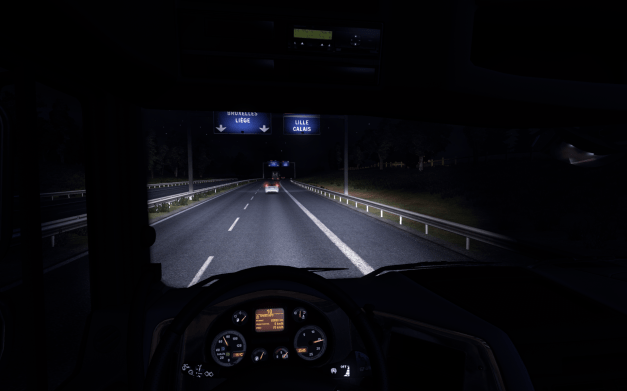
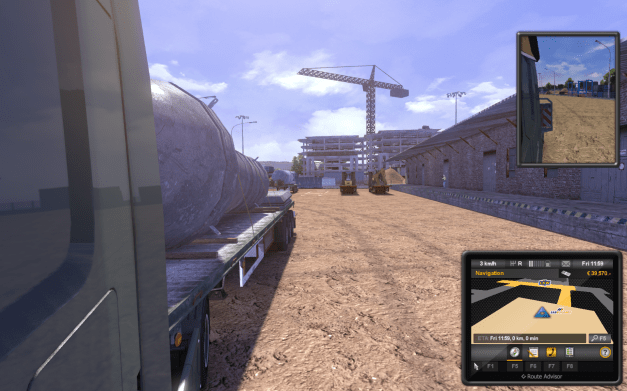
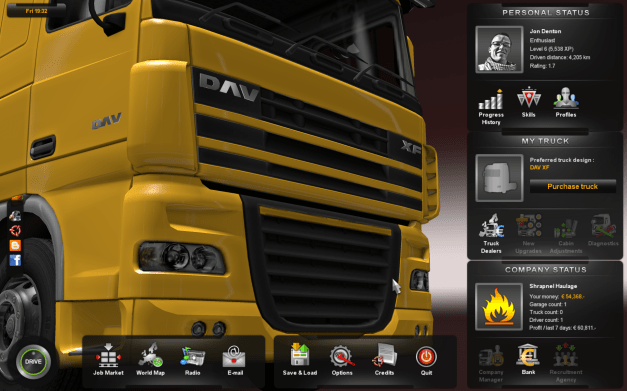
I’m sure I could smell last night’s booze on his breath when he passed me the keys to the DAV XF outside.  Might explain why I was given the contract, and why it was so lucrative. Still, it’s nearly eleven PM on a warm summer night here in Paris and I need to get this little lot over to Dusseldorf by tomorrow morning; it’s going to be redeye.

Slipping into the cab I familiarise myself with things.  Not sure about the wood veneer panelling but I guess the Dutch like to do things a little differently.  The dashboard is laid out nicely and I think I can come to terms with the various switches that turn six slots in the gearbox into twelve total gears. With the key in the ignition, the 410hp, 12.9 litre diesel lump rumbles into life. Mirrors-check (all six of them), warning lights-check, huge trailer with two massive diggers on it-check.  Time to go, before they realise that I’m a sim-racing driver!

Night trucking is very atmospheric.

The early scene in European Truck Simulator 2 (ETS2) has you setup as a jobbing truck driver, borrowing trucks here and there from companies that aren’t quite Eddie Stobart or Norbert Dentressangle, and driving various loads around Europe;  the pre-cursor to buying your own truck, and becoming a lone-wolf on the open roads of Europe.

The design works well, and introduces you to the various trucks on offer before you hit the dealerships as a buyer.  You’re also given a gentle introduction to the game by being given pre-planned routes and deliveries.  Consequently you don’t have to worry so much about fuel loads or whether you need forty winks or not, and can get on with the important business of driving huge, great hulking trucks around Europe.

Finally, out of Paris.  That ring road is a bitch; just when you’ve got going and you’re shifting up into ninth for a cruise, some traffic lights come along and you’re back to a full stop again.  Green… moving, first-third-fifth-seventh-ninth that’s forty kilometres per hour reached!  Oh, what’s this, the lights ahead are green, but all these idiots in cars don’t seem to be GETTING A MOVE ON, AAAARGH, don’t make me stop again. Bah, too late.  I stop two centimetres short of the Ford Focus ahead.  Hopefully they were terrified when my looming grill appeared in their mirror; I hate the guy in that Focus, I hate him so much.

Still, now we’re tramping along, nearly seventy five kmh on the dual carriageway before turning off on the Autoroute direction Bruxelles.

There’s something intrinsically relaxing about all this.  Once you get up to speed and have your truck settled into the inside lane at a spritely ninety kmh, you can just relax a little as the dashboard lights illuminate your dials and the road ahead pours into view of your dipped headlights. Occasional bursts of main beams make you feel suddenly blessed with sight-beyond-sight, but then something always comes the other way.  The soothing hum of the motor, which pushes out maximum torque between 1000 and 1410rpm, becomes almost hypnotic and can be supplemented with your own MP3 collection to offset the “long blinks”.  It’s a far cry from racing engines tearing out 14000rpm plus.

We’re into Belgium now, that’s me and my truck, heading for Liege on the E42.  It’s still very dark, nearing four in the morning, not much on the road but me and my truck driver brethren.  To the south of Liege is a trio of Belgian villages, Spa, Malmedy and Stavelot. The route between them became a race track some time ago, and as I approach the German border I find myself silently amused by the concept of driving my loaner DAV (And yes, it should be DAF, but the guys at SCS Software have not managed to get all of the trucks licenced before release) around the historic Circuit de Spa-Francorchamps.

Border control seems pretty relaxed; there goes the “Willkommen nach Deutschland” sign and I didn’t even have to turn off cruise control.  Though I was partially lucky, it seems ETS2’s AI are not quite as perfect as they could be; a lane closure had caused them to line up parked and so I had to do a fairly alarming swerve to avoid them as I careened onwards, daydreaming about the masta kink.  On the whole, however, the AI impress. Lunatics in Range Rovers overtake you on blind crests, which seems pretty accurate, and it was to great surprise, when waiting at a junction, that I noted a car had stopped and was flashing to politely let me out.  What a nice guy.

On the whole, though, the same things that afflict you in ETS2, AI wise, will be the same things that probably cause most real life truck drivers to develop a weeping, pulsating ulcer in their gut (not AI truck stop dinners!).  Every time you get a good bit of momentum up, some car driving dick pulls out in front of you and causes you to have to brake to a near stop.  Then you get to exercise your clutch leg all over again as you scale up the many, many gears to get back up to cruising speed, no doubt to have the next unfeasibly stupid idiot pull out of the next junction, the other side of a blind crest, to make you throw out the anchor again.

This bit is not easy!

Playing this game with a sim-racing “rig” adds a vast amount to the experience. An H gate shifter and clutch pedal are a must, though automatic gear options are there, how better to really test your driving skills than to get as close to replicating the real vehicle as you can?  And this is the key, I think, to why I’ve been enjoying ETS2 so much this week.  It’s all good and well launching into apexes and controlling powerslides in race cars in various racing sims, but that is only one part of what driving really is about.  How difficult or easy you may find it to keep a simulated race car on track is a very different prospect to backing an articulated truck into a tight spot around the back of the depot in Bremen in heavy rain.  Initially, getting these wheeled buildings around a corner in town without knocking over lamp posts and traffic lights can be a challenge, let alone double-declutching it up a steep slope, or keeping it from running away down one.

As virtual drivers these are things to be relished.  The test of your driving skills is why people boast about laptimes so much in simracing; Scania Truck Driving Simulator (SCS’s last title) gave us challenges to test this mettle, and a global online leaderboard that frankly terrified me!

I’ve just missed my turning. What am I doing? I am such a buffoon.  Right, okay, where are we?  It’s getting a bit light, I should have turned off north to Dusseldorf but I am still heading east.  How bad can it be? There’s got to be a junction where I can turn around, I’ll get off at the next one.   Here we are, E41 to Frankfurt, that’s south but there must be a way to get back going the other way. There isn’t. No…  No… NO!  It’s knocking on for six AM and I am driving AWAY from Dusseldorf, I need to be there for ten, and what, now my avatar seems to need sleep, he’s doing long blinks, ACTUAL ON-SCREEN LONG BLINKS! Okay, calm down Jon, this can’t be the end of the world, you can turn around at the next junction, yea, you thought that before didn’t you. It’s one cock up after another for you Denton you useless excuse for a human.

Dawn breaks on my wood veneer.

Here we go, an Ausfahrt, this will have to do. It’s a tight one, not really designed for taking a trailer of this girth around, but sod it.  Hmm, bit of grass, she’ll be alright.  Okay, we’re on the way now, the E41 north, it goes to Dusseldorf, perfect!  The sun’s just coming up in my rear view mirror and I feel the need to torture myself fading away with every virtual kilometre.  I pull into the depot and park up.  Amidst the long-blinks, I made it.

Stepping out of the cab at quarter past nine I ask the lads in the unloading bay if they know where I can get a coffee; they direct me down the road and into town.  Time to find a B&B for some shuteye, then its back on the road for me.

Are racing sims treading the right path?

Posted by shrapnel1977 on October 17, 2012
Posted in: General Simming. 5 Comments

There has been a trend emerging in vehicle simulation software over many years now, where a simulator is seen as a “platform” and thus an ongoing project that never ends. This allows many benefits; not only can media portals not review a sim without being told that “it isn’t finished yet”, but it also allows developers to completely redefine the word “beta.”

It strikes me that nearly everything is a beta these days, for a very long time, and those betas, unlike the betas of old, are very much public, and very commercial.

Racing simulators like to think of themselves as separate to other simulation platforms, and in many ways they are. For a start, they are rarely as focussed when it comes to vehicle systems, and for a finish they present a competitive environment that brings in a wholly different type of user.  Nonetheless, there are similarities between the various vehicle sim platforms out there, and maybe some things to learn.

For those that don’t know, the long running “Microsoft Flight Simulator” (MSFS) series, that has been around just about as long as PC’s have, is done and dusted.   The development team that had worked up to the release of Flight Simulator X (FSX, that’s ten by the way) were all laid off as Microsoft had to “align resources with their strategic priorities.”  Thus, the biggest and most popular platform for flight simulation was to come to an end. Countless modders, experienced in MSFS products for many years, were left wondering why.

MSFS, including the most recent product, FSX, has always been an open platform for modding, and over time, the creation of payware mods of a level of detail often far and above the main product has become the norm.  The software was made this way, much like rFactor was back in 2005.  Where, for rFactor, we have a vast array of cars and tracks and entire race series available for free, we also have commercial add-ons that licence the ISI engine to implement and produce their own full game. Often, and I’ve heard this before somewhere, of a level of detail far and above the main product.

Pass me the manual!

Since 2005, the number of racing sims released based on the ISI platform, I suspect is higher than any other platform, and thus it’s fair to suggest that rFactor is the most successful racing sim platform of recent times.  Whether it is the best is neither here nor there, for many.  There are a huge amount of simracers that will take quantity over quality, and if you can get five million tracks and ten billion cars for the price of a single game, why go elsewhere?

The same has applied for many moons in the flight sim market. I bought FSX in 2007, and since then the platform has developed well beyond its original scope.   There are a huge amount of users worldwide and some will boot up their sim with a hanger of hundreds of aircraft, with thousands of airports to travel to, all of which could well have been free.  At the same time, some will have commercial add-ons that replicate a given aircraft at a level of detail that racing simulators seem terrified to imagine, that could cost up to £60.

What was that?  £60 for a single plane?  That’s madness surely?  Well, I am not sure, the add-on I refer to is “Concorde X”, and with the huge manual provided you can accurately operate one of the world’s most iconic aircraft ever, and spend hours and hours learning it’s systems to such a degree that if you were to sit in the real thing you’d know which switches to flick to have her in the air.  Thus, the flight sim hobbyist that shells out for a given aircraft will be working around a simple equation of cost versus fun.

Where this comes back to Microsoft, and their all important strategic priorities, is that they must be wondering why all these commercial  mod teams are making money when Microsoft need cash for the new moon that they want to put up (cue: “That’s no moon” quotes, etc).

So, before long, and ignoring the petition signed by 100,000 people to bring back MSFS, Microsoft announced their new foray into Flight simming: Microsoft Flight.

“Putting the fun back in flight sims” was the line.  I paraphrase, but this new release aimed to stop the keen hobbyist in their tracks and bring in a whole new audience by pushing more “game” than “sim” into their product. No more checklists and being serious about handling aircraft, this was to make flight sims less daunting and complex and more a jolly fun time gambolling around in the skies.  Of course, we didn’t know this in the beginning, but when MS Flight was released, in February 2012, the reaction was….  well, mixed.  Microsoft flight is free to play, a favourite move in modern gaming, with promised commercial add-ons provided by the development team in the form of DLC as the product develops (does this mean it’s a beta, who knows).  The sim offered a graphically pleasant rendition of Hawaii to fly around in one plane, thus providing quite a lot less than FSX’s thirty aircraft and the entire world.  Suffice to say, the keen hobbyist felt short changed, even when it cost nothing!  What of the casual gamer?  Well, chances are they read a review on EuroGamer and wondered where the guns were.

Now let’s imagine this whole thing in our cosy world of simracing, where we rashly assume that the only type of simulated racing in the world is in cars, and the whole community has become so insular that amazing ruckus can be caused by people using the wrong word in a sentence when English is their second, third or ninth language.

When developers licence the rfactor engine from ISI, they take it wholesale, so unlike FSX add-ons, there is no requirement for the base product to be installed. If someone released a free to play version of rFactor, licenced legitimately from ISI, we would get a full working product with the potential functionality of the rFactor product, and maybe more.  Then, if, say, they provided DLC car add-ons, of varying prices, and potentially varying levels of quality, what would you think?

This seems to be more or less the direction being taken by SimRaceWay.  A free-to-play sim based on rFactor 1 technology, with integrated multiplayer and online events and series run by the organisers in very much the theme of iRacing.  So rFactor meets iRacing?

It’s a leap.  Where iRacing charge us, sometimes quite high costs, for add-on tracks and cars, you are getting tracks that could arguably be called the most detailed and accurate available, as well as cars, which, we are told, are 100% accurate to their real-world counterparts.  We don’t get manuals for them or system modelling or the chance to get under the bonnet and poke around, but at least we get a pretty solid car model.  And everyone tells me no one wants all that anyway.

Cranking along a British country road in a Lancer Evo… Never done that before, honest officier!

So what of SimRaceWay?  Well, many of the tracks come for free, which is good considering some of them look decidedly ropey compared to what some of the best mod teams have managed for rFactor. And what of the cars?  Well, some are cheap, and some less so, based, possibly on the cost of licencing, but marketed as a replication of a real-world buyers’ market.  Prices are directly proportional to real life.  So, in real life you would pay less for an Alfa Romeo Mito than you would an Alfa Romeo 8C.  Reasonable, I guess. But where does the quality equation come in?  Do we get a nice PDF manual with each car, giving us background details, specifications, setup and driving tips?  Oh no, of course not, simracers don’t want any of that.  Silly me.  What do I think this is, a hobby?

Driving the cars is largely a good enough experience, in much the same way that rFactor is with a good mod.  But then one car and the next can be notably different in quality. The accuracy of tyre feel, body control and overall vehicle dynamics seem to vary car to car, like the QA team sometimes take long holidays.  There are, fortunately a few cars in the sim that I have driven in real life, and while some of them do a reasonable job (Mitsubishi Lancer Evo), some seem to feel very much like one of those rFactor mods you uninstall after ten laps of confused pedalling.  The variance in quality is exactly what you expect from community made free mods, many of which are made by someone or other who is just giving sim-car building a stab.  But when you’ve forked out for a car, even if it is just seven or eight dollars, you kind of expect a professional job. When you are asked to pay nearly forty dollars (!) for a McLaren-Honda MP4/4, well, I want Concorde X levels of detail.

Now, I am not really here to slate SimRaceWay, I’ve just been ranting out my opinion.  But on the whole I have to wonder where SimRaceWay fits into the simracing arena.  I am not one of those that thinks simracing is “too crowded” and I encourage new simracing products entering the marketplace, especially those that enrich the genre by presenting new features and a different slant on the hackneyed “here are some tracks and some cars, go and crash… <ahem>.. race on them.”  But is SimRaceWay doing this?

Of course, just like seemingly everything in the world now, it is in beta, and so is easily defended with a “Well, when it is released it will have magic, and spoons, and jumping monkeys and simulated cars that drive at least a bit like real cars.” But if you take this stead then iRacing is still in beta, for the last 5 years!  The PC gaming industry is tied into an “always on” web-connected world with every sim being developed, be it a flight, train, bus, lunar lander or ice cream van sim, it is touted as being in constadev.  How many developers, in the last few years, have you heard say upon release: “Well, this is it, released, it’s done, no more patches, no new features, just get on with it and shut up?” Not many I will wager.

If we wait for everything to be complete to pass any kind of opinion or judgement we are left wondering if there is such a thing as an opinion anymore. In fact, maybe all of my opinions are in beta and could well be developed or changed as my life moves on through the development process.  There’s a novel idea.

SimRaceWay seem to be doing one thing different, and that is appealing to the motorsports enthusiast, and not the existing simracer (who might compare their sim to other products on the market!) or the “Where are the guns?” casual gamer.  They have put in sponsorship at sites like Radio Le Mans, which is practically the global voice of sportscar racing.  They turn up at race events and tout their wares to people that love motor racing, but may not have driven a sim.  An open minded market, in other words.  They also sign up famous stars like Dario Franchitti and Allan McNish to issue some marketing bumph… <ahem, sorry, it’s a Tourette’s thing>… expert opinion on the driving physics of the sim.  The oldest one in the book, of course; doubtless old Mario had plenty of kind words to say about the realism of “Mario Andretti’s racing challenge” back in 1994 when that venerable sim was released.

I don’t know if this approach is working too well or not.  SimRaceWay have more “likes” on Facebook than any other “serious” racing sim, but on the occasions I have gone online in the sim this is not really reflected by the sparsely populated races.  I may never have found the right time of day or week, but I would imagine that over five hundred thousand keen “likers” would manage to spread out over a fair range of times.

What this makes me wonder is whether this whole “free to play, expensive DLC” plan is really for the best.  If you offer simracers cars and tracks of a quality below that which is available for free in other platforms, they will turn away.  If you offer any casual gamer the chance to pay more for a single car than they would for a full game, they will turn back to Gran Turismo (where they can get 500 cars for the same price!), and if you provide a few cars that you can drive for free to an uninitiated audience, the natural expectation, for me anyway, is that this free try would pique their interest.  That piqued interest would lead them to forums, the simracing community, and the wholesale realisation that there is better out there for less outlay.

Where can this lead SimRaceWay in the long run?  Well, I can’t be sure, of course, because it is being constantly developed. Maybe next week a new release will come out that will make every other sim on Earth redundant, but to see where this could really end up, maybe we should look back at Microsoft Flight and its poised focus on strategic priorities.

The reviews of MS Flight were up and down.  Many a hard core simmer chastised the flight modelling, and many a casual gamer chastised the half-arsed attempt at gameplay.  Having someone come along and ask you to fly a packet of cheese across Hawaii does not really change the fact that you are simply flying from one place to the other, and, without a narrative or any variance completing “missions” becomes repetitive and tiresome.  Plus there were no guns.

So the casual gamer turned away, bored, after their free try, and the hard core simmer turned away because the sim offered so much less than sims such as FSX or X-Plane.  The people that were left were offered the chance to buy a few single plane add-ons, for a snip at £5-10, many of which lacked a cockpit view and were of a standard well below many free FSX add-ons, let alone the payware.

On July 25th 2012, just less than six months after release, Microsoft announced that further development on MS Flight had been cancelled as part of “the natural ebb and flow” of application management.   A few more add-ons would be released in the coming months, but in the long run, this sim is done.

The PC gaming industry seems to have a history of bandwagoning on various design concepts. How many games have tried to replicate World of Warcraft?  How many publishers will tell developers that every sim must be multiplayer or else it is doomed?  This leaves very few developers following their own path.  Concepts such as free-to-play with commercial DLC are seemingly a way for developers to be their own mod groups.  Where modders in the past kept games going for years with updates and add-ons, the developers want that pie to themselves. When you start asking people to pay for these add-ons, when they are professionally made, they need to be up to scratch with, if not better than, everything else out there.

Offering up a product that adds no depth, no innovative features, and nothing to separate it from the racing sims of five to seven years ago should not be satisfactory to this community.  Dumbing down of simulation or just finding new ways to make people pay more money over a longer term is not an answer to increase the audience for simulators.  A free-to-play sim will be played by people, for free, once.  They won’t like it any more whether it is free or not.  Compromising the serious simulation hobbyist, for the casual gamer is a tricky road to take, but just making a sim more accessible and less complex does not mean the casual gamer will jump at it.  Simulations need to look more deeply into the “game” aspect of their product for this, and create something that is immersive and engaging from a perspective beyond just the driving of a vehicle.  That game should then carry the depth of simulation and gameplay to give replay value to both the sim nutter and the casual player alike.

Something new please.

F1 2012

Posted by bobsimmerman on October 5, 2012
Posted in: Reviews. 3 Comments

F1 2012 Review, PC version
Published and developed by Codemasters
Patch II version reviewed
The past two years the month of September has brought two things–my birthday, and the latest Formula One game from Codemasters. Well, a lot of Septembers have brought my birthday and I am now at the point where I sort of look the other way when they roll around…how does that saying go? Oh yeah, something like “Youth is wasted on the young”. I’ll say. Youth may be wasted on the young, but a fully licensed Formula One game seldom goes unnoticed, much less tossed aside like yesterday’s newspaper.

It has been quite a while since Geoff Crammond’s Grand Prix 4 or EA Sports’ F1 Challenge graced the store shelves and it was not without great anticipation that we learned the license had been renewed, paving the way for a new series of Formula One games, for consoles and the PC. With a first iteration announced for a 2010 release, Codemasters licensing coup was met with what seemed like a fifty-fifty mix of grand elation and grand skepticism. Elation that the PC was, finally, getting an up to date and fully licensed Formula One game…skepticism that Codemasters, not exactly known for their hardcore simulations, would take it much beyond the arcade fun racer stage. I queued in the ‘wait and see’ line, hoping for the best.

The first effort, F12010, met with decent reviews, critical acclaim, and, when all was said and done, it wasn’t half bad. I played it quite a bit, logging nearly 83 hours–a lot of time considering how many other things I had going on at the time!–and, for the most part, I thought that they did a pretty good job of giving us the experience of being a Formula One pilot. Combining elements of the non-racing side of things with a passable driving model, I found a lot to like.

However, there were definitely some growing pains with that first release. Poor performance on many PCs, sketchy DX11 compatibility, weather modeling oddities, a very annoying bug that had a tendency to wipe out your player profile and, to top it all off…a final patch that in many ways broke a lot more than it fixed. Even worse–Codemasters all but announced that they were busy with work on the F1 2011 game and further patching of F1 2010 was not going to happen. This, in turn, led to some very justified criticism, in my opinion. Was Codemasters simply milking the license, tossing out a game with substantial bugs, a couple of cursory patches, and moving on with their bags full of cash? At the time, yes, it would appear so. I think those of you who game much will immediately recognize this business model.

Promises of never buying another Codemasters game flooded the interwebs and as much as I would have liked to have joined them, as a freelance writer of ill repute, I was all but assured of purchasing the next game in the series. Surely, a license so sought after, so appreciated by the fan base, would not be treated like the next installment of a mindless shooter game. Would it? Only time would tell.

September 2011 brought the next iteration to the streets and a couple of things were clear–Codemasters had taken many of the community commentary to heart and, for whatever reason, brought some of the worst of F1 2010 along for the ride. For example, the dreaded ‘corrupted profile’ bug had made a return for many folks. When you are three years into a five year career and the game decides that it no longer wishes to recall your progress, well, that’s not good. And it furthered the doubts many of us had that Codemasters was doing this for anything other than the cash-grab a Formula One license can bring. On the other hand, there was much to like in F1 2011 and it was clear that Codemasters was making a valid effort at not only improving the game, but squashing the bugs as well.

Featuring an updated–and more realistic–driving model, superior weather modeling, better feeling force feedback and improved DX11 compatibility, F1 2011 was, again, a critically acclaimed effort. I was starting to become convinced that they were genuinely working hard to provide the best Formula One game experience since GP4 and F1 Challenge. In fact, I felt that F1 2011 surpassed both of those previous efforts quite handily, in pretty much all departments, including the driving.

Then again, as Denton points out, “Those games are ten years old!”. And, of course, he is right–it only makes sense that a modern day game, unless it is dumbed down beyond belief, should be able to offer a better experience than those that have been released a decade previous.

Still, there were warts to be found, and it was hoped that, maybe, next year Codemasters would finally get it nailed with a minimum of drama and an even barer minimum of bug carryover.
We hoped.

Our hopes were met, this time, in the form of a demo; a first for the series and something that I feel any serious software effort requires. For one, it would give folks a chance to check out the driving model and the AI behavior. I tried the demo, was pleasantly surprised at the driving dynamics–strange incidences of understeer aside, that is, you got the feeling that you had to slow unreasonably to make the corner–and felt that it was a more than adequate presentation of what the purchaser of the full game could expect, at least in terms of how the cars handled. No seventy five G lateral turns or six meter braking points from 350 Km/h to 40 Km/h, for example, were noted.

September 18th, 2012…the big day. Well, for us in the States, that is. Steam had been taking pre-orders for some time and, in an effort to outwit my string-and-can internet connection, I pre-purchased and then initiated the download before heading off to work, anxious for the midnight activation of my (hopefully) downloaded multi-gigabyte Formula One game.
Sure enough, my internet connection stayed true and when I got home the game was sitting on my hard drive, waiting for the go signal from Steam that it was ok to play. At about 12:00:01 AM, I began the process of playing. Well, I tried to play. Another fifteen minutes or so of file decryption was the final step and then I was allowed. Sometimes I miss the old fashioned installation disk.

First Impressions
First and foremost, the interface has been completely redesigned, in terms of both graphics and layout. Still console oriented and not a mouse cursor in sight, the multi-platform development is clearly evident. No matter, the keyboard works just fine for navigating the menus and if we were able to forgive Richard Burns Rally for such things, surely, we can find it in our hearts to overlook this blatant omission from the latest Formula One offering.
I setup my profile–first name, last name, nickname (Professor), nationality, so on and so forth, and then it was time to dig in and see what we had this year.
Game Modes Overview

F1 2012 is, as the saying goes, ‘Chock Full’O Content’.  Champions Mode is one of my favorites, and a lot of fun. Basically, you select a champion–Kimi is first on the list–and try to complete the task at hand at the given venue under one of three difficulty modes. In the case of Kimi, you are behind him with fresher tires and five laps to go at Spa. Can you overtake him? Sure you can! Given your performance here, you could win a Bronze, Silver, or Gold medal. All of the current Formula One past Champion drivers have their own challenge, with a finale of trying to beat all of them at the new Texas venue.  Champions mode is but one portion of the Proving Grounds mode and, in addition to the Champions Mode there is a Time Attack and Time Trial mode, both the sort of thing a hot lapper might appreciate.   Fans of multiplayer will find a lot to dive into, from simple pickup races, LAN events, and even a full blown Co-op championship mode.  Profile statistics and game setup and options are available in the My F1 section of the interface.   Additional modes are the Young Driver Test, Career, and Quick Race mode and these are discussed in more detail below.

The Young Driver Test
I’m feeling better already! A Young Driver Test! Sure, it’s a mere vicarious diversion, but given my advanced age I’ll take what I can get. Now, on to find out what the hell this mode is.
In the real sport of Formula One, the Young Driver Test is the perfect opportunity for those up and coming drivers in the lower classes to showcase their talents to the teams at the Pinnacle of Motorsport at a real track, in the real cars. True to the sport, Codemasters has seen fit to include this in the latest game in the series, with the testing taking place at the lovely Abu Dhabi venue.
Feeling extra special, I chose to showcase my talents with the tradition-soaked Ferrari team. Upon entering the garage of the team of your choice, you are met by your race engineer, your guide for the testing. At this point, I got sort of freaked out because the animations of my race engineer were such that you have no trouble believing you are, in fact, in the garage of the Ferrari team…but those eyes. His eyes were eerily realistic. Perhaps, too realistic. I wasn’t too freaked out to notice he needed a shave but, given what Ferrari has been through the past year, I was able to easily overlook his slightly unkempt appearance. Besides, expecting them all to be running around in Armani suits is not a realistic expectation on my part.

So…they drop me in the car for my first test and before I leave for the track the interface asks me to turn the wheel this way and that, press the pedals, and hit a couple of buttons. I found this to be an interesting and immersive way to setup the controller, and though I had already done so, I went through the motions anyway. Besides, you couldn’t leave until it was done.

In summary, this mode seems to be designed to expose the new driver to the rigors of handling a Formula One car, from the basics of negotiating various types of corners to the intricacies of using KERS and DRS alone on the track, and the vastly more complex and difficult time when other cars are on the track. As expected, veterans of racing simulators and Codemasters previous efforts in the series may find this quite boring and unnecessary as this mode assumes that you are quite the newbie, to put it mildly.  On the other hand, when we reach the point where ‘ we know it all’ we have, perhaps, reached a point where we know nothing at all…ok, enough with the philosophy, you get the point.

Your race engineer is chattering at you all the while, and a nice touch was the inclusion of video explanations for some of the concepts introduced. Dry and wet track conditions are presented and, depending on how well you do in the Young Driver Test, your initial team options in the Career mode could be affected. I liked this mode, and I thought it was a welcome addition and a fine introduction to the latest release in the series if for no other reason than it added something new to the mix that is on topic to the real sport.

The Career Mode
Career modes in racing games seem to be greeted with one of two responses–you either love them or you hate them. Personally, I like it when a game goes beyond what happens on the track and digs a bit behind the scenes: keeping track of your progress from a detailed statistical point of view, and rewarding you as you gather experience. On the other hand, a poorly executed career mode will have you begging for less in no time. I think that this is the sort of thing that Codemasters does well–career modes, not causing us to beg for less…

Starting off as a lowly driver for a backmarker team, you are given this or that goal, and as you meet those targets you advance and if you fail at those goals, well, plan on being with your backmarker team for some time. There is even the possibility of moving mid-season! I am not sure how realistic that is given that mid-season driver changes seem to be quite rare these days, but it is an interesting possibility nonetheless.

I chose the five year long career, 100% race length, in the Caterham, at a Professional level of difficulty–I’m not quite ready for the Legend mode just yet, but when I am it is easily changed. I like that the difficulty levels are not locked solid for the duration of the career, but even at Professional level I was no doubt in for a struggle.

It was in the career mode that I had my first jaw dropping moment. That is, when I discovered that Codemasters dropped two entire Practice sessions from the race weekend simulation. I needed answers! When I got them, I was not pleased–according to Steve Hood, an official spokesman for the game, the sessions were dropped because, in essence…”Nobody used them”. What the hell?  Seriously? No, Steve, seriously? Apparently, they were serious because when you loaded up the race weekend, not a P1 or P2 in sight, just a ‘P’, and an hour long. Woe unto you if that hour doesn’t include any rain and the Q sessions do, for example. And too bad if you can’t get a setup sorted in an hour. Utter nonsense. I can understand cutting features that are frivolous, but removing things in the game that actually worked and, further, enhanced the realism of the entire experience? That flag isn’t flying over here.

Hey, if you don’t like practice, then skip it, I don’t care…but to take that option away with the nonsensical excuse of ‘Nobody used it’ is BS and I am calling it out. To further rub salt in the wound, it would appear that at some time during the game development the missing practice sessions were there as you have about five sets of tires for the weekend, but the first set  appears to be locked out as you can’t use them.
And, just in case there isn’t enough salt in that gaping wound yet, Hood has stated that the modes will not be added at a later date. Maybe they will be back in F1 2013.
Nonsense, but for the good of the team I kept going–I have a review to write and maybe I will get over the lack of those missing practice sessions soon enough.

Thankfully, they didn’t put machine guns on the cars as an alternative to the missing practice sessions.

\rant mode off

Ok, ok, back to the game now. The career mode is chock full of all kinds of things to do and look at. Emails from your agent, race engineer, and team owner lend to the credibility that you are, in fact, part of a larger effort with the possibility of moving upward from your spot as number two driver. In addition, some of the races have special icons above their selection markers indicating various things such as ‘Home Race’, for example. In other words, expect some expectations above and beyond the usual expectations. Think of what the team expects of McLaren at the Silverstone event and you get the general idea.

I hopped into my lovely green Caterham for the hour practice, and my times were about what one would expect. That is, near the bottom of the field. Heading into qualifying, I held no illusions and was quickly remanded to the garage as the other two qualifying sessions proceeded without me. Yes, the full qualifying experience is there; thankfully those were kept intact. Finally, race day came around and there I was, near the back of the grid, with one expectation–finish 19th or better.

Further cause for grumbling surfaced as I made my way through the 100% distance event. For one, the penalty system appears, on the surface at least, to be severely broken. As one example, you may find yourself getting crashed into by an overanxious game driver (who shall remain nameless) and you wind up with the penalty which can range from a ten second penalty or a more severe disqualification from the race entirely.
Fine, I thought, I’ll do the drive through, it’s not like I am battling for first place here. Except, I couldn’t do the drive through because every time I came in to do it, I was pitted. Not once, but twice. On my third attempt at driving through I was, for some mysterious reason, allowed to drive through. Thankfully, I had all those extra tires from the missing practice sessions…

Had I been disqualified, I am sure my rage would have been difficult to contain. A glaring bug that surely should have been caught in play testing before release, but wasn’t.
With the race over, I must say that I was rather pleased with the entire affair. Penalty bugs aside, it was quite fun using the KERS and (occasionally) the DRS systems, and the race engineer prattling on about this or that further enhanced the immersion factor.

And there was never any doubt I was in a backmarker car. With underdeveloped everything, it was down on power, handling and brakes. When the tires were on the verge of giving up, the driving model reflected this quite well. Going off line put marbles on the tires–my engineer told me this–and he wasn’t kidding, the grip was reduced for a time until they were gone. And speaking of driving line, many are reporting that it isn’t showing up as the race progresses but I could have sworn that I saw one, though it was nowhere near as dark as the line of F1 2010 and F1 2011. I may have imagined it, or it may be another fix to be added to the patch list. I did manage to see a video on YouTube of the PS3 version and it would appear that version of the game has a drying line that rubbers in just fine.

The force feedback felt great, I thought it was noticeably better than that found in F1 2011 and substantially better than that found in F1 2010. In addition, this time around, there are settings built into the game that support many wheels from the menu, including my Fanatec CSR.   However, there was a bit of confusion–in the game, at the bottom of the screen on any given page, there are red circles with numbers in them, indicating which button to press to advance to the next stage, for example.  Unfortunately, there is no ‘Number 6’ on the Fanatec CSR, as a result, figuring out the correct button to push on the wheel involved a bit of trial and error. Annoying, but not a game breaker.

Quick Race
Due to the absence of enough practice sessions, I decided that it would be wise to hop into the Grand Prix mode and load up the next event on my schedule to get some track time in. As it turns out, Grand Prix mode is missing! Or, rather, it has been renamed to ‘Quick Race’ and the ability to run an entire season in this mode, perhaps as your favorite driver, is gone. Pick a venue, a race weekend length, a skill level, assists or no assists; however you choose, this is now the single race weekend mode, albeit without the ability to setup a regular or custom season. I’ll be using the mode as my practice session for the next venue on my career path.

Quick Race was the mode I used to check out the driving models and, as expected, each car seems to handle quite differently. Hop in the Caterham and be prepared for a bit of extra work as it seems to want to throw out the rear end if one is not careful through high speed curvy bits. On the other hand, I found the Mercedes under the same track conditions to be rock solid with a very noticeable improvement in handling and stability.

In A Bit More Detail…
Honestly, this is the part of any driving simulator review that I struggle with.  Unlike my esteemed colleague Denton, I do not have experience with quickish open wheelers or karts in a real world capacity.  My personal driving fast experience is limited to insane back road speed motorcycling and insane dirt road speed Subaru Impreza driving, hardly the stuff Formula One legends are made of.  We can pore over endless reams of physical data, lookup table tire models versus dynamic tire models, polar moments, angular momentum and Lord only knows what else but at the end of the day it all seems rather meaningless if you can’t convey how these modeling parameters transfer to a computer game and then back again into reality.  In other words, what would Fernando Alonso think?  Beats me…but here is what I think.

Anthony Davidson, former Formula One driver, had a bit of a hand in the development of the driving model as fans of the series no doubt are already aware.  However, with that being said, I found the driving dynamics of F1 2010 to be a bit on the forgiving side.  Slides seemed too easy to catch, the brakes seemed of the sort to make practitioners of the black art of carbon braking systems green with envy and bumping into other cars felt more akin to ‘rubbin paint’ as they say in NASCAR. That is, a bit of contact with an AI driver–or a wall–didn’t have the effect on the cars that it seems to have on them in the real events.  In other words, the slightest bit of contact didn’t send shockwaves of panic through the driver and crew that in the next high-g corner parts of the delicate suspension would self destruct.
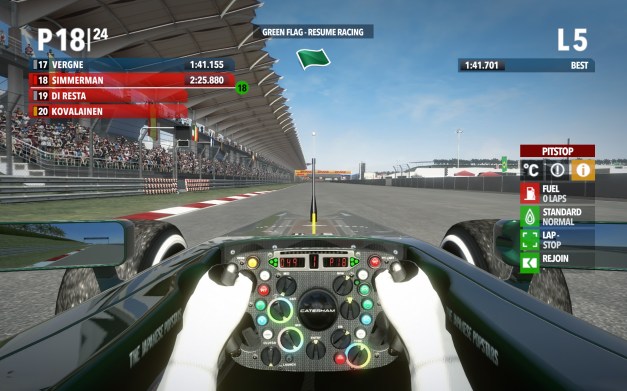

I mentioned earlier that the driving model has evolved from version to version and let me elaborate a bit on that Mercedes versus Caterham comparison, taking both through turns five and six at Sepang in dry conditions.  In the Caterham, the entry to this complex is relatively straightforward as you move to the right of the track before entering turn five and then flick the car to the left to enter the complex.  As you do this, you get the sensation through the wheel that the car is doing something it would rather not do, that is, deviate from the high speed straight line you had it in scant seconds ago.  So far, so good.  The trouble comes when you try and flick it back to the right to catch the entry and apex of turn six–if you are not careful, the back end is going to suddenly start to feel light and you may be able to catch it with a bit of lift and a bit of brake…or you may not as the car responds to your input in a very real life way by spinning around and this feeling, of losing the back end, is conveyed quite well through the wheel.

If the back end slips out a bit and you manage to catch it this will be on your mind the next go around.  To further hamper this negotiation, if you have strayed offline somewhere before the turn five entry and covered your tires with the offline rubber bits–marbles–the grip of the car will be noticeably lessened and you really have to pedal it until the marbles are gone from the tires and normal grip returns.  Prime or Option tire choices will also change the characteristics of the car in this complex as the grip levels are noticeably reduced with the Option tire.  One more question to ask yourself–are you pitting this lap?  If so, then, again, plan on reduced grip as tire wear is modeled in believable fashion and fresh rubber is what it always is–a Superhero’s Cape.  Brake bias, adjustable from the cockpit as in the real cars, is also important as too much to the front will find you locking up one tire or the other depending on which way the corner goes.  While not such a factor in the complex of five and six at Sepang, it will become relevant as you hit the braking zone for turn nine.  Not only will you get a visual confirmation of this as one tire stops spinning altogether, your engineer will remind you that you can move the bias toward the back to help alleviate this problem.  If you are the type of driver who likes smoking the tires to melted rubber heaps during braking, you will quickly lose your ability to turn.  Or stop, for that matter.  In other words, tire wear is modeled to a degree of believability that has been lacking in previous versions of the game.
Now, about that Mercedes…as one might expect, taking the Mercedes steed through the same set of corners is a much different affair as the game version is noticeably more stable than the Caterham.  The turn in to five is similar, but when you flick it over to make six, the feeling you get versus the Caterham is one of confidence–the Mercedes is sticking like glue!  Again, screw this up with too much speed or steering input and the feeling of confidence flowing through the front tires and the wheel is soon to be replaced with a visit to the brake pedal as you attempt to catch the rear end from tossing out on you.  As always, practice makes perfect, but I feel that Codemasters has done a fine job of conveying the suspension of disbelief required of all simulators in any genre, that is, you are easily convinced that you are driving a high speed Pinnacle of Motorsport vehicle.  In addition, Codemasters has also reflected the reality of the sport in that the backmarkers are backmarkers for a reason–they are down on handling, or power, or brakes. The driving model and dynamics have evolved remarkably and, I feel, F1 2012 is the best of the bunch.
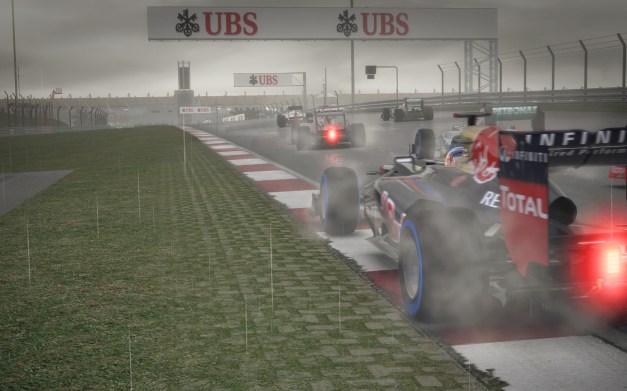
Another area Codemasters has done well with is the weather modeling. This time around you may, at times, notice that one part of a track is under a bit of rainfall and another is in perfectly dry conditions. The track may eventually be soaking wet as the rain takes hold, or it may clear up and leave the entire venue perfectly dry. This forms a nice feature that will no doubt make the decision to switch to dry weather tires–or to wets–more than a trivial thought. Further enhancing the experience is the vision in wet weather, or rather the lack of it. This time around, driving in the rain is cause for concern as visibility is drastically reduced, and I mean drastically! If you are behind a gaggle of cars, you’ll begin to feel as if you are driving on instinct alone as braking points and apexes become lost in the mess covering the visor. I was very impressed by this decision to hamper the drivers’ visibility in such a way as to genuinely affect the driving from the driver’s view perspective.

Now this is a bit odd…
Of course, I had to take the Ferrari to Monza, if only to drink in a bit of this tradition steeped venue in the lovely modeled Ferrari and it was here that I noticed a couple things a bit out of sorts.  The first thing I noticed was how ineffective the brakes were going into the turn one chicane.  I think I missed it three times before I finally started braking about 20 meters earlier than what reality–and previous versions of the game–would indicate you needed to brake.  At first I thought that it might be a complex modeling of cold brakes taking longer to stop the car but after a while this didn’t make much sense as the brakes seemed to be quite ineffective no matter how warm they were.  It may have been my imagination, I may have not had the brake bias set correctly, or, it may be poorly modeled brakes!  Evident in the demo version as well, for whatever reason the brakes did not seem to have the effectiveness of a system that is capable in real life of producing around five negative g’s of force on the car and driver.

Also catching my attention was the tendency of the car to understeer on entry to the Lesmos, for example.  Not the sort of understeer you get by approaching the corner 100 Km\h above a reasonable entry point, but the sort of understeer that causes you to shake your head a bit in confusion.  To be fair, this point of understeer was addressed in the same post that Steve Hood discussed the reasons for eliminating the two practice sessions perhaps indicating it may be addressed in a future patch.  This understeer behavior was not noted at all of the tracks I ran, but at Monza it was as plain as day.

I found the damage model to be a bit lacking, if I may put it mildly.  Scrapes with other cars or immovable objects such as walls all too often resulted in mild damage.  Given how extremely delicate these cars are in real life, I thought that this aspect of the game was one of the weaker points.  It may be an attempt to keep the race alive for those wall bangers, or, it simply may be the way things are, once again.  A weakness in all versions to this point, the damage is definitely undercooked.

Closing thoughts
I have to admit, I have been a fan of the Codemasters F1 series since the beginning. There is no question that they have, and are, going through a learning curve. There is also no question that the games are improving from one year to the next and, as I have previously mentioned, I find F1 2012 the best in terms of driving physics and overall immersive experience. However, before we go slathering the Awesome Sauce all over the place, some valid concerns remain. One, Codemasters has shown a tendency to carry some substantial bugs from one game to the next. Following release, barely a day went by before the calls came in of people not only losing their profiles due to file corruption, but completely losing the ability to save the game state at all! This, as far as I am concerned, is inexcusable. For such a devastating bug to appear in the game three years in a row is, in my not so esteemed opinion, flat out incompetence and raises serious questions as to the relevance of the QA department–or lack of such–at Codemasters. To their credit, at the time of this review, over 200 ‘issues’ are being addressed by the development team in the form of released and pending patches, but, golly, that’s a lot of issues to get to the paying public, demo or not.

As such, given that I had reservations on reviewing a game where my game characters destruction was imminent, I proceed from here on with caution. While it is often the policy of game reviewers to review a product ‘out of the box’, that is,  sans any patches, had that been done in this case, I am not sure my numbering system goes that far below zero and I am only partially joking…
I can only hope that the remaining glitches are dealt with before the team goes into Ultra Stealth Mode as work on F1 2013 begins.

Pros
Noticeable improvements to vehicle dynamics and force feedback
Improved wheel support
Stellar graphics and lighting effects, car models extremely detailed
Cockpit graphics well done with car specific wheels
Excellent frame rates at high graphics settings
Excellent weather modeling
Career mode offers depth and realism, enhancing replayability
Young Driver Test Mode a welcome addition to those new to the series or genre
Extensive multiplayer modes including Co-op championships
Cons
No mouse support
Two year old bugs turning into three year old bugs…
Penalty system is erratic
Drive through penalties often result in multiple pit stops
Damage under-modeled
Mirrors useless until car behind is within a few meters
Odd understeer phenomenon at some tracks, cars seem to drift unrealistically on turn-in forcing corner entry speeds that feel unreasonably slow to the driver.

Codemasters support commitment…to be determined
7/10
Bob Simmerman

Fanatec Clubsport, BMW rim and Formula rim review.

Posted by shrapnel1977 on October 4, 2012
Posted in: Hardware. 9 Comments

The steering wheel, for some it’s a way of life, for others it’s just a thing they hold onto on the way to the shops.  For simracers, it is the key to unlocking the deepest secrets of their hobby.

Unlike any other vehicle simulation, a force feedback controller provides a truly tactile communication between the software on screen, and the human controlling it.  Were it not for this communication, our racing simulators would provide less than half of the immersion that they do today.  I raced in a pre-force feedback world, and now the idea of not being able to feel the front tyres through my steering wheel seems entirely alien.  Over the years the output from the simulation software and the precision in the controllers has increased, and with a good steering wheel, the difference between a good sim and a great sim can be ascertained within a few corners.  Conversely, a great sim with bad force feedback can be consigned to the scrapheap by players in a heartbeat.

This has pushed sim developers to focus heavily on the area of force feedback, to push more and more tyre feedback through the wheel in a convincing fashion, thus increasing the immersion of their simulator.  For it is this immersion that makes a player think “just one more lap” at 2am on a weeknight.

But are we all getting this information?  With a good range of wheels available in the budget range, and a reasonable amount in the mid-range, is either really serving us with the precision we need?   Can your wheel be better? Can your performance increase if it were to improve?  And how much is our opinion of any given simulator formed by this feedback that we have in our hands?

This is the first article of a long running series I will be writing on RAVSim since acquiring my first “high end” wheel, the Fanatec ClubSport.  This device, heavy, chunky, re-assuringly German, is not the kind of kit that the “casual” simracer will be purchasing; with the price coming in at €449.95 for the wheel base, you’ll be throwing another €249.95 at the BMW wheel rim (an exact replica of the wheel found in a real BMW M3 GT2 racecar), and, should you opt for both (as I have) €179.95 for the “Formula rim” which replicates the rectangular style of wheel seen in modern Formula One and most single seaters above Formula 3 level.  So, at €879.85 for the full pack this wheel is coming in well above the budget Logitech DFGT that I replaced it with, but still below some other top end wheels, notably the Frex FFB SimWHEEL and ECCI’s Trackstar 6000.  Its price still classifies the wheel well into “hobbying enthusiast” territory rather than the “I have the odd blast in a racing game now and then” zone.

To broach two potential questions from the above paragraph, I would like to get the issue of price out of the way.  The question mark here concerns whether this wheel is worth the money it is priced at, rather than the deeper question of whether any sim-wheel should cost this much.  When you look at the quality of engineering in this wheel, it is not difficult to understand the price point.  The facts are that while many in this hobby may not be able to afford such a wheel, many others will, and the concept of fairness for all does not apply in a capitalist world, and certainly not in motorsport.  While I will talk about the relative merits of this wheel in regards to its place in the marketplace, any discussion about the rights or wrongs of spending money on a hobby one is passionate about can be had elsewhere.

The second point is concerning my previous wheel, the Logitech DFGT. Many seem to regard the DFGT as a low-end wheel.  Yes, it is at a price point that is very affordable, but it’s pedals are abysmal (I don’t use them as I have BRD Speed 7 pedals), but the wheel itself is a good unit, with plenty of buttons.  Having tried both the G25 and G27 wheels comparatively, and several Fanatec Porsche branded units as well as their CSR, I don’t feel the DFGT comes off badly in comparison, and many of the world’s top simracers have been known to enjoy a DFGT.

So back to the Clubsport wheel (CSW).  I am not the sort of reviewer that talks about the box a product comes in, or the impressive use of polystyrene involved, but I will say the artwork on the CSW box, if I saw it in a shop, would be enough to draw me in. The BMW wheel is very impressive to look at, and the feel of alcantara reminds me of the cockpits of many a race car, the Formula wheel rim, also, feels tight and direct in your hands before you’ve even plugged it in.

So, onto the plugging in.  I use a BRD Race Frame Pro, which is a bit “old school” for some of you but, having had this cockpit setup since 2003, I regard it a high quality bit of kit that has worked for me for many years now.  The platform for the wheel fitting is a metal panel, which most wheels, historically, have clamped onto the same way they would onto a desk.  Digging around in the CSW box for some manner of clamps or what not, I found nothing but a few bolts.

Outraged, I headed online, and found a drilling template, and an optional extra (for €49.95) CSW table clamp kit.  Many might say I should have done this research in advance, and should well have known, but then, many might also say that when a wheel costs this much it should come with a way of affixing it to the platform on which it resides.  More on this later, as I was to find, there are reasons for this move.  The fact was, at this point, I would need to use a drill for the first time in over ten years.

It’s true, I am not DIY-phile, and I largely despise “home improvement” missions. I find hardware stores to be one of the most annoying places to go on a weekend, or ever, with their disinterested staff and confusing alleys of screws and light-fittings.  Alas, on this particular weekend the Olympics had just started, and my local hardware store just happens to be situated within sight of the Olympic park.  After a few deep breaths, I got in the car and headed out, with a list of requirements established.

The Blonde, luckily, owns a drill, being maybe more inclined to use such tools than I.  I had by then established that I needed to drill through the steel of my race frame base, which meant I would need some manner of heavy duty metal drilling drill bits. What an adventure in learning I was having.

Marked out, time for drilling. Shitting myself.

On top of a drill bit set capable of rending steel, after two more visits to B&Q, I had acquired a metal ruler, some heavy duty metal cutters, a nail punch set, a hammer, and a spirit level.  The kitchen table had been turned into a workbench, and I was ready to start drilling.  Well, I wasn’t, every time I have drilled things in the past it has almost always resulted in an unmitigated disaster, so I decided to have a cup of tea first and have a big long think about how I am not going to screw this up.

So, it happened, I drilled three holes, with a fair bit of difficulty, but no major disasters, trips to A&E or broken furniture.  A mere six hours after unboxing I had the wheel base bolted to the frame plate and was ready to put everything back together and maybe turn a lap or two.

So what does one drive first?  I have most driving simulators at my disposal, and within the first two hours of play I had tried every single one briefly, over a few laps to gather the overall feel of the wheel.  As I said, this will be a series of articles which will involve a “long term test” of the CSW. I would like to hope that the unit will last me many years and take all the abuse I can throw at it. As we move through the series I will focus on various sims specifically as and when I have put in serious time in them.  For this first piece, I want to focus on initial impressions of the wheel across a range of top simulators. Note, that on RAVSim we talk about simulators, so I have not tested (and won’t be testing) with arcade style games such as “Test Drive Unlimited” or “NFS: Most Wanted”, I come from a background as a driver of many cars in real life, racing cars, fast road cars, gearbox karts, and even the odd Ford Focus.  I base my time in racing simulators on a focus on realism and thus feel that the key to force feedback to me is not establishing good “effects” such as engine rumble or tyre blow out madness, but rather the feel of the front tyres through the steering wheel, on entry to, and through a corner, as load builds, peaks and dissipates on exit.

I will also, however, test the wheel with a few other “hard core” (I hate that term) driving simulators that are not racing based, such as OMSI Bus Simulator and SCS software’s Truck simulator series. This is primarily to look at how the wheel weighs up these environments, and whilst I don’t imagine anyone would look to the top end of the wheel market for such sims, my feeling is that a top end wheel should benefit any serious simulation.

It’s a beauty.

The first thing to address, with this wheel, is the built in “tuning menu” on the LED display of the CSW. This contains various settings that can augment any in-sim settings to provide fine tuning of the wheel performance.  This has been a common theme on a few Fanatec wheels for a while, but having never run a Fanatec wheel long term before I was a little confused as to what did what in these menus.  Digging through the box, any trace of a small manual explaining this was absent, thus, one Google later and I was linked to a Youtube video that briefly went through the settings.

I must say this is not ideal.  If I am making changes on the fly, within a sim, it’s not that simple to just pop over to Youtube and run through the video again and again. Having a paper manual that goes through these setting should be a must, to be able to quickly and easily refer back to them, I wrote down all the various settings for my reference, but had to do some digging to truly understand them.  The video has no speech in it, and as such while a brief run through is performed, there is no real explanation of what each setting actually does within a sim.  This was a disappointment to me, I am sure that all of the settings will become second nature over time, but a video manual is oxymoronic and not overly useful in the long run.

The BMW rim is larger than the average sim-wheel.

To help out RAVSim’s loyal readers, I shall publish the finding of my research on the various settings:

  1.  SEn – Sensitivity: This is simply to set the degrees of rotation of the wheel between an amusing “90” and a more reasonable “900” degrees.  Setting this to off will allow the setting in the Windows driver to control wheel range.  Obviously, most modern sims allow this to be set in their options screens as well.
  2.  FF – Force feedback: Control overall force feedback strength from “When your 6 year old is having a go:”10% to “It’s more fun than a workout:” 100%.  There is an option to set it to “Off” as well.
  3.  SHo – Shock vibration: Strength of vibration of two vibration motors located in the rim from 10% to 100% as well as “off”.  I’m still quite baffled by this one, but it seems to reflect FFB “effects” rather than wheel turning force, such as rumble strips and the like.
  4.  AbS – ABS vibration: By using this feature, you can make the brake pedal trigger rim vibration and brake pedal vibration (only on Fanatec CSP and CSP V2 pedals) to let you know when you have reached a certain braking value to trigger the ABS.  I don’t have Fanatec pedals, so this setting is fairly useless for me.  However, I get the impression it is purely linked to brake pedal force, and thus the setting works to add a rumble effect to the rim. IE: If you set the AbS setting to 80%, then if you hit the pedal to 80% of its maximum, you will get a rumble on the wheel rim, the strength of which is naturally controlled by the “SHo” setting above. This is a nice touch, but in an ideal world it would be better if a the sim software was able to provide the ABS force feedback feeling when the system activates, rather than it just being based on pedal movement.  Perhaps this will come in the future.
  5. LIn – Linearity setting: Yep, just like the setting in every game/sim since 1991.
  6. dEA – Deadzone: This sets the deadzone around the centre of the wheel, where a setting of  100 will give you about 20 degrees of deadzone in each direction from the centre. This setting is generally left off, but in some sims I suffered oscillation around the centre point, especially under high longitudinal tyre loads, adding a slice of deadzone here can ease that problem.
  7. drI – Drift mode: I have no idea what this does, and as I don’t do “drifting” I am not sure I need to. I am given to understand from other reviews that it overrides in game force feedback and does some crazy drift thing with the wheel that I am sure works great in drift world.
  8. For – Forces setting: This setting controls the strength of all force feedback effects aside from spring and damper effects.  Where the relationship between this setting and the “FF” setting lies I am not totally sure. But this setting seemed to reflect more directly against wheel force being pushed from software into the wheel. When set at 100, it would be at “default” and thus reflecting what the sim is telling it, with a range up to 400 to amplify this force.  Initially this seemed to be the main setting I would change from sim to sim. My focus is to get a solid feel that is akin to a real race car. This means in some cases that the wheel has enough strength for me to lose control when being unable to move it fast enough.  This, for me, reflects realism.  Some sims, however, in the interests of not snapping a plastic $40 wheel in half, have their force feedback outputs a lot lower than this level, and so can feel much weaker than a slick shod race car.  Playing with this level can increase it to a satisfactory feeling.  At the same time, some sims seemed to output a level of strength that was much too high, and made the wheel virtually immovable, so being able to reduce this setting helped in such cases.  It could also be tuned to temper overly excited centre point oscillations along with the deadzone setting.
  9. SPr – This setting controls the strength of spring effect which returns the wheel to the centre upon movement, which is rarely used in PC simulations. Arguably, as a car’s wheels do not return to the centre point when you release the wheel in real life, this setting has no place in something claiming to be a simulator. However, in OMSI, where there is no force feedback modelled at all, I found it nice to set a mild spring to get the feeling of some resistance when turning the wheel.
  10. dPr – This setting controls the strength of the damper effect.  Similar to the above, and not generally used in serious simulations, but it did have benefits in sims with no force feedback to add a gentle resistance to the wheel.

So, ten settings in all, and five pre-sets for them.  Thus, if you wanted to set the “For” setting to 280 in Sim A, and 120 in Sim B, you can easily setup two “profiles” out of five to easily switch between settings.  Whether five profiles will be enough, and how much variance is required, will be revealed in future pieces, and as I work through various sims, I will publish my recommended settings for each simulator based on playing around with settings to find the optimally realistic feeling.

After plugging the wheel in Windows recognised it and installed a generic driver, which lacked functionality, so naturally I headed off to the Fanatec site and downloaded their native driver, for which there are both 64 and 32 bit versions.  Once installed the driver provides a simple page to test the wheel, its many buttons and axis, and test some force feedback actuation. Good to go.

For the first sim I opted for the rFactor 2 beta and the new Formula 2 car.  This was primarily because I had been testing this car for another article for many laps in the days running up to the new wheel’s arrival, so it was the sim I was most familiar with at the time.  On the whole, I have found the force feedback in the rFactor 2 beta to be superb, and possibly class leading when it comes to the fidelity of forces of clipping kerbs, rumble strips and bumps.  Where it has felt vague to me is on corner entry and the precision from the tyre on transitioning into slip, with the tyre feeling a little too much like it is “skipping” along the surface (An issue which I feel is improved with every new build of rFactor 2 at present, it is a beta, remember!).  This issue is still apparent with the CSW, but greatly eased due to the considerably higher fidelity of the wheel. For one thing, there is never any vagary around the centre point of the wheel, and this precision holds strong in every application of the wheel. It takes very little time to adjust to the wheel because any lag is imperceptible, correcting small slides becomes considerably more instinctive, and keeping hold of the car easier as a result.

To a point, of course, as I mentioned above, I have set the wheel to replicate the feeling of a real race car.  For the first time I can remember in a sim, when trying out the Formula Renault 3.5 at Sepang, I ditched the car into the gravel braking into turn fourteen because the wheel just plain slipped out of my hands.  This is what real life drivers describe as “the car got away from me”, and it took me by surprise initially!  This had mainly occurred because, being used to much weaker force from previous wheels, I did not hold the kind of grip on the steering wheel I would in a real racing car, something I rectified in future outings.  Something else I ensured to remember, from my ARDS training, was that in the event of an “off” to get my hands away from the wheel in case it should snap around on impact with a wall.  Not carrying out such diligence with this wheel could easily incur an injury, my advice would always be to avoid crashing, as you would in real life.

Someone needs to change their FOV (before you start!).

Moving on to other sims I came to reflect upon the power and precision of this device more and more. Driving with this wheel is simply joyous; you never feel that it is behind your input, or that your correction of a slide “felt wrong”, and the tactility of every sim’s tyre model is exposed and open for you to feel more than I can recall with any other wheel I have driven.  What this serves to do, of course, is highlight the issues in some sims when it comes to force feedback.  More on that in future articles.

Where my earlier concerns started to ebb away was on the clamping front. After being rankled by the lack of an included desktop clamp for the wheel, I came to realise that this would be an impossibility.  The sheer strength of the wheel is too much for any mere clamp to bear; if this wheel were not bolted to the race frame I am using via my mastery of the drill, then I am fairly sure it would have worked its way off the rig and half way across the room by now.  Already, at times I hear my race frame groan and creak under the counter force of my wheel movements (A good headset helps to not notice!), and my biggest fear is that it may well tear the whole thing apart one day!

One aspect of the wheel that was quite daunting was the size of the BMW rim.  Bigger than most stock sim wheels, this beast, when cushioned down in a nice bucket seat in a race frame, can end up taking up part of the screen and obscuring the car’s dashboard.  Still, this is not far off realistic, and the LED displays come into their own in such cases to ensure you know when to shift and what gear you are in, also flashing when on the pit limiter and when fuel is low.  I tend to drive with the in game steering wheel turned off (as I have one in my hands and all), so in some cases, where on single-seaters the shift lights and gear indication are on the wheel, they become invisible to me.  This is solved by the LED display and it adds an extra level of immersion to any sim.  The software for this, confusingly is developed by a third party team at http://fanaleds.idrift.nl/.  Most sims require you to implement a plug-in to make the LED’s work and there is a GUI for configuration, the exception being iRacing which supports the LED’s natively.  I am not sure why this software is not provided directly by Fanatec “out of the box”, but it’s out there nonetheless.

So, to end the first part of this “long termer”, what have we learned?   At the beginning of this piece I asked the following questions: Can your wheel be better? Can your performance increase if it were to improve?  And how much is our opinion of any given simulator formed by this feedback that we have in our hands?

Well, the answers are succinct. If you’re running a mid-range or bottom-end wheel, then, yes, it can be better, and your immersion and enjoyment of the sim-driving experience can be hugely improved by moving to a CSW wheel.  As for your performance, it’s a tough one. In the competitive runs I have had, I have not noted any real increase in overall pace, but I have noted a decrease in “offs”.  This is simply because, when the car slides, or threatens to get away from me, I can catch it.  Not 100% of the time, but a lot of the time, and this adds to one’s confidence to push the car more and more. In theory, this should bring more pace; for me, it brings more consistency.

The final question is one I will answer in fullness over the series of articles on this wheel.  From an initial run in all of the sims I have, it was immediately apparent that more information was getting to me via the CSW wheel than any other wheel I have tried.  In some cases it immediately made me feel more, or less, of certain simulators with regard to how directly driving them feels like driving a race car.

This wheel can replicate what a racing car’s interaction with the tarmac feels like, but the software has to be in tune with that to achieve the ultimate feel.  This is down to the software guys.  For now, Fanatec have done their part.

I own tools now, can I have some man-points please?

Online Racing Championship: Exclusive first drive

Posted by spamsac on September 13, 2012
Posted in: Independent Racing Simulators. 6 Comments

As stated in our interview, my plans to drive Ash McConnell’s Online Racing Championship (ORC) project were somewhat hampered by a controller glitch that had left me with perfectly functioning steering and brakes, but sadly no throttle. Some head scratching, tweaking, testing, head scratching, tweaking, testing, swearing, tweaking and more testing finally saw the problem resolved.

The version I have on my hard drive consists of a real world single seater in a formula that sits below F1 in performance terms (licensing not secured) and a very much work in progress fantasy track. Through the course of the controller difficulties, I had become quite accustomed to the cockpit and pit lane. It was both a relief and enjoyable to hear the engine note rise as I flexed my big toe, and finally see the pit lane start to pass me by as I engaged first gear.

At this point ORC gave me my first surprise, and put its first smile on my face. With proper clutch support not yet in place, and a little overeagerness on my part, my take off was more F1 pitstop than gentle getaway. With the rear tyres well lit up and a smidge of left lock on the wheel, the rear of the car started to push around as forward momentum increased. With a quick application of opposite lock, followed by some subtle corrections, I was heading down the pit lane grinning from ear to ear. Maybe not the most important element of a racing sim, but pulling away from a standstill at full beans (as I tried a few more times) is entertaining, challenging and manageable.

Ready for the carnage to begin…

Come the end of the pit lane and the first right-turn out onto the track, and the second surprise came my way. With the input of a good chunk of steering lock, it became apparent that something wasn’t quite set up right as the car’s response was somewhat underwhelming. Focussing on the in-game wheel, it became apparent that the steering lock wasn’t correctly configured. Pressing escape brought up a selection of option tabs overlaid onto the in-game action, and I duly selected the control tab and moved my mouse to the “steering lock” slider. Without any numbers on the bar I wondered how I would know where to place it to obtain the correct ratio, but as I moved the slider I saw the in-game wheel slowly adjust its lock. By putting my wheel at 90 degrees and adjusting the slider, I could watch the in-game lock change in real time until they matched up. Whether this is intentional or just a coincidental by-product of how the game functions, the ease and intuitiveness with which settings can be tweaked without exiting to menu screens puts more convoluted UIs out there to shame.

With the virtual steering inputs now attuned to my physical ones, I once again laid some rubber down as I pulled away, this time fishtailing a little more as my enthusiasm got the better of me. The WIP track immediately began to cause a few difficulties; with a lack of trackside detail it is both difficult at times to judge pace, but also to learn exactly where you are/where you’re going. As I tried to push a little prematurely, the inevitable happened and I ran out of track and onto the grassy surrounds. The car promptly “sank” and there was little choice but to return to the pits and try again. I would be lying if I said this was the first and last time this happened, but it is the nature of software at such a level of development and one of those things you have to work around rather than against. Backing things off and tip-toeing around to familiarise myself with my surroundings, a few things quickly became apparent.

Firstly, whilst the content might not be finished by a long shot, the graphics are suitably pleasing on the eye. The in game models I am using are the handy work of Nick Ovey (now of Reiza studios), and Ash has clearly put some work in to get the Ogre graphics engine well incorporated into ORC. It was only after a number of laps that I noticed the realtime shadows dancing across the cockpit as my car changed orientation to the sun; not only does it look nice, but the graphics and effects are unobtrusive and only act to submerge you deeper rather than bling your mind to death. We’re not talking Project CARS levels of detail and polish, but we are talking attractive and convincing.

To turn to the driving model, before I had familiarised myself enough with the car/track combination to get anything close to the limits of possible pace, I had started to explore the limits of the car (and driver) under a number of different circumstances. In many respects there isn’t a huge amount to say about the driving experience. This is no bad thing, but rather it all seems really rather good, and consequently somewhat predictable. Too much throttle, brake or steering input and the car can be unsettled and the resulting behaviour is believable and as expected. A bit too fast into a corner and the front end will push out, refusing to go where you intend it to; try to rectify too aggressively with steering or brake inputs and the understeer can soon make way for oversteer. Similarly, too much brake or throttle will soon see a snatched brake or frantically spinning tyres behind you, respectively. Whenever such an occurrence takes place, the behaviour in that instant is always understandable, and likewise the instinctive responses always seem to have the correct effect. Locking a brake or losing the rear end can happen in a tiny fraction of a second, and yet there is that almost telepathic “connectedness” with the car, and you sometimes seem to react before it even happens. In this respect the car is hugely engaging, as you can push and explore the limits as well as really feel what is going on. It never feels like you’re learning where the limits lie before something funky or unexpected happens, it is very much pushing and feeling the limits of adhesion between the car and track.

Perhaps the trickiest part of the circuit, these esses are challenging but offer massive reward for nailing the line.

Force feedback is, for the most part, very good, though this area is where my only real “Huh?” moment has arisen with ORC. Sometimes when the wheel is around the centre point (specifically on a straight as opposed to changing lock from one direction to the other), an odd repulsive force from the centre is noticeable. Holding the wheel at the centre point is like trying to keep two oppositely polarised magnets lined up as they move closer and closer together. Consequently, sometimes you find yourself struggling to push the wheel towards the centre, resulting in a somewhat nasty weaving line down the straight. This isn’t like in certain past titles though where the wheel would oscillate madly on a straight if released; it’s somewhat more subtle. Thankfully, it is also something Ash has confirmed he is fully aware of, and no doubt it will be rectified soon enough. Putting this issue to one side (I’ll stress again that this is far from a finished title), there are plenty of positives to take from the wheel input/output on the whole. There is absolutely no discernible input lag for one. Moving the wheel from side to side as fast as I could, I literally could not detect any latency between the wheel in my hands and its on-screen counterpart. When driving, this immediacy ties up with the (centre-point issue aside) fantastic FFB to provide a sublime feeling of being at one with the car. Often I find FFB tends to lean to either too exaggerated or too subtle. The FFB in ORC strikes a fine balance here, and provides a wonderful level of feedback about what the car is doing without being over the top. The end result is like much of ORC; I didn’t start driving and find myself thinking “Wow, the FFB is great”, but rather you don’t notice it at first. It’s only when you stop and reflect that you realise how good a job it is doing.

A word that I can happily apply to my time with ORC is “fun”. This isn’t some pseudonym for “watered down” or “compromised”; ORC is sim through and through, and I’ve found driving it a real blast. Nailing the turn in point and line through the high speed esses (not easy with no braking markers or real features of any kind) is massively satisfying and enjoyable. Braking for the hairpin at the bottom of the high speed straight, mindful not to lock the front tyres and miss the line, is challenging and entertaining. Squirting the throttle between two low-speed corners before accelerating away, feeling and judging just how much of a squirt you can get away with, is testing and immensely satisfying. It’s hard to say just exactly what it is that ORC seems to be getting so right here, but as a whole it just does what it does very well indeed. The included single seater provides a combination of engine, chassis and tyres that grant you the ability to pile on the speed at a significant rate, as well as carry that speed and scrub it off in equally impressive fashion. What ORC does is give you a feeling of a full control over all of this; such a machine provides a pretty frenetic driving experience and ORC captures that, whilst at the same time always making you feel like you are in charge. When you pull it off you feel you pulled it off. When you don’t, you know it is you who is responsible. It’s a fine line between between being on the limit and being over it. Walking that line is far from easy, but it is enormously engaging and entertaining.

Since when was approaching a hairpin this enjoyable?

Having spent some time with ORC now, I can say that I am really rather impressed. It’s only natural that at this stage of development there are issues. The graphics are nice but incomplete, the place-holder sounds are some way below the level that they need to be to compete with the established titles on audio terms, and there is the FFB quirk to sort out. The first two of points are really not something to worry about (visual content will be done when it is done, and a new sound engine in on the agenda), and the FFB bug will no doubt be quashed. That’s the only real negatives of my experience out of the way. On the plus side, even in this early form, ORC provides a solid and absorbing experience. The menus, interface and general presentation are high quality, and put a number of other finished titles in the shade when it comes to usability and aesthetic qualities. Similarly, the physics engine of Gregor Vebles seems to justify Ash’s high praise, and it is successfully absorbed into the rest of the code to provide a truly solid sim experience.

How ORC shapes up further down the line as a complete product depends on a number of factors. An initial implementation of tyre and brake heating are in place, but interaction between the two, along with tyre wear and damage, are yet to be included. Also of upmost importance, the netcode obviously needs to be experienced first hand before I can pass comment and, likewise, content can only be judged and assessed as and when it is available. Netcode is apparently well developed, and many things that aren’t yet included are on the “to do” list. I certainly look forward to trying different machinery within ORC and seeing how it handles them, and given the nature of the underlying engine there’s no reason to suggest it will be with any less aplomb than the formula car driven here.

I said in the closing remarks of our interview that I wouldn’t hesitate to say “watch this space”. Having put some good time in behind the wheel of an up to date build, I can only reiterate this sentiment. Many of the foundation elements are in and appear to be implemented well, and it just remains to be seen when and how it all comes together. With ORC it is the same old story: if Ash can find the time to work on it, I see no reason why it can’t be a top class title. Let’s just hope we don’t have to watch this space for too much longer.

rFactor 2 – FIA Formula 2 driver’s preview.

Posted by shrapnel1977 on September 5, 2012
Posted in: ISI Simulators. 7 Comments

Since opening the doors to their open beta back in January, ISI have been relatively quiet on the development of rFactor 2.  The sim, pushed to a beta at quite an early point in development, has come in for mixed reception, with division in the community as to whether it is the next “sliced bread” or not.  Meanwhile, development has plodded on, and with each new build released to the baying public there are improvements in almost every area. Sure, sometimes those improvements are subtle, sometimes you have to really dig, but for the attentive, it is clear to see that rFactor 2 (rF2) is developing into a vehicle simulation of quite some scope.

One area that until recently has remained limited for rF2 is in licences for real world tracks, cars or series. Naturally, some feared that this may persist, and then the Brabham BT20 was announced, and a little sigh of relief was heard. Still, much of the content in rF2 is a familiar picture named with an alias, and you get the feeling that ISI may not have as many dollar bills to throw at licencing as some other sim developers can muster.

This made it very welcome news to hear of the agreement signed by ISI to licence the FIA Formula Two series within rF2.  Formula Two (F2), in its current guise, features a field of young, up and coming stars, trying to make their mark on the motorsport world in high powered single-seater racing cars developed to specification by Williams F1.

The original brief for Williams F1 when developing the JPH1B for the revived F2 championship in 2008 was to find a balance of performance somewhere between Formula Three (F3) and Formula One (F1).  Other series, such as GP2 and Formula Renault 3.5 were proving too expensive for many F3 graduates, and so the FIA sought to bring in a more affordable alternative, that would still provide a valid stepping stone for drivers to be able to make the jump to the top category.

Christopher Zanella’s virtual counterpart threads his Williams JPH1B into a tight turn.

The JPH1B (named after MSV’s Jonathan Palmer and Williams F1’s Patrick Head) began production in 2009 with a carbon fibre composite monocoque chassis, full length underbody venturis and many safety design features dripped down from F1.  The aerodynamic design, based around allowing close racing, but not at the expense of solid aerodynamic grip, pushes 40% of total downforce production on the underbody “ground effect”, allowing over 900kg of downforce to be produced at around 150mph without too much focus on the front wing. Thus, the cars should be able to run closely in a race without fouling their airflow and losing front end grip.

The powertrain, derived from Audi’s 1.8 R4 20v turbo engine, produces some 425hp as 8250rpm, in race trim, with an overboost that temporarily raises output to 480hp for short bursts.  Tuned up from the road car base by motorsport engine specialists Mountune Racing, the unit differs considerably, with lightweight crankshaft, connecting rods, pistons, valves and camshafts as well as a dry sump configuration that allows a lower centre of gravity.  Mountane also fitted a Garrett GT35 turbocharger unit with roller bearings for improved response, and an external wastegate with high speed closed loop pneumatic valve boost control, for absolutely precise automatic boost control.  All this contributes to turning the engine from a family hatchback into a rip-snorting, fire breathing, racing engine.  Power is delivered via a six-speed wheel mounted, sequential paddle shift, and hand operated clutch, helping to prepare a driver for F1 technology.

I had the chance to test ISI’s upcoming new mod for the rFactor 2 beta, which introduces the JPH1B into the simulation, to get a feel for the driving technique, and to bring you guys a little preview of what is coming up.

In the pit lane the JPH1B sparks into life with a gratifying bark. This car carries with it a unique sound, with a snorty, rough and ragged bustle, as the revs “hunt” to find a suitable idle while the turbocharger spins up and starts to whistle, you really get the feeling that this is a four cylinder lump tuned to the very peak of its capability.

A little mid corner understeer is to be expected.

Pulling onto the track the JPH1B feels very stable as the speed mounts, with a tendency towards understeer inherent in its base setup, the car slices into apexes on turn in but has a tendency to push mid corner.

The ground effect makes for a rearward centre of pressure on the car’s downforce points, so the rear end can be very stable and malleable at high speed, as considerable aero grip is generated, making it possible to be more aggressive with the steering and throw the car into corners – not so easily done at low speed.  The tendency towards understeer, as such, at high speed is still present, as the front wing is not as effective as one might wish and the ground effect really comes into its own, sucking the rear of the car onto the track.  Naturally, setup work could well change this balance, but with such a rearward bias of aero grip, it’s going to take some engineering.

Where the F2 car differs from F3, Formula Renault 3.5 or GP2 considerably is in engine performance is in the lower range. The turbocharger gives the engine a much flatter torque curve than is conventionally seen by the highly tuned in-line four in an F3 car, or the higher output normally aspirated engines seen in the higher Formula series.

The below video shows a “driver eye view” of a few laps in the F2 car.

The Audi powerplant is not the tamest of beasts. With a huge delivery of torque arriving from the turbo at very low RPM, getting out of corners cleanly can be tricky, with a kerb weight of only 570kg the punch of the engine can make for a very challenging drive indeed, and modulating the throttle on exits becomes a key factor when it comes to staying on track.

As a result the driver has to wait until the car is nice and straight before really putting in big throttle inputs, this makes for a smooth, clean style with the car and reduces the amount of mid-corner “playing” you can get with some single seaters to balance out the inherent understeer of a mid-engined car, instead you can find yourself dancing on the throttle pedal, keeping the opening very small to keep things spooled up for the exit.  When the power does come, allied to that almost terrifying turbo shriek, the car is very fast, and can build a head of speed in no time, with the overboost button giving another 80bhp to aid overtaking moves. Thankfully, the lightness of the car, and its carbon brakes, mean it can bleed off speed even quicker, leaving braking distances sometimes shockingly short as the Yokohama tyres chirp and squirm in protest.

With a very positive initial turn-in bite, the tyres respond well to being heavily loaded on entry and mid-corner, but harsh and fast inputs can cause the grip to ebb away rapidly. This makes the tyre more suitable to a more precise driving style, drivers preferring to brake deeper into turns will find the tyres less tolerant of combined loads, causing the rear end to come around and ruin their day. As outlined, this is similarly apparent on exits, where the tyres are far more tolerant of longitudinal forces when the lateral force has started to die down.

Below is a video of an awesome race in the F2 car.

As a single-seater in rFactor 2, the F2 car goes up against the established Formula Renault 3.5, which comparatively is very different in feel as the cars differ in almost every dimension, at the same time; they arrive at similar lap times. Whilst the Formula Renault’s engine is more usable in the lower rev range, it becomes a handful at higher revs, which is quite the opposite of the Formula Two car. However, with both cars employing ground effect to generate a significant amount of downforce, they are both similarly skittish on the limit, and can be very wilful on bumpier tracks.  Overall, I feel the Formula Two is a more enjoyable car to drive, as the turbo “kick” presents an interesting new throttle technique that makes for a more adventurous lap, while the normally aspirated car becomes all about being precise and smooth, the Formula Two car can be hustled more, and time can come from really pushing.

It won’t be long before all rFactor 2 beta subscribers will get their hands on this car to try out, here’s hoping for some packed online servers for us all to enjoy.

Posts navigation

← Older Entries
Newer Entries →
  • Recent Posts

    • Mercedes-AMG W13 E Performance – iRacing December 23, 2022
    • Grand Prix Legends is 20, a legacy that created a genre. December 8, 2018
    • “I have a car simulator project that might spark some interest”: My Summer Car August 26, 2016
    • iRacing’s McLaren-Honda MP4-30 Hybrid December 17, 2015
    • A driving title with a difference: Jalopy November 27, 2015
  • RAVSim on Facebook

    RAVSim on Facebook
  • Follow us on Twitter

    Tweets by RAVSimulations
  • Categories

  • Post Archive.

  • RAVSim Authors

    • bobsimmerman's avatar bobsimmerman
      • Simbin RaceRoom Racing Experience Interview
      • F1 2012
    • Eliot's avatar Eliot
      • Forums: A Survival Guide
      • Volvo the Game – Review
    • ljmagyar's avatar ljmagyar
      • Taking a seat in the HumanRacing GT Chassis
    • shrapnel1977's avatar shrapnel1977
      • Mercedes-AMG W13 E Performance – iRacing
      • Grand Prix Legends is 20, a legacy that created a genre.
    • spamsac's avatar spamsac
      • “I have a car simulator project that might spark some interest”: My Summer Car
      • A driving title with a difference: Jalopy
  • Feeds.

    • Create account
    • Log in
    • Entries feed
    • Comments feed
    • WordPress.com
  • Enter your email address to follow this blog and receive notifications of new posts by email.

Create a free website or blog at WordPress.com.
Privacy & Cookies: This site uses cookies. By continuing to use this website, you agree to their use.
To find out more, including how to control cookies, see here: Cookie Policy
  • Subscribe Subscribed
    • Race and Vehicle Simulations
    • Join 49 other subscribers
    • Already have a WordPress.com account? Log in now.
    • Race and Vehicle Simulations
    • Subscribe Subscribed
    • Sign up
    • Log in
    • Report this content
    • View site in Reader
    • Manage subscriptions
    • Collapse this bar