Race and Vehicle Simulations

Bringing you in depth coverage of Vehicle Simulations

  • Home
  • Index
  • Writers

Simulating the racing

Posted by spamsac on September 2, 2012
Posted in: General Simming. 22 Comments

In the world of simulations, and perhaps none more so that of race simulations, the word “hardcore” gets bandied around a lot. With each new title announced or released, almost as soon as news has broken, people are categorising the title along the spectrum of how hardcore it is or, as if often the case, is not.

With racing simulations, we have titles like Grid and Dirt firmly occupying the “arcade” end of the spectrum (I won’t go as far as the likes of Mario Kart; I think you’ll understand I am talking of a spectrum within a spectrum here). In the middle ground, we have the likes of the Gran Turismo and Forza series which are increasingly labelled under the now-popular “sim-cade” title. And of course, at the top of the spectrum we have the likes of rFactor, the Game Stock Car series and iRacing.

Within these sub-genres, there is also a spectrum; Forza is, by many, regarded as a more serious simulation than GT, and netKar Pro, especially in original trim, was undoubtedly up there as the most hardcore of the hardcore racing sim titles. Whilst there are some empirical measurements, for want of a better word, of just how realistic a title is (in-sim performance vs real world; track accuracy; level of detail of the modelling of various aspects and so on), this categorisation is largely a subjective matter, and you probably don’t need me to tell you that much debate ensues over just what the pecking order is.

Some titles seem particularly prone to such debate. Live For Speed had a devoted user-base that other titles could only dream of, and there is no doubt that for many LFS really was the sim of all sims. But despite all the clever and fancy physics modelling going on within the title (it was to my mind the first sim to get a proper handle on tyre flex, for example), many saw it simply as “arcade”. Perhaps if the conversation were taking place now rather than 5 years ago it would be “sim-cade”. Who knows? Quite why there was such difference of opinion remains something I am not too sure about. More recently, it is unlikely to have escaped the attention of sim racing fans that SMS’s Project CARS seems to have picked up the mantle of most-debated-on-the-sim-scale. Just recently things really seem to have escalated in this area, but that’s another story for another day.

Whilst some would argue heatedly over whether title X is a sim, sim-cade or even arcade, there are some titles that generally seem to be above such debate, at least in wider circles. A good case in point is iRacing, a title which has, it’s probably fair to say, held the title of king of the sims for a good chunk of the time that has passed since its release. Now I’m not getting confused here; let’s make it clear that not everyone likes it. For some it’s the price of content and monthly subscription rates, for others it’s the race structure and somewhat hit-and-miss appeals system. But whilst these are factors that do not really affect iRacing’s claim to being classed among the upper end of the sim spectrum, there are also those who take issue with elements of the physical simulation. I’ve seen the term “IceRacing” used numerous times for example, with a number of people clearly not happy with the perceived level of grip on offer from Kaemmer’s black round things. There’s also the infamous (and perhaps somewhat overblown) “two-footed-magic-save-hack”. Whilst there is real-world theory to support it as a physical phenomenon, the ensuing discussion over on the iRacing forums led to the discovery of an undeniable physics flaw relating to the application of torque on the chassis by the drive train. Do these things mean it isn’t a sim? To nearly all simmers, no. It simply means it isn’t perfect. There are flaws. There are errors. There are quirks. But it is still very much a sim.

When we talk about arcade, sim-cade or hardcore simulation when describing the likes of Grid, iRacing, Project CARS and the rest, most of the conversation seems to centre on the interaction between driver, car and track. It’s about whether or not input X in car Y in situation Z has an output that matches our expectations of real life. For some it’s as simple as “Can you do doughnuts?”, while others take a more astute approach: “Does increasing the throttle from 30% to 75% at 2500rpm in 3rd gear exiting an off-camber corner cause the rear end to push out the correct amount?”. Either way, we have expectations (justified to varying degrees by our individual experience, knowledge and understanding) of what should happen, and we judge what actually happens against those expectations. For many years people have stated the old mantra “As simulations become more realistic, they will converge to being the same product”. Whilst there is an obvious logic to this statement, I would contend it is undeniable that the current crop of sims are some way from this singularity. Take a similar car out in iRacing, netKar Pro or rFactor, and were it possible to transplant their physics engines into a common interface, I dare say anyone accustomed to these titles will likely be able to tell which one they are playing. All sims are flawed, all have issues, and all are different. But despite the differences, and whilst one might have their own pecking order for iRacing, nKP and rF, I doubt many would classify one or the other as anything other than a racing sim. But something recently has caused me to ponder this.

In choosing the title for this website, we wanted to make it clear that we were interested in car sims (like those mentioned so far in this piece) as they are our bread and butter. But also, as can be seen in Bob’s piece on SCS’s Scania Truck Simulation, we have interests that spread beyond these confines. The car sims will undoubtedly make up the majority of our content, but every now and then we might like to spread our wings a little. You’ll probably have noticed that the allusion to car sims within our title is the “Race simulations” part. Not “car sims”, but “race sims”. Why? I’m not quite sure to be honest, but all of the car simulations mentioned above simulate cars on tracks, so why not? Isn’t it just semantics? Maybe, but maybe not.

What has caused to me question of lot of the titles we call “racing simulations” is a title which I am sure many would not. The title in question is iGP Manager. For those who aren’t familiar with iGP, in a nutshell it is an F1 management title. You pick suppliers, sponsors, drivers, staff. You develop your car, practice for a race and determine car setup for your drivers, define strategy ahead of qualifying and the race, and then you leave your drivers to do their best come race day. During the races you can leave them to it, or you can watch and monitor certain statistics such as live timing, tyre temperatures and fuel use, and in your managerial role you can take on race engineer duties and alter strategy on the fly. In a sense it’s an incredibly simple title. Whilst there are a number of decisions to be made outside of the races, and the number of possible permutations will have a large number of zeros on the end, the strategy for success is a largely linear one: get the best drivers you can afford and attract to your team, secure as much sponsorship income as possible, and develop your car as best as you can. This is glossing over things, but I hope you get the idea.

Could traditional racing simulators learn something from iGP?

Race strategies are also pretty simple. Or so I thought. On the surface, choosing the strategy is a fairly straightforward process: soft tyres are quicker than hard tyres but don’t last as long; pit stops obviously take time and so you want as few as possible. You want to strike the optimum balance between pace on the track and time in the pits. That’s about it. Yet choosing a strategy can be agonising. Sometimes that strategy you’ve spent so long tweaking turns out to be a real dud as you watch your nearest competitor head off into the distance. Other times the roles are reversed, and that winning strategy you settled on seems so obvious that you can’t believe that your competitor messed it up so badly. Perhaps most galling of all is when you think you’re in contention, running right up at the sharp end, only to see your competitor pit a lap earlier or later and stealing a march on you. Sometimes when you fuck up it’s better to really fuck up. Actually, no, scrap that. Most galling is when you are running in a strong position and run out of fuel in the pit lane on the final lap (unlucky, Jon).

So if it is so simple, why is it so difficult to get right? In short: it’s so difficult to get right because it isn’t so simple. The relative durability and pace of the different tyre compounds are not fixed, easily predictable parameters. Instead, they are complex variables interdependent on one another and a whole host of other parameters. The first thing to consider is the compound impact of the abrasiveness of the track surface and effects of the circuit layout on the tyres (conveniently supplied as a “Tyre wear” rating for each track in the circuit information). The next key factor is temperature, which is determined from real-world data (Jon looked out of the window ahead of last season’s round at Silverstone, whilst league member Suresh handily provided us with a weather report from outside of his door in Singapore prior to qualifying). This is updated by the minute, so if the clouds roll over on a sunny day you better hope the drop in temperature doesn’t adversely affect your setup too much. Conversely, if you did your setup work in cooler temperatures, you can find yourself nervously watching the ambient temperature hoping the sun doesn’t appear.

This is only the tip of the iceberg. The harder tyres take longer to warm up than the soft variants, so time lost at pit stops isn’t restricted to time spent in the pit lane. Whilst with a bit of forethought this can be taken into account and the relative pace of the different compounds can be guesstimated over the length of a stint, what is nigh on impossible to account for is what your competitors will do. Whilst the time lost getting a set of the harder tyres up to optimum operating temperature might be offset by time gained from ultimately running longer in the stint, if that dropped time sees you lose track position, crucial ground can be lost trying to regain it. Similarly, a set of softs might see you gain an initial advantage, but if you’re stuck behind someone on cold hard tyres and you’re not past by the time they are up to pace, that advantage has diminished if not turned to disadvantage. With a number of laps until your next stop, knowing a competitor ahead is pitting imminently, should you tell your driver to push to gain a short term advantage on the overlap in the knowledge that in doing so you are sacrificing longer term pace by pushing the tyres too hard? Should you sacrifice some overall race pace to try and get the jump in qualifying? Combining the changing weather with the fact the track changes over the course of a race, the length and order of the individual stints takes on even greater importance.

Even on a circuit where tyre choice is a no-brainer, strategy is anything but. Monaco is a prime example: the low speeds, relatively cool temperatures, and tight and twisty layout make soft tyres the only choice. Doing the calculations, a 3-stop strategy is the way to go. Easy. Except again, it isn’t. In our league’s last visit to the land of extravagance and £20 pints of beer, one of our league front-runners made a seemingly bad strategy call. He opted for a sub-optimum 4-stop strategy, and at half race distance was languishing down in the middle of the pack a long way from the sharp end. However, as the leaders started to encounter the dreaded backmarkers, he started to make up ground. As the leaders were slow to react and continued to see time pour away, he closed in. As the race played out, his punt on (sorry, Tero, “inspired decision to adopt”) an alternative strategy saw his driver proceed to the front of the running order, and ultimately hold on for a narrow win. A sub-optimum strategy turned out to be the best when all stochastic factors came into effect.

So where am I going with this? Well let me first pose a question: is iGP a simulation? After a few races, I’d have said no. Putting the races to one side, as a management title to ask if it is a simulation is bit like asking if Themepark is a themepark management simulation. This isn’t meant in any way as a glib comment or a slight against iGP: I think it is a great title and it has provided me with a lot of entertainment. It is also in a sense relatively simple (though it is worth noting it is in constant development and numerous features have been added since release and are continuing to be added); for me it is a management game, and a fun one at that. It obviously isn’t a driving simulator, since you can’t drive the cars. And whilst there are many factors in play, and their servers are doing all sorts of calculations during the races (which, unlike some other similar titles of this sort, are all calculated in real time), there is nothing on the scale of the conventional racing sims when it comes to physics engines and tyre modelling. To call it a vehicle simulation would be, I think, something of a stretch. However, one thing I won’t hesitate to call iGP is a racing simulator.

Perhaps the highest praise I can offer to iGP in this respect is that playing it has had a massive impact on my viewing of real world F1. Whilst I always found it easy to sit back and admire the nous of Ross Brawn as he called seemingly perfect strategy after perfect strategy during the Schumacher years, and similarly sat there and was astounded by some of the dreadful decisions made by Ferrari in recent seasons, I’ve always taken it a little for granted. It’s something which, on the surface, is pretty simple. Just like forming a pre-race strategy in iGP appears. It’s easy to look at someone getting it right or wrong after the event and think how obvious it is how things panned out. But now I watch the races with what I feel is an added insight and interest. I find myself paying far more attention to the splits and deltas, visible tyre wear and traffic gaps. I’ve found myself thinking “Well I wouldn’t have done that in iGP” as McLaren seem to try there best to lose a race; I have increased admiration for Perez as he gets more life out of a set of soft tyres than anyone else; I’ve thought “Been there, done that” as Kimi drops down the order like a stone as he tries to survive to the finish line on rubber that is a long time past its best.

Whilst iGP represents the world of F1, in many ways there are things which are quite inaccurate (or, perhaps more fairly since it isn’t an official F1 title, are different). For starters, you are not required to run both compounds of tyre in a race. Additionally, the implementation of KERS does not operate like in real world F1; instead of charging and use governed on a per lap basis, instead the KERS charges over the course of the first few laps, and this supply lasts you for the duration of the race. Were such equivalent discrepancies between reality and virtual representation present in a conventional racing sim, the title would no doubt be ridiculed by the community and consigned to the arcade end of the sim spectrum. But in iGP, it doesn’t really matter. Whether you call it “F1” or “Super Magic Coloured Dot Racing”, the title succeeds in capturing the essence of the sport and, “inaccuracies” or not, it does a fantastic job of simulating the racing.

That might look like just a purple dot, but that purple dot is Jon’s star driver.

So to bring this back to where I began, how does iGP fit in with the conventional sim racing titles we know and love? Despite its “simple” nature, I find it hard but to conclude that iGP as a racing simulator is right up there. It isn’t hard to imagine it being far more “hardcore”; a full bank of telemetry data and a few bucket loads of extra detail and functionality would soon see to that. But when we talk about racing simulators (with the emphasis on racing) as we are used to calling them, I think many could learn a lot from iGP. iRacing’s tyre temperature foibles might have an affect on the behaviour of the car over the course of a lap, and undoubtedly detract to some degree from its successes as a simulator of the included vehicles. But where the impact is really felt is when it comes not so much to the driving per se, but rather the racing as a whole. Should the focus of accuracy and detail in a simulation be millimetre perfection in track layout when something so fundamental to the racing as proper tyre temperature, wear and life-cycling appears to be so relatively primitive? The Williams FW31 could do with a phone book-sized manual to guide you through setting it up properly, yet tyre management, such a huge part of F1 (and not just in the current Pirelli era), forms such a relatively small part of the driving experience. iRacing is in constant development, and Kaemmer’s ever-evolving New Tyre Model is slowly but surely improving all the time. But it feels to me like sometimes the focus isn’t quite in the right place. It’s not just iRacing, and it’s not just tyre temperatures.

Assetto Corsa stands as possibly the most highly anticipated title in sim racing circles. With both the online component and the welcome inclusion of AI, it is clear that a large part of the AC experience will be in the racing. Whilst Stefano has shown in nKP and FVA what he is capable of (including some very good tyre modelling; heating and wear included), in AC I see another area which is going to be very important: brakes. Much of AC’s line-up is comprised of standard road cars. Whilst they might be sports cars, something that plagues nearly all road cars when on a track is brake fade. In reality, anything over a few laps of most circuits in an E30 M3 is going to require some serious attention to brake and tyre temperatures. The presence or absence of well modelled brake fade will have a big impact on what it is like to drive such a car in a sim, but an even bigger impact when it comes to racing. Brake fade brings with it a fairly major issue in sim racing, namely a lack of feeling in a normal sim brake pedal. Even a fancy hall sensor will make no odds in this respect. But does that mean it shouldn’t be included? I say no, others may disagree.

As much of a fan and advocate of racing sims as I am, the truth is I spend a very small percentage of my seat time actually racing. I’ve often wondered why this might be the case. I’ve had enough experience to know that, generally, open servers in various titles are a big no-no. But even in organised racing environments such as over on the iRacing servers, the appeal which racing has held for me has always felt somewhat limited. I’ve had some experiences on iRacing that are sure to put many off (waiting the best part of an hour for a race to start only to be taken out from behind in the first corner, for example), but that doesn’t account for why I feel far more inclined to run practice laps or time trials than to engage with other racers. And whilst far from the most experienced of racers, I’m experienced enough to know how to behave on track, and am comfortable enough dicing with others. Indeed I have enjoyed some fantastic racing in a number of titles, including iRacing, over the years.

Some time ago I came to the conclusion that it isn’t really racing simulators I am interested in, it is driving simulators. It isn’t the racing that interests me, but more the pleasure and challenge of driving the car itself. Whilst I think there is some truth to this, I’ve also come to the realisation that this isn’t quite the full story. I have realised that what I don’t like is having to race at 100%, 100% of the time. In probably any title, you can go into a race, back things off a bit, and pick up places as others overstep that fine line between on the edge and over it. But I don’t want to compete purely on attrition, I want to race. Real racing, in many forms at least, is not about going all out, all of the time. Yet until racing simulators improve in some of the key areas of car preservation (engines, transmission, brakes, tyres), provided you can maintain full on attack without mistakes, too often it is possible to sustain this approach where in real life the machinery would not allow it. Ask your driver to go all out in iGP and soon your tyres will be toast and components on the car will deteriorate at a higher rate, just as in reality. Racing sims far too often seem to do too little to reflect this fact.

There are a whole host of things that could help to remedy this. As I have discussed before, one the greatest appeals for me amongst the proposals for Racing Legends was that of car ownership. If a sim car weren’t simply a collection of polygons and data values reset each time it were loaded, but instead had some persistence of existence, with the player having some semblance of ownership (and responsibility), it might have a big impact on one’s approach to how it would be treated. Similarly, if abusing a sim car carried with it greater repercussions, in line with the real world, these things would matter a lot more. Think of a Tamagotchi with wheels.

I worry sometimes when I write a piece like this that it will be perceived as overly negative. I think it’s fair to say (and I have been told on numerous occasions) that I am very good at seeing the bad points in something. Whilst I might not say so as often,  I do see the positives too. I think iRacing, for example, is a superb simulation, and it does many things very, very well. But I also think the sim racing landscape is potentially on the brink of changing. Whilst a number of facets of rFactor are really showing their age in comparison to some of today’s top titles, ISI seem to be making great strides with rFactor2 in many of the areas that help qualify iGP for me as such a success when it comes to simulating racing. The advanced new tyre model in conjunction with the modelling of the ambient environment and “live track” conditions already make it quite a different experience from the competition. No longer does “What time have you run at this circuit” really mean anything; to glean any real significance from the answer also requires knowledge of the time/temperature and how rubbered in the track was. As with all titles, rF2 (in its beta form, it is worth stressing) has divided some in the community. Many love it, some appear to loathe it. However, whether or not you think it is the best simulation of a given car or not, and whichever way the remaining development goes, there are enough things in place to suggest it could significantly move the goalposts in terms of simulating actual racing. Similarly, in our recent interview, Ash McConnell mentioned the recent inclusion of heat transfer by Gregor Veble in his constraint based physics engine powering ORC. This is a very real feature that, depending on implementation and the car in question, could potentially have significant effects on how one needs to manage the car. Such advances really could be a game changer for sim racing.

Just as techniques improve in all areas of software development, the modelling of tyres, aerodynamics, transmissions and so on are all incrementally getting better. Whilst things sometimes take a step backwards (see Jon’s interview with Stefano about removing features from nKP, for example), overall it’s probably reasonable to say that the simulations we drive and enjoy are moving forwards, and in the process getting closer and closer to reality. However, there are some areas that are arguably some way behind the curve, and that only now are starting to catch up. GTR introduced sim racers to the world of live track technology yet it has been sadly, and perhaps strangely, absent ever since. Tyre models have improved undoubtedly in many areas, but some aspects of this seem to not to have been given the level of attention they arguably deserve.

Perhaps the biggest question mark hangs not over the heads of the developers on whom we depend to provide the things we want, but over those of us simmers. Do people want to race a car that suffers brake fade after just a couple of laps? Whilst less realistic, would it be more fun if it didn’t? Do sim racers want to have to worry about tyre temperatures and condition to such a degree that it becomes as important as any other factor when racing? In the clamour for realism, and the instant denouncement of its absence, maybe we in the sim community need to be more honest with ourselves and with each other about exactly what it is that we want. I feel and believe that I want absolute realism, or at least as much as can be shoehorned into a PC program. But would I want to run laps of the Nurburgring in a car that is begging for mercy half way around? Would it be enjoyable? Some might say that one of the many benefits that simulated racing holds over its real life counterpart is that we can avoid such things, but then isn’t that what the sim-cade genre is for; to maintain elements of realism, but water it down for enjoyment’s sake? Perhaps the answer is to stop looking at things in such simple terms and accept it isn’t as black and white as something being a sim or not. The introduction of “sim-cade” into the simmer’s lexicon helps to some degree, but the fact is it isn’t a three-stage spectrum, it is a continuous one.

We might slowly be heading towards convergence, but with so many elements of simulated racing still left to be given the proper attention they demand, there’s still a long, long way to go to until we reach the fabled singularity. I’m looking forward to enjoying the progress.
Assetto Corsa at GamesCom 2012

Posted by shrapnel1977 on August 29, 2012
Posted in: Kunos Simulazioni. 2 Comments

2012 seems to be the year when the simracing world is coming alight, as has been discussed before on various portals. With a number of new products in development or beta this year things are looking genuinely exciting for the simracer.  As such, it was only natural that I popped over to Köln for GamesCom 2012 for a browse around the show.

Of course, the sim that seems to be garnering a huge chunk of excitement is Kunos Simulazioni’s “Assetto Corsa” (AC).  With new screenshots nearly every day on their Facebook page and tasty titbits of obscure programming weirdness on Stefano Casillo’s twitter feed, people are growing almost insatiable for new information about their upcoming simulator.

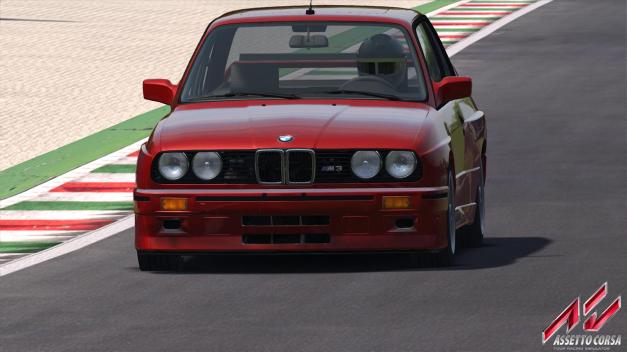
Assetto Corsa is looking very pretty indeed.

So they went to GamesCom, and invited excited simracers to come and try out the development version of the sim.

As covered in the March issue of AutoSimSport, I paid Kunos a visit earlier this year to try out the simulator in an earlier incarnation. Since then plenty has been written about the ethos and design of AC and I won’t bore you with it all over again. Suffice to say that Kunos plan to learn from their experience with netKar Pro, and hit the market with broader horizons.  Does this mean that AC will be the most incredible piece of driving simulation software ever conceived?  It’s hard to say, but such a claim, to me, seems an unfair one to lay on such a small development team.

With limited resources to hand, it is unlikely to expect a sim that picks up the genre and turns it on its head. Their focus for AC is to make it solid, reliable, and drivable. They have laser scanned circuits, but, in the initial release, no promises of variable weather, a bird flight model or arm-waving inflatable tube men by the road sides. Neither are they promising a new era in online action with complex statistics and matchmaking.

No, what they are bringing us is a racing simulator that gives us laser scanned tracks, vehicles modelled in meticulous detail and the chance to race them, both online and offline.  It’s a starting point, they say, for a software product that is being designed from the ground up to be adaptable and moddable, allowing the Kunos team to continue to develop it for years to come, and modders to have a go too.

With all this in mind, what we do know is that the guys at Kunos know their cars, and their tyres, and they have some great artists. The screens we’ve all seen show AC to be beautiful, and the videos show that the physics already look pretty sorted. So there is no reason to suspect that AC will be anything other than a hit amongst the more hard-core end of the simracing community.

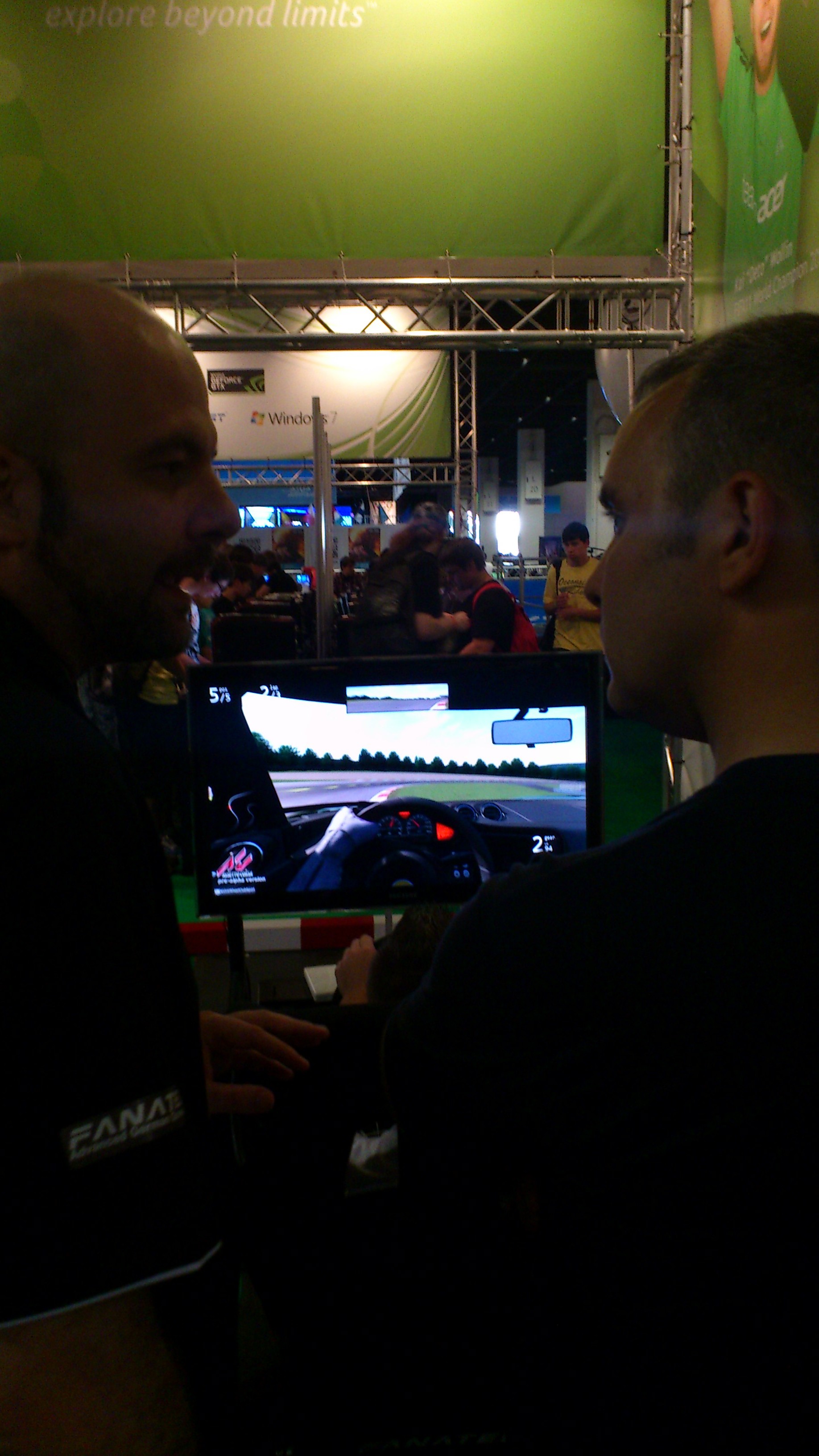
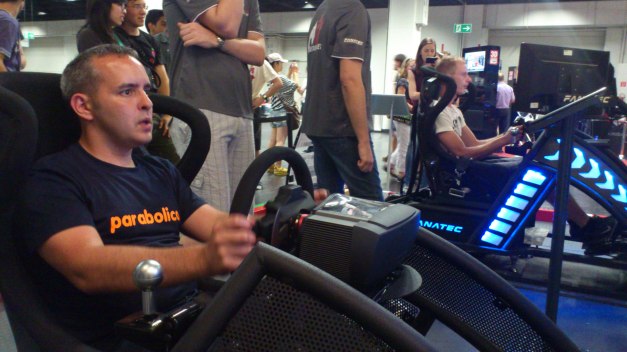
Of course, going to GamesCom was for more than the hard-core bunch.  For Kunos, it was to put AC “out there”, and make the broader gaming world aware of what they were up to.  Whether it worked remains to be seen, but on hand were two high-spec sim PC’s at their booth, one with triple screen and a motion platform, and both using Fanatec’s Clubsport wheel.  At no point while I was there was there not a queue of people (mainly young lads) waiting to try out the sim, some with more success than others.

When I arrived I had a sit down with Stefano Casillo and Marco Massarutto to indulge in some sort of ridiculous “beer mixed with grapefruit juice” concoction that seems to be all the rage in Germany (Probably everywhere else for all I know!), after a bit of chat (and a Currywurst), I was invited to try out the sim.

Having tested the sim in a more apt environment back in March, I figured this would be a good chance to see how development has come on.

Well, how wrong I was!  I can certainly tell you that a huge video game show is no place to really get any solid feeling for a racing simulator.  The amount of noise in the arena area behind us was phenomenal, and normal conversations had to be switched into “shout into each other’s ear” mode.  In fact, the first thing I noted, taking out the KTM X-Bow, was that I could not hear my own engine, tyre noise, or just about anything at all. Driving deaf may not be as bad as driving blind, but it’s far from ideal.  The below video, taken by the blonde, should give you an idea:

Aris barked at me (The only way to be heard) “Use the torque of the engine!”  Sadly, knowing what RPM I was doing would have helped with this, it was effort enough to know when to change up!

I moved on, to try out the BMW Z4 GT3, which is a louder car, so I could almost hear it, and did enjoy running it around Monza. Then I hit the Lotus Evora road car around Nurburgring GP. All fun stuff and I will say there were some aspects I did pick up on.

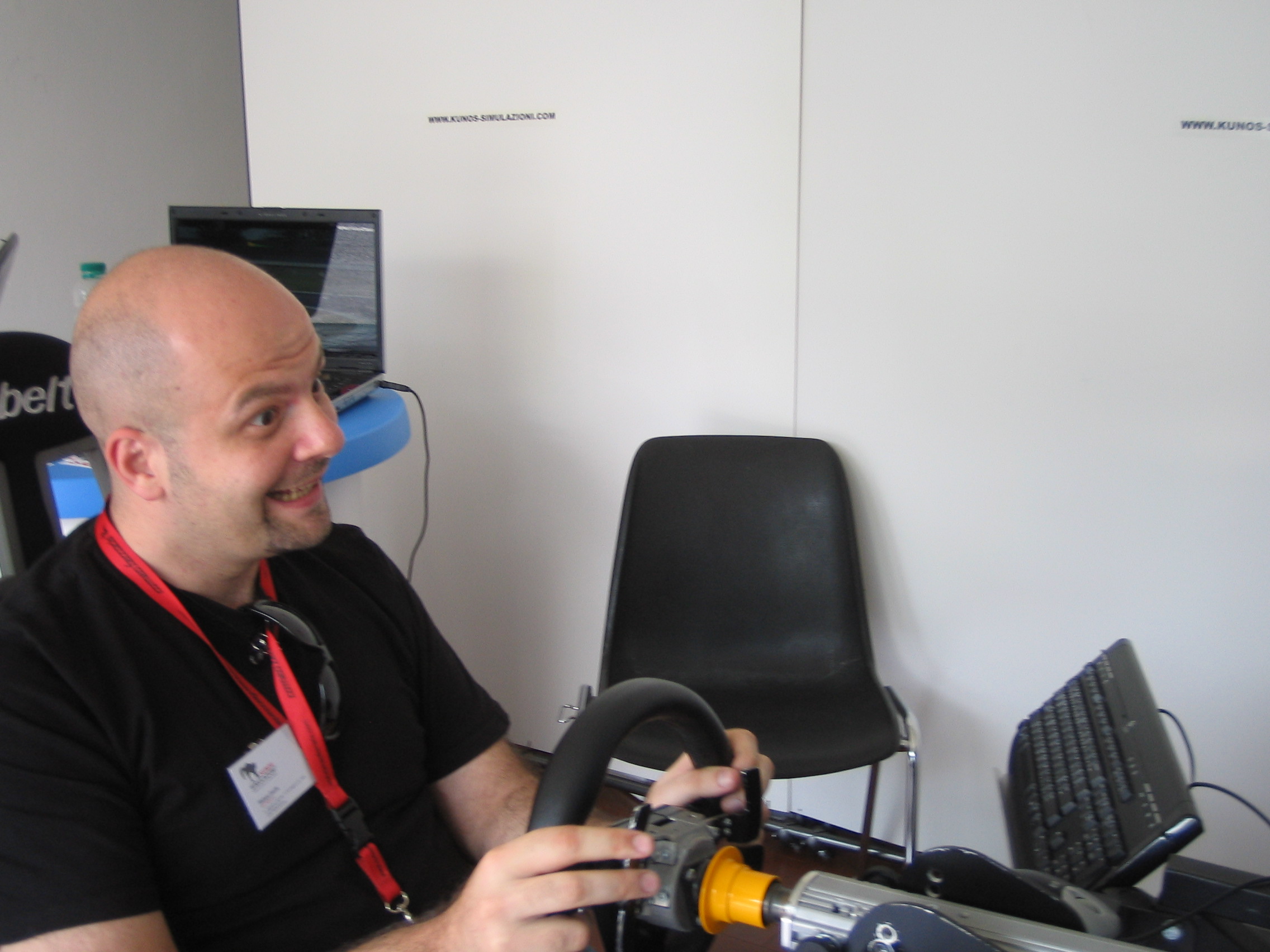
And the prize for “Stupidist sim driving face” goes to….

The Clubsport wheel I was using did seem to be to be weaker than I am used to as the force feedback had been turned down to for the purposes of the general public’s use.  Where AC really comes into its own is in the communication a driver feels through the wheel.  Judging braking areas is very natural as the car squirms, and without any audible tyre noise it was still very easy to feel the understeer and subsequent yaw in the car.

One area that felt much improved from earlier in the year was the transition from under-to-oversteer mid-corner that came across very nicely through the steering, while the fronts scrubbed there was no vagary around when to start peeling away the lock and straighten the car, and catching the odd slice of oversteer was a brain-free experience.

AC continues, for me to slightly change the approach one makes to a racing simulator.  In the past I would leap into any given sim and slowly build up speed, as is normal.  But often, with other sims, I would get hit with nasty surprises. Say, for instance, a car violently snap oversteers under brakes, so then the next time around I would ensure to brake in a straight line and not let that happen again.  This would push back the learning experience as ultimately finding the limit would be tempered by a desire to keep the car in one piece (not crashing in racing sims is an affliction of mine, my mindset goes too much like real life race car driving).  As such, finding that ultimate braking limit would be a longer and longer process, as it would in a real car if pushing too hard resulted in an enormous “brown trouser moment.”

The same, in some sims of the past, could have been said about finding the earliest point to get on the throttle out of a corner, get bitten once, pull it back two levels, and then take another two hours to get where you should be.

In AC I find where I build up the speed slowly I don’t get hit by as many of these surprises, I rarely ever had moments where I thought: “Why on Earth did that happen?” that would make me scale things back, and it just meant I could push that bit more over the next lap, and grow closer to that limit. When the limit comes, it’s understandable, and the car does what I might expect it to.

This, however, is early days for AC, relatively. At the time of the show there was no tyre heat or wear build into the tyre model, and this can change car behaviour considerably, as well as this the drivetrain and brake modelling continues to be worked upon.

We shall have to wait to really get to grips with this sim, I am sure when it is released I will get plenty of laps in, for a more solid, and audible, experience.

For now, rest assured, Kunos know how to make a sim-car feel like a real car, and if, for you, that is what racing simulations are all about, you should be in for a treat with AC.

Online Racing Championship: Interview with Ash McConnell

Posted by spamsac on August 27, 2012
Posted in: Independent Racing Simulators. 7 Comments

As anyone who has sat tight waiting for a new release will be all too aware, quality simulations don’t become a reality over night. Even so, by most standards Ashley “Ash” McConnell’s simulation Online Racing Championship (ORC) has had something of a protracted development period. It is perhaps fitting that I first became aware of Ash’s simulator (formally known as Sirocco in a previous incarnation) on the West Racing forums for their title Racing Legends (a title which redefines the term ‘protracted development’). At some point over the ensuing decade, our online-paths crossed and I have been chatting to Ash about various things for many a year now, from babies to Android apps. Throughout this time, development (at various rates) has continued on ORC, and he kindly agreed to discuss the past, present and future of the title with me for RAVSIM.

In its original guise as Sirocco, the title was covered in the very first issue of AutoSimSport (http://www.autosimsport.net) way back in 2005. When asked the dreaded question “How long before we get a finished work”, Ash cautiously stated that after around three years of part-time development “I reckon perhaps two more years are needed to get something that is nearing completion”. To dive in at the deep end: that was over seven years ago now… What happened?!?

“I can’t quite believe it’s been that long, how time flies!  Sirocco was really a step for learning the nuts and bolts of sim development.  Even when I started ORC it was still just a fun side-project (I was working full-time), I had hoped I could do it full time, but didn’t think it could be a reality with bills to pay.

Luckily, four years ago I was given the opportunity to go full time on ORC and I took it.  Unfortunately though, in the last year or so with family illness I’ve had very little time to develop ORC and now I will have to return ORC to it’s part-time status.  It is a huge shame as I believe it has great potential and is not too far off being completed.  I am trying to find a way where I can spend at least a good chunk of my working-time on ORC every week.”

The menus in ORC are sleek, stylish and highly intuitive.

Going back to the beginning (I won’t expect people to remember that first interview!), Sirocco started as a part time hobby project, born in part from a misunderstanding with Chris West (of West Racing); he thought Ash was working on a sim when in fact he wasn’t, which begged the question: “Why not?”, and subsequently he started working on it. So what prompted the change in direction that saw Sirocco become ORC, and why did this necessitate effectively throwing out Sirocco and starting again?

“Sirocco was a hobby project, really just for fun and as a way to learn the basics of game development. ORC was a complete rewrite of the entire engine from the ground up.  I previously had created a graphics engine/physics/sound engine of my own (in Sirocco), but when it came to ORC I made the decision to build upon some of the great opensource libraries out there. Also, Sirocco had it’s own physics engine (quite basic if I’m honest) that I built from scratch, and I made the decision to move to Gregor Veble’s great physics engine for the vehicle dynamics, which certainly made a huge difference. The knowledge of Sirocco wasn’t thrown out, but I had learnt so much in the time it had been developed that it made sense to start with a better design and structure.”

On the subject of opensource elements in ORC, Ash continues:

“The main opensource component is Ogre3d, it is a very powerful, extremely extendible graphics engine with good cross platform support.  It has a lot of documentation and great support in the forums.  If I was starting over again, I would consider using Unity3d, but at the time it wasn’t really an option.”

Stats and rankings are integrated into the ORC experience.

Gregor Veble will be known to some for his association with West Racing/Racing Legends; what does his physics engine consist of exactly and how did it come to be used within ORC?

“I’ve known Gregor for a long time now, we talked about racing physics in an old newsgroup (yes kids, before forums existed :P) – rec.auto.simulators, probably about 12-13 years ago.  We have become good friends, he even came to my wedding!  I asked him when I made the transition to Ogre and he agreed.  It is a constraints based physics engine which allows you to define individual constraints such as rods/springs/dampers/tyres.  It even allows fun stuff like chassis flex and twist and tyre/brake heat.  As well as normal constraints he has made a few realistic car aids such as ABS and Traction Control.”

Such an approach is incredibly open ended and malleable (which is a very good things for supporting different types of vehicles and set ups). When asked about the suitability of the core engine for different configurations, Ash responds:

“The physics engine is extremely flexible.  It could be used to make anything you desire, as many wheels and as complex suspension as you wish.  Gregor made himself a 4WD Subaru, and a Tyrrell P34 6-wheeler was also made.  Another company was thinking of using the physics engine for industrial digging machines.
Everything is made up from constraints and rigidbodies.  For example for suspension you connect the wheel hub (rigidbody) to the chassis using a number of rod constraints, you can use the same mount points as in real life and the suspension characteristics will just be realised automagically.  These constraints can allow some flex, so rod flex in the suspension can be simulated (although minimal), it is even possible to break a rod if the force on it is too high, but we haven’t implemented that yet.  Interesting stuff like chassis flex can be achieved quite easily using the physics engine, making it suitable for karting.  Another feature that Gregor added recently is heat transfer that will allow heat to be generated by the brakes and transferred to the wheel/tyre.”
With a solid and flexible engine at ORC‘s core, there is good news for potential future content (Industrial Digging Machines Simulator anyone?!?). However, to date we’ve only seen an Indycar-esque and F1-alike  single seaters in game (complete with glorious spoofs of real-world liveries), but what does Ash have in mind content wise, and is there any chance of loose surfaces and rallying/rallycross? (Yes, I will continue to ask this of every developer!)
“I certainly would like to model loose surfaces at some point, but for the minute the focus is to try and get something out there for people to try.  Gregor is big rally fan, but I’d rather have head to head racing, perhaps Rallycross would be the natural compromise 🙂  Actually those manic ice-racers would be fun!”
Industrial diggers to one side, fans of simulations of more conventional land-based vehicle types (ORC‘s focus) know that one of the key aspects in the physics engine is the tyre model. Ash (and Gregor) thankfully know this too:
“It is a physical tyre model, meaning that the tyre characteristics are determined from a simplified model describing the characteristics of the tyre. The model is proprietary and is related to the string type family of tyre models, where the tyre carcass is described as an elastic string, and the forces and moments are determined by the stick-slip dynamics of the contact patch area in interaction with the carcass.
We avoided the traditional Pacekja model as it’s just so hard to tweak and most of the data is incomplete, whereas with our model we can get reasonable tyre behaviour by just feeding the tyre physical data such as carcass stiffness and grip coefficient characteristics, instead of tailoring somewhat obscure parameters.  We believe this will give more predictable results in all cases, whereas Pacekja by it’s nature is only fully applicable in limited circumstances.”

Over the years it has become apparent that Ash enjoys the programming side of development, but he clearly has a lot of faith and passion in ORC to have persisted with its development  for all this time. With numerous other titles out there, I wondered how he saw ORC fitting in within the sim-racing genre.
 “There is a thin line between faith and insanity, I’ve probably been on both sides of that line during the development of ORC :).  I have faith in it because the foundation (Gregor’s Physics Engine) is exceptional.  I just hope I can do it justice!  I would like to make a game that I want to play and keep playing for a long time.  The key things for me in a sim are atmosphere, physics, networking and social aspects.  I think atmosphere is a very difficult thing to create, but I hope our passion for motorsport will shine through.
For me, and I think quite a lot of sim-racers, time is very short. It’s hard to budget two hours to do practice/qualifying/race only to get t-boned on the first corner.  It is probably controversial amongst hard-core sim-racers, but I think (as a default) pick-up races should be short.”
Appealing to wider audiences is a pertinent subject for all sim-developers, and even those at the hardest end of the core-scale have had to make concessions to broaden appeal (see netKar Pro and iRacing as prime examples). But just in-case this is setting alarm bells ringing in the heads of any of the hard-core crowd over ‘dumbing down’, fear not:
“Of course, allow the option to have practice/qualifying/race of any length, but by default a 5/6 lap race.  This heads into the addictive ‘Oh go on, just one more race’ territory 🙂   It also means that if life gets in the way of sim-racing for 10 mins you can come back for the next race without a huge wait. For me it’s fine to mix ultra-real physics with a more casual race format for pick-up races. I think a closely integrated achievement and ranking system, while probably not considered “sim” enough by some die-hards, will add some fun elements.”

Hmmm, looks vaguely familiar…

With physics sounding to be in good shape, and the networking/social side planned to be taken care of by the race structure, the issue of atmosphere is an interesting one. iRacing has unarguably accurate and faithful recreations of the circuits, but at the same time suffers from somewhat staid and sterile environments. It’s somewhat intangible, but I wondered how ORC could deviate from this.

“I don’t think it’s one single thing that generates atmosphere, it’s a combination of hundreds of things I believe.  All the technical things are important, graphics/sound/force-feedback/smooth networking in order that the driver can ‘suspend his disbelief’,  but I don’t think that’s the end of it.  I think there needs to be a feeling of community, somewhere where you can go and have a few laps with your friends.  GPL had atmosphere coming out it’s ears, but people say that iRacing hasn’t, I’m not sure why that is. Perhaps the history of GPL and the on the edge feeling helped.  Another big thing that helped GPL was VROC, it really was a place to come and talk nonsense with friends, then go and have a race.  For ORC I think it will be something that is built over time, I hope our love and enthusiasm for motorsport will spill through :)”

ORC‘s development obviously hasn’t been quite as smooth as may have once been foreseen but, stopping to take stock and looking forward, where exactly does ORC‘s development now stand? What is in, what is to do and, dare I ask, where does Ash see things going from here?

“Yep, 2011 was a very difficult year for me and my family with illness and bereavement.  Unfortunately this meant very little time to develop ORC in the past year.  At the moment I’ve had to get a full time job in order to pay the bills, so ORC development has been very slow recently.  I am desperate to get back to it at least a few days a week.  I have considered trying to get some funding either by an investor or trying to get some crowdfunding from something like kickstarter.  I think that I would need a more polished demo to show to people in order that they could see the potential.  I’m not sure about getting an investor as I would be worried that they might have too much influence on the project and I don’t like to be in debt to anyone, but never say never.

Everything is done to some degree (Physics/Networking/Graphics/Sound/Ranking/Achievements/Upgrade Shop).   I just need to finish off a few areas and then get a trusty band of testers to tell me how stupid I am 🙂  Then hopefully I can unleash it unto a bigger group of testers and then to the unsuspecting world (Mohahaha!).  Getting the time will be the hard part, but I will get there :)”

As alluded to above, sim developers have to be careful in how (and to whom) they are pitching their products. With such a relatively niche product and community, the release model takes on significant importance. It has been mooted in the past that ORC could potentially be released as a free-to-play (F2P) title, with income generated from micro-transactions for vehicles, upgrades and other in game items/content.

“We are still hoping to go down the free to play/micropayments route.  It’s hard to know what is the right direction, I don’t want people to feel they have to pay for every little bit, but I also want to be able to continue developing ORC for as long as possible.  There is a balance to strike.”

With ups and downs and a number of challenges along the way, obviously the target for ORC is to be successful and return some income for the huge investment of time and energy it has received to date. With that being said, I asked what the personal targets were for ORC, and if there were any milestones or achievements on the horizon that would provide that ‘I’ve done it’ feeling?

“Perhaps I should be thinking that way, perhaps I should be more of a business-man about things, but I haven’t really.  I am just someone who has always loved cars, racing and racing simulators, it has been my ambition for a very long time to release a sim that I would like to play.  I am hoping it will be successful enough to allow me to keep developing and be able to pay the mortgage and bills, but I haven’t looked much further beyond that :).”

So, it’s fair to say that ORC has been a long time coming, and still isn’t here quite yet. However, just as with any number of smaller, indie titles, it has all the potential of those coming from the larger developers, with a number of advantages associated with its independent status. I don’t hesitate to say ‘Watch this space’, and here’s hoping for Ash, as well as for us sim fans, that ORC can one day be another great title to add to the small stable of quality racing sims.

I had planned to accompany this piece with a ‘first drive preview’, however things haven’t quite gone to plan on that front; Ash has provided me with a new build but, as is life, there is a controller issue to resolve before I can put it through its paces. I first drove an early build of ORC  around a couple of years ago now, but to judge it on such an early build and from memory would be somewhat pointless and unfair.  I will, however, hopefully bring you a hands-on report on ORC in due time, so stay tuned.

You can follow Ash on Twitter https://twitter.com/AshMcConnell

and ORC’s development at http://onlineracingchampionship.com or on Twitter https://twitter.com/orc or Facebook http://www.facebook.com/OnlineRacingChampionship

Stefano Casillo on netKar Pro (part 2)

Posted by shrapnel1977 on August 27, 2012
Posted in: Kunos Simulazioni. 11 Comments

Back in December 2011 I conducted an interview with Stefano Casillo of Kunos Simulazioni in AutoSimSport magazine. At the time, it was cut into two parts, primarily because there was so much to talk about. We were discussing the story of netKar Pro, how it came to be, the events surrounding its conception and some of the personal challenges Stefano endured during its genesis.  Part one of the interview, if you missed it, can be picked up from the December 2011 issue on www.autosimsport.net , but to fill you in, part one ended with the eventual release of netKar Pro to the public. A moment that should have been marked by relief for Stefano, I sat down with him to talk about how it went.

Jon Denton: So, Stefano, cast your mind back to that fresh spring in April 2006, the day of release of netKar Pro V1.0 is coming, how are you feeling?

Stefano Casillo: Very tired and very nervous, I spent the afternoon lapping in multiplayer with Simone.  I was nervous but unaware of the hell that was about to break loose!

Jon Denton:  April 10th was the big day. Did the sim take off in terms of purchases and downloads, or was it a slow burn?

Stefano Casillo: We had a good number of pre-orders, then on the release date sales were going very good for the first couple of hours.  Then forums started to fill up with not so good comments.  DrivingItalia.net (DI.net) was our main forum for Italian players, and there was an English section too, but the main English audience were on RaceSimCentral (RSC).  On that night DI.net was packed with people.

The final blow, for me, was that there was a crack released 3-4 days after release.  That pretty much killed it off in my mind.

Jon Denton: Crack for the demo download?

Stefano Casillo: Yea, the crack to unlock the full game from the demo.

For those that were not aware, at the time a single car, single track demo was released for netKar Pro, to give drivers a feel for the sim. There was no multiplayer, and options were limited, with some of the nicer sim elements missing, such as the AIM display.  This was a cut down version of the full game .EXE, as such, talented hackers were soon onto the case to break open the chest and merrily assume that all of the world should be theirs for free.

Jon Denton: Did the crack really hit sales? Or was it more for the casual pirate?

Stefano Casillo: It really does hit the sales, and it really hit my morale.  When you put blood and sweat into something, to have people just rip it off is hard on the heart.  It was the first experience for me of this sort of thing, now I have a more pragmatic approach, I know it is going to happen and I live with it.  I dont even bother working out a smart way to protect the software, copy protection is there, but it’s not that hard to figure out.

Approaching deadlines a certain level of insanity is to be expected.

Jon Denton: Pirates will always find a way around it

Stefano Casillo: Yea, it’s wasted time, better to use the few remaining brain cells for the sim.

Jon Denton: So, was the forum reaction all bad news? I must admit, I had run a few versions prior to V1.0 and had no technical problems at all, was I just lucky?

Stefano Casillo: We ran together, in those early days, we had the chance to explain to you what was going on over Skype, which would be a big help in the learning curve. Plus you and the other AutoSimSport guys have been driving sims for years, as well as having a sound understanding of motorsport and how things work.

The fact is, netKar Pro is really bad at explaining what is going on.  The technical aspects of the sim were quite a way above what was around at the time, or even now.  As such, what may be simple to a real life driver like “release the gas to change up”, or remembering to make sure you refilled your fuel tank or changed tyres when you went back to the pits were unexplained.  The gearbox modelling was pretty hard-core, and took a lot of practice. If you imagine back then people were driving sims where you could flat-shift and never had to blip on downshifts, we maybe expected too much of the player base for them to pick all this stuff up without any tutorials or information. There was also no real manual at release.

But if you have somebody talking you through it, then it, sort of, makes more sense.

Jon Denton: Well, it’s simple though, right, you have cars, you have tracks, and you drive on them?

Stefano Casillo: Maybe, but no racing sim had ever asked anyone to start the car manually, let alone without telling them which switch on the dashboard starts the car!  Then, of course, if you didn’t start it properly, with the right amount of throttle, it would stall. A few attempts at that and your battery would run flat, and that was that.  With no manual or tutorial or in game instructions the “green” driver was in trouble.

Jon Denton: Some of these things, of course are things that, if you actually drive a car, are not that hard to grasp. Some simulators need one to learn a vehicle to really get to grips with it. Many a flight sim can throw you into a “cold and dark” aircraft and you would not know where to start, however, on the most part such sims come with an “easy mode” where all of that “actually being a pilot” stuff is done for you, and in the sims where this is not an option, there is always a hefty manual to explain the ins and outs.  For such a complex simulator to throw a player in at the deep end like this was quite an oversight.  But simracers, they love a challenge, right?  Using the grey matter to learn a thing or two about real racing cars was a chance to relish, no?

Stefano Casillo: Maybe for some, but most people approach a (sim) game as a game.  If something doesn’t work they perceive it as a bug, not as a feature.  If the car won’t start something must be wrong with the software, not with what they are doing, and with no documentation to tell them otherwise, it’s understandable.

For example, the original sim modelled flat spots on the tyres very noticeably. And let’s be fair, the first time you drive a sim and get used to the controls, you will lock up the odd tyre here and there.  As such, by the time just about anyone started their first flying lap in the sim, the front tyres were like a fifty pence coin, and the steering wheel would be shaking in your hands. Realism.  But, well, my inbox was full of emails saying: “The Force Feedback is shit, it just shakes like crazy, no feeling”, change your tyres mate.

Stefano Casillo: in Assetto Corsa (AC) we are planning to give visual feedback to everything that is happening in the sim, if you bend a suspension arm, there must be something on screen telling you that fact so you don’t think your steering wheel is broken, or you need new drivers, or something.  I think we got it backwards in 2006, it should be possible to make a hard-core sim work in the marketplace, but you have to educate the driver. If we make the sim accessible first for the beginner, then, if they want to get serious, give them a series of switches in the options menu to ramp things up.

Jon Denton: There’s a reason FSX has ten tutorials!  So would you say that a lot of the issues you had with netKar Pro initially were this type of problem, or were there a lot of hardware bugs, and the like, too?

Was netKar Pro too complex?

Stefano Casillo: Hardware compatibility and stability of the software has always been ok.  The biggies were the infamous “Scazzato” sound engine that just didn’t work on some machines.

Jon Denton: Ah yes, I remember it. An interesting feature, not yet repeated, it worked very well to help a driver understand what the engine was doing. But it did not have the atmospherics of sims like GTR at the time.

Stefano Casillo: Yes, very low level audio programming, bytes and buffers, I am not that good at these things.  Same reason perhaps I struggle with netcode, it’s a tad too low level for my taste.  The Scazzato sound engine had tiny samples for a single “bang” in a cylinder, and then these were mixed into the software at the right rate mixing different bangs for exhaust noise and intake noise.

Jon Denton: Do you think this is something that, one day, could make a comeback in a car simulator? Or is it too much tech for not enough gain?

Stefano Casillo: It’s hard to say, there are companies doing amazing stuff.  Like those speakers you can get in your car to make it sound like a Ferrari 430! Lol.

Jon Denton: So, 14 days later, April 24th 2006, V1.01 was released, did it save the world?

Stefano Casillo: It did sort out the most urgent problems. Lots of license activation problems with Nordic characters, Spanish characters and so on.  I think it also fixed the fact that every car in multiplayer had the default skin!

Jon Denton: At the time the online servers were busy, but scarce. You would see people pop in, crash, then leave, lots of times.  Newcomers seemed to be struggling. Some of us were punting around doing lap after lap, others seemed to be really struggling with the sim. Do you think this was the lack of information primarily? I don’t think, personally, driving wise, it was much more difficult than other sims at the time.

Stefano Casillo: I think it was different; most people were used to F1 racers like Crammond’s or ISI F1 games.  Pretty much every developer had an F1 like car in their sim, our cars were something very different, everything in netkar Pro was so different from other sims.  You were free to start your car and go around while the starting light was red, no one was telling you what to do, you had to manually hit the “go to grid” button, in the current version that button is flashing green but back in v1.0 it was just a button.

Jon Denton: It amazes me that such little things cause such problems. Do some people really sit there just waiting for the machine to tell them what to do?

Stefano Casillo: It can be really confusing absolutely.  As well as this, I think the driving was quite tricky. The tyre model was not very good in v1.0, the cars were twitchy, very weird at high slip angles.

Jon Denton: Why was this? The initial model was very Pacejka based, no?

Stefano Casillo: Yes

Jon Denton: Early versions also exhibited the weird “slide down a hill when stopped” thing.

Stefano Casillo: Well that’s a sim problem that is there in different forms and gravity in every product.  It’s really hard to stop a car in a physics simulation with discrete time steps.  At the moment AC is quite good at it, because the nature of the tyre model is not static.

The problem is that tyre models are based on the concept of slip percentage.  Which is basically a division between the rotation speed of the tyre and the speed of the wheel hub, as the hub speed goes to zero when you are stopping, the result of the division goes up to infinity.  At pure zero kmh, it is not even defined, and the software will crash.  So what you do is select a very low speed where you just say “ok the car is stationary” and stop the simulation freezing the car, if that speed is too slow, it might never be reached if you are standing on a hill, thus, you keep sliding down that hill.

Jon Denton: This naturally meant there were people saying “not realistic.” I would say, however, the tyre model at speed was superior to any of the sims on the market in 2006, would you agree?

Stefano Casillo: Yea, I always say my sims are only realistic over 15 kmh, lol!  Under 15 kmh, you are in the land of pure hackage.  As I said, AC is much better, I think it is not bad even at 3-4 kmh.

Jon Denton: Based on my brief try back in March I would agree (See AutoSimSport March 2012 edition).

Jon Denton: So the online code came in for a lot of flak, my personal experience was that it worked ok if there were low pings, but if you wanted to race someone in the US, forget it. This seemed to be the biggest complaint in the community. What went wrong?

Stefano Casillo: Netcode is hard, very hard, it’s very asynchronous, so very hard to test.  To test it properly you’ll have to ring somebody in the US.  The internet is the least reliable network in the world, sadly, and this makes netcode such a hard thing to do.  It’s totally unreliable and, even if it is reliable you still need to guess where a car is now based on information that is 200ms old.  200ms dont sound that much, but at 150kmh your typical high speed corner velocity  you can be anywhere in a circle of 8 meters.  Hence, if it goes wrong you see cars inside cars, and flying bouncing chaos. So when people complain of a ghost collision showing me a screen shot saying “look there was some good 2-5 cm between me and him” I can only lol.

Jon Denton: Yes, it’s an incredibly difficult thing to get right. Not helped by bigger development teams like ISI and Papyrus doing it so well.

Stefano Casillo: I have profound respect for my competitors in this area because what games like iRacing and rFactor do with netcode is truly an amazing achievement.  It’s not a subject covered in literature, there may be lots of information out there about the Quake 3 netcode, but come on, that’s easy-easy-easy compared to a car.

Jon Denton: Indeed. No one wants to run around in Quake inches from each other.

Stefano Casillo: Your typical FPS character is moving at constant speed, a race car not only is NEVER at a constant speed, it’s not even at constant acceleration!  It’s a software nightmare materialized I am telling you!!

Does any sim since have such great driver animations?

Jon Denton: So the plan was to try to fix this for the next release, more sleepless nights.  V1.02 was released, in October 2006, and had some high expectations. If I recall this release was quite an improvement?

Stefano Casillo: Yea sure, 1.0.2 was a step in the right direction, but nothing massive. Jaap Wagenvoort and the GPC league guys got involved with online testing for V1.03.

By this stage I was really burned out, so I left it all behind and went to Vietnam to rethink my life, for two months, to forget about RSC hate posts for a while!  I remember lovely things like: “oh gosh, the sim has bugs and he goes to Vietnam.. let’s kill him!!!” Lol.

Jon Denton: Development seemed to go quiet for quite a while then. The gap between V1.02 and V1.03 was nearly two years. It led many to think that Kunos had abandoned the community of people that had purchased their sim. Was this the case? Or were you hard at it?

Stefano Casillo: I have to be honest; I almost gave up on netkar as a “gaming” sim.  During that period I was doing very cool stuff with BRD that literally saved us from going down in flames.

Our contract with BRD was 2 years, and there you can do the math with the time between 1.0.2 and 1.0.3.  After 2 years me and Marco (Massarutto, Production Director at Kunos Simulazioni) just sat down and had to decide what to do.  We thought we could still have our say in the “game” sim racing world, as opposed to motorsport industry simulations, so we decided to re-join the fight. I started work on “saving” netKar Pro, while Marco set to work on what we could do after netKar.

Jon Denton: So the time with BRD was spent developing the sim core for motorsports customers? Or more for motion sims and the like? Or stuff you can’t talk about?

Stefano Casillo: It was a bit of everything, we worked on an amazing BRD motion platform, worked for Honda F1 on their simulator, we had a BMW X3 at London Victoria station with our sim, it was all cool, cool stuff.  We also did the Singtel simulation, which was the first F1 car in the netKar Pro sim.

Jon Denton: And was 1.03 the saviour? I seem to remember running in the GPC league with it. The netcode was very much better than in the first versions.

Stefano Casillo: Yes v1.0.3 was netKar Pro as it was supposed to be at v1.0, and also the last “pure” netKar pro.  With “full mode”, gearbox modelling, etc.  Jaap and his guys helped a LOT for v1.0.3, we tested night after night with the guys from GPC, he wrote the amazing manual, and developed the GPOS website software, which allowed driver stats, etc. Linked with nKRank it is all in use to this day.

I miss you Jaap :p

Jon Denton: V1.03 seemed to have some happy customers. V1.1 was nearly another two years, and yet the features decreased (but the GUI changed), What happened?

Stefano Casillo: We started to look into ways to expand the audience for netKar Pro, we felt the GUI was a big obstacle, it was really scaring people away.

Jon Denton: But it was Windows!?

Stefano Casillo: Yes, but it wasn’t a “game,” I still love the 1.0.3 interface, people were scared away by thinking it was more of a professional simulator, than a game you can have fun with.

For a long time I used a similar interface for AC during development.  We called it the “AC Shell,” I love those things, but I came to accept the fact that the majority of people don’t.

Jon Denton: It’s a shame there can’t be an option.

Stefano Casillo: I agree, perhaps I will release the AC Shell open source so modders can make something similar for AC.

Jon Denton: Also, things like the gearbox simulation and full mode were removed. Auto car start-up was added (as a menu option, thankfully), and a much better interface for controller setup. Some good, but why did the hard core stuff have to go away for the people that may have wanted it?

Stefano Casillo: Because it was a lot of work, at that time I was changing the entire setup system and making it work with the full mode gave me daily headaches.  Eventually, I had to choose between throwing weeks of work away on the new setup system and revert to the old one, or let full mode go.

Jon Denton: It’s a shame, I still think the gearboxes were the best I have known in sims, you had to drive *properly*.  Of course, this does not always work for people with different controllers, without a clutch, and so on.

Stefano Casillo: True, the real problem was that the netKar source code was (is) impossible to work with.  In 2001 when I started it I was all about “code, code, code, just code and make it work”, I have learned the lesson, and in the last 3 years I have been really into software architecture and studying more about organizing big projects.

Jon Denton: So netKar grew up, in a sense, with you. In that the base of the product started out as a hobby, but the seeds of that were impossible to work round as the product grew into a much bigger monster.

It struck me, though, that after V1.1 there were more people playing, I think the community had changed quite a lot by then and was less “hard core” in its make-up. There were, and are now, a lot more people and not all of them serious car enthusiasts

Stefano Casillo: I think, with V1.1, the software was better, the presentation was better and it took care of the user a bit more.  The tyre model was better, and more drivable,  every netKar release has lots of improvements in the tyre model.

Jon Denton: It definitely was more like a game than something you might find in a dark room at McLaren.

So you constantly worked on the tyres? A tyre modeller’s work is never done!  What were the key challenges? As you said, the early releases were a bit edgy to drive. Was the focus on making a more malleable tyre?

Stefano Casillo: Basically, a tyre with less parameters.  Pacejka is a monster of something like 100+ parameters, every parameter can potentially screw something up, and realistically, you never have the raw data available to even try to get those 100+ parameters.

To fix this I tried to build a tyre model that has a physical based theory in the formulas and that can be tweaked with very few parameters that cannot create anything “destructive.”  This involved moving away from that particular pacejka model.  The basic pacejka “magic formula” is still valid to create basic curves, but a good tyre model needs to be more dynamic. The model we see in netKar Pro V1.3, Ferrari Virtual Academy (FVA), and AC are all based on the idea of generating a “base” slip curve that is then adapted to the behaviour of the tyre.  I call it “slip profile,” in netKar Pro and FVA this adaptation is done in steady state analysis, in AC I added the dynamic of the carcass and thread to the equations.

This not only makes the tyre more dynamic when put in extreme situations, like riding kerbs and so on, but also makes a big difference on flat roads, in the way it reacts to load transfer when you turn the steering wheel.  I makes it feel…  Rubbery.

Stefano and I set the world to rights at GamesCom 2012.

Jon Denton:  V1.2 came along in November 2010. It felt like an evolution of V1.1 mainly. But the Formula KS2 was added.  This was the “almost F1 ” car that many had been waiting for, but also things felt a little more solid from the tyre point of view, was much changed?

Stefano Casillo: FVA came out in September 2010, I knew a lot of people would buy FVA and would find it hard to go back to racing the F2000 or Formula Target in netKar.  After a year working on FVA I tried netKar and it all felt like slow motion!  So I just called the car graphics guy and I told him: “I need a fast bad single-seater, next week.”

Jon Denton: I raced it in a few series, (even got a win!). I think it ranges as one of my favourite sim cars ever.

Stefano Casillo: What changed really in V1.2 was just more polishing of the tyre model, thanks to a lot of very tasty data fresh from Ferrari. Every time I can get my hands on new data, something pops in my head and some magic relationship with some other data I saw becomes evident and a new formula is born.

Jon Denton: Racing the KS2 was so demanding; incredibly fast, obviously, it brought tyre management to the fore as races could be a bit longer than in the Formula Target. Keeping the tyres “sweet” really became something about “feel” for me, you would find part of a race when different drivers were quick. The more experienced would always adapt fastest to the changes in the tyre throughout its lifecycle.  Real, nice, hard core simming stuff.

Stefano Casillo: It was a very well balanced car, very cool to drive, very demanding for the netcode though, because of its crazy rate of acceleration.

Jon Denton: By now it struck me there was a whole new world in simracing. iRacing was getting busier and busier and the niche communities of netKar Pro racers were like a small family. You would race with the same people in different leagues sometimes. Amongst this some very serious followers developed, and you became regarded as one of the greats of simracing. How does that feel?

Stefano Casillo: It still feels strange.  The period between 2006-2008 really had a big effect on me.  Back then when I read “kunos” or “netKar” on a forum I always had to brace for impact.   It’s weird to see now, that netKar is considered as a point of reference for sims.

Jon Denton: Almost *THE* point of reference when it comes to tyre model and driving feel.

Stefano Casillo: It feels good, It makes me feel that not going full in for the “professional” market but staying in simracing in 2008 was a good call. I only wish I had made something like v1.3 in 2006 to release, then history would have been different.

Jon Denton: So V1.3 came along with another new car, the Shelby, and Trento Bondone, the Osella, and RAIN!?  As well as hugely improved netcode. You threw it all at us!?

Stefano Casillo: The last netKar, V1.3 was a very good step forward online, I understood how important time sync really is in netcode, which made things a lot smoother. From this I now have a new smoothing algorithm planned on paper, hopefully it’ll be a step forward.

We wanted to end the netKar journey with a bang, we knew it was going to be the last netKar pro, so we went all in. Simone wanted to have a go at car modelling and so he did the vintage, you’ve got to love the guy, he is arguably the best track modeller in the business but still loves to challenge himself.

Jon Denton: And why not. It’s a beautiful car.  But then Aris (Vasilakos) came along and gave it slicks and suspension!

Stefano Casillo: Yes, the big comeback of the flying pig, LOL!

Jon Denton: Simone has been with Kunos since the start, no? You and Marco must have had some up’s and downs over the years too. Has the team always been like a family?

Stefano Casillo: We “lost” a “family” member on the road, Alessandro “outrunner” Piemontesi, who did many things for netKar free and was part of the initial team for netKar PRO.  Sadly, going from free software to a business can create frictions and sadly that happened.  Also, Aris was in the initial team but he quickly got fed up with my control freak attitude and left.  Things are much more solid now, no big egos.  I used to be a pain on the physics, never wanted to leave it alone.  But Aris has gained my trust 100% for what he did on P&G (Aris worked on the car physics for the famous P&G GTR2 historic mod), on FVA, and the way he is pushing the right directions with AC.  So here I am, I am just a code monkey now. 😀

Jon Denton: So netKar Pro is, as it stands, a defining racing sim of the previous generation. There are many eager souls waiting for the next generation as we speak. I guess you never thought it would be so revered. Do you think it will always be remembered as a bit of a rough diamond?

Stefano Casillo: I hope people will remember it.  It is rough, it has a lot of attitude, some of it a bit tamed now, but still has an attitude.  It’s like trying a drop shot volley at Wimbledon, you can end up looking like an idiot or like a hero, but at least you tried.

Jon Denton: It is a superb piece of work, which, for me, from the first few laps felt very natural and understandable in the way it communicated to the driver. It still features some aspects that no other sim has touched (dirt on visor, clickable cockpits), and the driving experience is still yet to be bettered I think.

Stefano Casillo: After ten years of reading simracing forums I think we are almost there at cracking the code!

Jon Denton: I don’t think the simracing forum will ever be a place where there are lots of people saying “This could never be improved, I am in love”, sadly. I suppose a happy game forum is an empty game forum.

Well, that’s netKar Pro, 6 years of driving pleasure. Has it been tombstoned as software, or could there be further development?

Stefano Casillo: I don’t think I’ll do major improvements on it, but some minor tweaks might appear.

Jon Denton: These six years have gone in a flash eh?

Stefano Casillo: Yes and no.  So many things happened, it also feels a long time ago that all this started.  11 years of netKar since 2001 are incredible though.

Jon Denton: Do you still drive netKar Pro now?

Stefano Casillo: No, I am so crazy, busy trying to get AC out this year I just have time for AC and some occasional guitar playing.  Since June we had to change gear and get more hours in, and things are going to get worse the more we approach winter.

Jon Denton: I don’t need to tell you the expectation in the community for AC is very, very high. It feels like a similar time to 2005/6, when nothing truly awesome had come our way for a while, simracers were discontented with the current offerings and gasping for something new. You’ve got to do it all over again!

Stefano Casillo: I hope people don’t set their expectations too high for AC, it’s a brand new piece of software, the aim is to get a very SOLID release on v1.0. I would rather to leave a feature out of the sim than release it with bugs. It’s a first step into the next 5 years of PC simracing.  We have to enjoy the PC while there is still something called PC!

Who says a six year old sim can’t be beautiiful?

Scania Truck Driving Simulator

Posted by bobsimmerman on August 27, 2012
Posted in: Reviews. 5 Comments

First and foremost—Welcome, all, to the new RAVSIM project!  It is very exciting to be working in the simulator world again, and we hope you share in the excitement of RAVSIM as well.

**********

Image

Scania Truck Driving Simulator

With a lineage dating back to 1997, SCS Software is no stranger to this business having provided scores of simulations including hunting games, a bus driving simulator and, of course, their many truck driving simulators.  18 Wheels of Steel, UK Truck Simulator, and German Truck Simulator are but a few of the games from SCS in the wildly popular genre of big rig trucking simulators.   Owing to that popularity, SCS has embarked on the development and (planned) 2012 release of Euro Trucker 2, a release as highly anticipated as any other sim in any other genre, and a game that stands to be the jewel in the SCS Software crown to this point.  Game play videos abound go a long way to satisfying the masses until release date but, until we get the thing in our greedy hands, well, we’ll just have to wait!

But if you’re like me…you simply can’t wait and must have some sort of holdover until the big day.  Enter Scania Truck Driving Simulator, the latest release from SCS Software and a product that clearly shows how far the fit and finish of this genre of game has evolved over the years.  In a slight departure from other games in the series, there is only one truck modeled, the Scania R-series.  And what a lovely truck it is…modeled to near perfection, it is a beautiful representation of the real world counterpart, inside and out.

Offered as a free demo download, the price of admission is just right and if you do choose to purchase the game, all you need is to complete the financial transaction, enter the activation code, and off you go—the download contains the entire game.  In fact, there are two downloads, one around 500 MB in size and the other around 1 GB in size, the difference between the two is that the larger one comes with a gallery of images and videos of Scania trucks and highlights of previous Young European Truck Driver competitions, otherwise they are identical.  Price for purchase is around thirty dollars USD, and, given the current condition of the dollar, a few minutes hunting for returnable bottles should fill your pockets with the cash you need to seal the deal.

First Impressions

With installation complete, the first thing you see is the first thing you see with any other game or simulator–the user interface.  Fonts, colors, graphics, backgrounds, web link buttons, and the overall layout of the interface are very pleasing to the eye and an early indication of the pride SCS places on their product.  Given the lackluster, drab, and 1980’s era look and feel of other ‘modern day game’ interfaces, it is nice to see a company go that extra mile and put on a good first impression.  Of course, a well designed and attractive interface quickly becomes a moot point with a substandard product but, fortunately, that is not the case here as the interface is not the only point of attention with Scania Truck Driving Simulator.

Driving License–In this module, you will learn the finer points of frustration control as you learn to handle a big rig…and an even bigger trailer connected to it.  Consisting of several exercises designed to ease you into the critical matter of tractor and trailer control, it is a good idea to start here for the newcomer.  Trust me, if you have never attempted to back up a simulated trailer make this your first stop.

Image

Driver Competition–Much like the real world driver competition using Scania trucks, this module strives to put you in the mix.

Image

Dangerous Drives–Now we are getting to the meat and potatoes of the simulator.  Be it driving mere inches from a cliffs edge and certain death below to hauling an important load of supplies through a flood stricken city, this module puts to practice your truck driving skills.  Easier said than done, you will have to develop a good sense of situational awareness regarding your truck and trailer as the margin for error in some of the challenges is razor thin.  In the beginning, you may find yourself more often than not finishing a challenge with ‘zero’ points as merits are deducted for collisions with roadside objects or worse calamities such as going over a cliff with your gear.  Since beginning this product overview, SCS have released several updates to the game that have upped the number of driver challenges to twenty at the time of this writing.  Once you have completed a challenge, you can watch a replay of your adventure and compare your performance to a global database of other truck sim drivers.  Additional challenges in the list become unlocked as you complete earlier ones and the difficulty increases.

Image

Image

Freeform Driving–Similar in nature to the standard truck driving simulator, you pick up loads of your choosing and scoot them to the destination with, hopefully, a minimum of drama.  You’ll have to watch out for traffic here, and, if you are like me, pay close attention to that map–I’m the type that gets lost getting the mail.  In addition to a beautifully modeled city, the Scania Demo Area is included.  This is where, in the real world, Scania demonstrates and displays their lineup of big rigs.  Updates to the game have increased the size of the map area providing plenty of virtual real estate, and, no truck sim would be complete without a virtual rainstorm here and there.  Wipers work…

Image

Time Reaction Test–This mode is about as straightforward as it gets, initially putting you in just the truck and putting virtual obstructions in your way at various times as you travel down the road at a minimum specified speed.  However, as you advance through this mode the complexity increases as the trailer is added and driving conditions become less than ideal.

Image

Gallery and Media


Offered as one of the components of the downloaded game should the user choose, or, later from within the game itself, this is a collection of images and video showcasing the Scania trucks and previous results of the Your European Truck Driver competition.  On the hefty side, adds about 500 megabytes to the game download.

Online Resources


Clicking this menu reveals a number of online resources available to the user such as Scania websites and corporate resources as well as links to a number of social media sites

Image

Driver Profiles


No surprises here, create one, or many, profiles for use in the game.

Options

Game play, Keyboard, Controller, Display, and Audio are the sub-menus found here and allow for the configuration of the game to suit the gamers taste.  Graphically, Scania Truck Driving Simulator is quite pleasing to the eye and some of the options the user can set are MLAA (anti-aliasing), High dynamic range (HDR), Depth of Field (DOF), reflection, vegetation, and shadow quality.  I was able to crank everything up and\or enable it on a three year old i-920 system with an NVIDIA GTX 460 graphics card and the game looked quite good and ran smoothly.

In the past, there have been some issues with controller setup, that is, strange things have happened when a conventional sim racing wheel is being used for control.  Personally, I have had issues with split axis and getting the game to recognize the controller, to name but one.  However, this time around, SCS have outdone themselves–not one, not two, but three controllers are now supported in the game!  A very welcome fact and one that may have come from listening to their gaming audience. I chose to use my Fanatec CSR wheel and keyboard for control and the only issue I ran into was that I had to go into the keyboard setup section and then select my paddle shifters during the up shift and downshift mapping period.  Hats Off and well done to SCS on the controller account.

Credits

Click on this option to see the folks behind the creation of this truck driving simulator.

Playing the Game

Looking back on my first experience with an SCS truck driving simulator, it is easily apparent that not only is the genre a popular one, it is also one that SCS takes quite seriously.  From graphics to substantial improvements in the driving physics, each new release from SCS clearly indicates a desire to learn from the past.

From navigating deadly roads to comparing your driving prowess to a global online leader board, there is a surprising amount of depth here, and more than enough to whet the appetite of those waiting, anxiously, for the release of Euro Trucker 2.  There was the occasional odd event, for example, I found that upon initially entering any driving situation, the force feedback was on the light side.  A short time later it would feel as if the force feedback kicked in and the steering, while not impossible, did require a noticeable-but not unrealistic-amount of increased effort.

One area that Scania may fall short for some is replayability.  For the most part, the Dangerous Drives are the heart of the game and once they are individually completed, there is little reason to reattempt them other than to improve your standings on the world stage or for your own sense of accomplishment.  The free-form driving mode is similar to past games in the series, that is, pick up a load, haul it to the destination and then pick up another but the area is not as vast and you do not have to concern yourself with sleeping, eating, or time constraints, for example.  For the diehard trucking simulator fan this is probably a good one for the collection but with the imminent release of Euro Truck Simulator 2 on the horizon, those who crave a more real world simulation of the trucking business may wish to wait.

Image

Bob Simmerman

Get off the line!

Posted by shrapnel1977 on July 11, 2012
Posted in: General Simming. 3 Comments

“It’s race six of the 1994 season, Mika and I have worked so hard on development to bring the McLaren-Peugeot into contention for wins, though I seem to be the only one to have taken any wins so far. The opening race at Sao Paolo was mine, with Jean Alesi taking second I got a leap on the championship battle that was to emerge with Michael Schumacher in his Benetton-Ford B194.  He won at Aida, then Imola, where I got third behind Hill. Monaco was all about the two of us but I emerged as the victor.  Sadly, in Barcelona Michael had it all his own way.

Now we’re in Montreal.  Michael stuck it on pole, with me on the front row beside him. We got away well and now I’m tracking behind him as we approach the first pit window. Hill in third is over twelve seconds back and battling hard with Mika and his team mate David Coulthard. My tyres are starting to struggle and Michael has a clear edge in the braking areas, I don’t think I can beat him here, unless I can work the pit stops to my advantage, he’s pushing hard as we come up to the pit window.  We chop under the bridge into the braking area for the turn eight chicane and I notice Michael has gone deep, I brake at my normal point, where I have the last twenty laps, he locks his inside front hard and pushes wide, over the chicane. I take the gap, I see Schumacher’s blue and green Benetton bouncing on the grass to my left, and then in my left mirror, sideways, rejoining the track wildly as I power down to the hairpin. I didn’t expect that, a grin spreads across my face. Still, there’s a long way to go in this one.”

Wait a minute, that doesn’t sound like the 1994 Formula One season. The season Senna started as favourite until that tragic weekend in May, the season that McLaren’s move to Peugeot engines began a dry spell that would last till 1997, the season that Schumacher took second place in Barcelona, despite his Benetton being stuck in fifth gear.

That’s because it was my 1994 season, as it played out in Geoff Crammond’s seminal simulator “Grand Prix 2“.  Such was the depth of this sim, the atmosphere, the attention to detail, that one could sculpt a story around it, build a fiction that could encapsulate a simracing mad teenager’s mind so much that focus on that next practice session took precedence over any suggestion of pesky homework.

I spent too much of my time in this cockpit.

It wasn’t just Grand Prix 2 (GP2), of course, I had lived through four full seasons in its predecessor, as well as two full Indycar seasons in Papyrus’ “Indycar Racing” the sim that allowed simracing legend David Kaemmer take the fight to Crammond, in which similar stories could be pieced together from races.  I still remember a white knuckle lap around Laguna Seca to steal pole from Bobby Rahal’s Lola after an hour-long tussle for the spot. I remember throwing a 32 second lead into the wall at the Vancouver street race due to a lapse in concentration and my parents being baffled at my inexplicable rage through dinner.

This depth allowed a racing sim to take over all of one’s free gaming time, which when I was fourteen was quite a lot, and it was in these sims that the foundation of what I now get to call a hobby was born.

Back in these days online racing was just a dream, and once or twice I hooked a 14.4bps modem up to a friend to manage a two player punt around in GP2 and speculated on a future where one could race random people the world over on the great race tracks of the world. Back then conceptions of online racing never got in the way of good, offline racing, against AI that, in some cases, was believable and immersive. I effectively decided I disliked Paul Tracy due to the way Papyrus made his on-track persona, and I respected and loathed Schumacher for his devastating race pace that allowed him to beat me on more than one occasion.  At season’s end, I would concoct a plot for the driver market, and move drivers between teams using mod tools to make sure the right helmets were in the right cars, and even contended a season in a midfield Tyrrell. The headlines roared out about my mistake, how would he get out of this contract in an uncompetitive car?

It was a time when every sim offered this kind of immersion. You could compete in a full season racing the guys you see on TV in Formula One, Indycar, NASCAR, by 1997 Codemasters entered the fray with TOCA Touring cars featuring the (then vibrant) BTCC series.  There were many directions for one’s imagination to race, and then came Grand Prix Legends (GPL), and the immersion stepped up another notch.

Racing Jim Clark, Graham Hill, Jacky Ickx, Lorenzo Bandini, in a sim? In 1998 I had only a passing knowledge of Formula One in 1967, now I am a noted expert on the subject!  GPL gave us accurately reproduced tracks of the era, along with cars that sounded like sheer heaven, and sometimes drove like sheer hell, accurate race program covers, an interface with that aged look and feel that we normally only got with World War two flight sims.  A full season in GPL took its toll, and my insistence on driving a Ferrari also meant that the best I could hope would be to beat Bandini over the season. A move to Lotus for my next season saw me repeatedly crushed by the genius of Clark in computer form, over and over. Never has a robotic version of a world champion garnered so much grudging respect as had Jimmy Clark back in the winter of 1999.  But then came VROC, and everything changed.

When the clouds of reverie disperse, we find ourselves in 2012, only seven years before Bladerunner will take place, where cars will fly, and androids may or may not dream of electric sheep; the simracing arena has changed,  and online racing is the focus of every sim out there that has any claim to the name. Major licences such as Formula One and NASCAR are given offline blasts in games that any serious simulation enthusiast would regard as “arcade” and a multitude of online only simulators own the serious simmer’s time, with examples of cars from the aforementioned series available as a “weapon of choice.”

Forums are naturally alight with competitive gripes, with lengthy discussions on better tyre physics or stronger realism, and in a sense, immersion. But is some of that immersion lacking from the very nature of the sim?  Can the immersion of racing against a field of drivers you see racing on TV, week-in, week-out be comparable to racing against a series of names you’ve never heard of?  Is racing Jimmy Smith the same as racing Jimmy Clark?  I think not.

In recent times, the issue that the offline sim has had, is poor AI. Games such as GTR2, GT Legends, the P&G add-on for GTR2 (It’s too close to being a completely new game to be really called a mod) and a number of others suffer from using ISI AI code that was seemingly thrown in as an afterthought to a sim that would be focussed on online play.  With AI that can do curious things, like line up and park behind a car that has spun, or turn in mercilessly on a human player that is alongside it into a turn, how can you be immersed? How can you run a full season against AI that does things that can only be classified as “daft as a brush?”  You can’t, and so the online packages get adopted.

But for many, online racing is not satisfying. At times you can get onto a server and spend hours just trying to get within a second or two of the incumbent drivers.  You could race for years without having a shot at victory, car choice gets limited to the fastest car or nothing, and when the race comes to an end, unless you race in a league there is little point to it, no championship points, no long-term campaign.  Even if you win the race any elation you have is not shared, there is no cinematic cut-scene with a champagne bottle cork launching into the air, nothing but back to a menu, and back to staid, real life.

Of course, this is the thing about online racing, it is real life. You, and all the other people in the race are really in there, doing this race, making it happen. It’s a great, great thing, but do we not sometimes like to play with simulators to explore our imagination?  Most Falcon 4 players don’t want to really be in a theatre of war, but they love their sim because they get to explore the depths of their imagination to see what it could be like.  When a Flight Simulator X player completes some insane challenge to land a Sea King on an Aircraft Carrier in extremely turbulent weather, they feel a sense of achievement, where the real life Sea King pilot would much prefer a nice, calm, sunny day.

Simulators of all forms, on the most part, give us the chance to drive vehicles we wouldn’t get the chance to drive in real life, and they can put us into situations that are tough. When we race online it’s sometimes too close to the bone, too real, and emotions run high, who needs the stress? We’re supposed to be doing this for fun.

There was a long period in video gaming when many a game would offer both an online and an offline component, appealing to both ends of the market.  I feel, in the modern era, when we look at the relatively small niche of simracing that encapsulates anything that can seriously be called a simulator, that offline play is neglected.  Is there no call for a serious simulator that takes on the IZOD Indycar series anymore, for instance? Whilst I understand that the global popularity of series such as Formula One or NASCAR have such broad appeal that a game has to be playable by a wide audience, there are many series out there that could be developed into a solid, deep and time consuming offline sim: DTM, GP2, GP3, Grand-Am, WEC, ALMS, even the Lotus Cup UK!

This isn’t an offline Grand-Am sim…

Throwing a Lotus 49 into an online sim doesn’t give the offline player the chance to be 1967 Formula One World Champion any more than chucking a Porsche 911 GT3 in would let you virtually battle René Rast for the Porsche Supercup title, and offline racing, indulging in our imaginations, is where this whole business started from.

With some good AI, attention to detail and realism, any racing series could be a great challenge for the offline simracer. It gives the player the chance to play the time of day that suits them, to save their game and come back to it if their five year old kid piles into the room mid race, to enjoy poring over tyre management (Crammond’s GP series enforced F1’s tyre restriction rules of the era) in their own time, and to be able to adjust the performance slider to fit in with their pace to make sure that they get the kind of enjoyment from their driving simulation that they want.

When I compare that to the Lion’s den of online racing, I have to assume that someone might want to give it a go.

Automation, the start of something special?

Posted by shrapnel1977 on July 3, 2012
Posted in: General Simming. 1 Comment

V8’s are coming to Automation!

Hands up who knows what I am talking about?  Of course, I refer to the new game in development over at Camshaft software: Automation.  Presenting a detailed car industry simulation, Automation is proving quite addictive in its early stages, where no industry is yet possible; for now, we just have an engine builder, and it’s a lot more fun than I ever imagined.

A V8 is prepped on the workbench.

Many will be excited by the potential for this “car tycoon” game in the form of the industry simulation, and building up your own car brand to be a world beater. Creating a world leading supermini or luxury sedan has never really been my thing, but putting the thing together does fascinate me, and the early engine builder demo had me locked right in when a proposal was put forth for me to build a high revving, low capacity engine for single-seater racing cars.  Studying the laptop screen intensely, as I was, the blonde asked me what I was up to “Oh, just trying to achieve the perfect cam profile”, she left the room promptly.

As the development of Automation moves on there could be more and more of this sort of thing, and the chance, I hope, to develop racing cars from scratch, engine, gearbox, suspension geometry, you name it, but where does it go?

This is where it gets fun, for me. The potential of Automation could well span across more than just the genre it encapsulates, it could become an institution.  Let me explain:

The Automation forums are teeming with people who are excited about this game. People who, engineering background or not, enjoy the creative aspect of designing and building cars, whether for the road or the track. Knowledge of the simracing community is not a given but what is reasonably common is that these people would like to be able to try out their creations in some manner of vehicle simulator.  Sure, they may just want to pootle around and may not have the desire to be bellicose with competitive spirit, but some hints have suggested that the Automation guys have thought about talking with sim developers for some kind of cross-over of vehicles built within Automation, to a simulator environment.

Quite how far this has or has not gone I do not know, but allow me to dream for a moment…

At present iRacing have world championships for both road and oval side racing. These series, we are given to understand, attract the fastest simracers in the world, competing every few weeks to be crowned at the end of the season and receive a nice big cheque.  One of these series is based on a Formula One car, that being the accepted pinnacle of road racing.

But F1 racing, in real life, is not like this, it is not a championship where everyone drives a Williams Toyota FW31, but rather a team based sport where technical endeavour has always been a driving factor. Sure, great drivers make it to F1, but they do not always make it to great cars.  The true spirit of F1 racing, from the earliest days of pre-war Grands Prix, to the modern era, is about a team of people pulling together to create a car from the ground up. They may buy in brakes from AP or Brembo, or sparkplugs from Champion, but the main basis of the chassis is made in-house, and in some cases the engines are built in the same factory.

So, for simracing, we have driver championships, but how about replicating this team spirit?  If a deal were struck between developers, what is to stop teams of people getting together to develop cars to race? With differing aerodynamics and suspension design, built within fairly loose criteria (Give it 50 years for the rule book to hit the 200 page point!) defining dimensions and engine rules, and then let those teams hire top simracers to race their creations in a serious bid at a virtual F1 series.

With a common in-game economy there could even be dedicated engine builders, for off the shelf units to be picked up by teams, or even custom chassis design consultation from engineers.  All of which leading to a point where your driver runs your creation on track for the first time, races it competitively and scores points for both constructors and the driver championships.

The top guys may want something more modern than this!

Where this gets even more exciting, would be a collaboration with the developers at iGPManager, which could bolt in and provide a web-based race interface for the team managers to use during races, to decide on fuel strategy and pit stops. Leaving the driving to the driver.

Feeder Formula could help drivers develop, at the same time team owners build up their skills by running in spec F3 or GP2 series, with off the shelf chassis being allied to engines built by Automationeers keen to build the strongest low-capacity engine they can muster, building up their coffers by supplying engines to teams, with the hope that one day they will have the funds to build engines for the F1 series.

But hang on, what is this, three developers, talking to each other? Making a collaborative MMO styled game that offers a potential interest point for budding engineers, strategists as well as quick drivers?  Where a team of like-minded, if differently skilled people get together to truly achieve something special in a virtual environment, could it happen?

I believe it could, and at the same time it could create a merging of communities to create a genuine virtual motorsport industry, with teams eventually pulling in real world sponsors, broadcasting deals, and teams of people building bonds across the globe based around victory in a genuine virtual team sport.

Over to you developers.

rFactor 2 beta coming along nicely.

Posted by shrapnel1977 on June 20, 2012
Posted in: ISI Simulators. 12 Comments

When I saw the announcement for build 85 of the rFactor 2 beta a few weeks ago, there was a small re-awakening within me.  It had been some months since I had done much driving in rFactor2 (rF2), as Alex Martini had lured me into machismo fuelled contest during iRacing’s first season of 2012 which had more or less consumed all of my simming time since the rF2 beta surfaced around Christmas 2011.

However, Alex’s assumptive attitude that virility, courage, strength, and being able to do fast laptimes in pretend racing cars, are concomitants of masculinity was soon assuaged, and the season fizzled to a unremarkable end like a squib that had been left in a toilet bowl.

The result of which was that all involved felt it was time for a change. It often remarks me in the simracing community how many people stick to one sim for their simracing times. Sure, we all have limited time to spend with our hobby, and chopping and changing can really affect competitive performance, but there can often be an attitude that one sim is the greatest and all the others are somehow hugely flawed. Partly propagated by the tendency for exaggeration and questionable literacy on online forums, this attitude is more or less common to all sim communities, and it’s a saddening reflection on a genre that, in reality, is provided for with some very strong products across the board.

What remarked me on the release of the rF2 beta, was how many people there were that decided it was no good (and demanded a refund) within what surely could not have been more than an hour after download.  The rF2 forum was alight with people saying “it’s a beta, it’s not going to be perfect” which rings some truth, but at the same time, how can anyone truly judge any sim without getting some serious laps under their belt?  I’ve been doing this a pretty long time, and I would say it still takes me a good few hours, sometimes per car to assess how good or bad a given sim’s various simulated components hold together. Sometimes this can be an even longer process if one’s mind is attuned to another simulator, where hours and hours of gameplay leads one to adapt to the foibles of a given product.

The early builds of rF2 were a blend of good and bad. the graphics were not top notch in the first public betas, and certain hardware configurations had strange problems here and there.  The driving model itself felt good, much of this feel came from the superb force feedback, but it was not without its faults.  The tyre model, whilst a clear improvement on rFactor 1, still felt very “WIP” (as it, quite rightly, still is), and so there seemed to be a rather severe drop off sometimes in rear tyre grip, and combined loads were not being dealt with very well by the physics engine. At the same time, temperature modelling and slide recovery, allied to the high speed controller response, felt natural and very drivable.

It varied per car, and in the first builds I would say the the above characteristics were more apparent on lighter cars, and on the Formula Renault, which was slick shod, it was far too apparent.  In recent builds, this has been greatly improved, and the Formula Renault has become very much a joy to drive fast.  No longer does it feel on a knife edge in the fast stuff, and spin like a top in the slow stuff.  Now you can push the tyre, especially under heavy aero loads, and whilst is sometimes skips over the bumps in the surface in a rather gratifying way, you never feel like the car is barely under your control.

The Formula Renault single seater in rF2 is greatly improved in recent builds

In a brief return to the aforementioned overly competitive nature of our hobby, I promptly start to get questions from friends who are planning to try out the new build, the first almost always being “What laptimes are you running?”

As was alluded to in my rF2 article in the December 2011 issue of AutoSimSport, such a question is not so easy to answer any more.  You see, running laps in rF2 s not the same as most other sims. To simply say “I did some laps at Sepang” is not enough, this could mean any number of varying track conditions that could bring a similar number of different potential laptimes.  If you want to tell someone about how you popped out for a spin in rF2, you have to write a little story.

“I arrived at Sepang International Circuit as the sun was just cresting over the top of the palm trees to the east beyond turn four. The track was clean from the previous night’s rain. At 8 am the oppressive Malaysian heat was rising up from the overnight lull and it was already 27 degrees as I peeled onto the circuit, with a mere 12kmh northerly breeze to take the edge off.”

The morning sun majestically peeps over the palm trees lining turn four at Sepang.

Of course, the story above made for clean, fast laptimes flowing nicely, tyres keeping themselves tidy and in a good heat zone. But then, as the day progressed and the Malaysian sun beat the temperatures up to a hearty 36 degrees, setup changes became inevitable, my on-board HUD telling me that brake and engine temperatures were nudging into the red, and with each passing lap keeping the tyres within their performance envelope became a chore. In I came: “Bigger brake ducts, adjust radiator opening, to hell with the drag, and drop a few PSI out of each tyre, my good man!” I bellow at my non-existent race engineer, imagination on overload.

Much like real life, running a laptime in rF2 is very much about the time and the place. On a nice, rubbered in track, under light clouds and favourable breezes, a 1.55s lap at Sepang may be a doddle.  On the same track, not rubbered in, on a 38 degree midday sun and a heavy southerly wind making the direction change in turns five and six more of an adventure, you may struggle to get into the 1.56’s. But this is how it is, and anyone else on track at the same time has it the same way.  This, in itself, becomes the antithesis of the simracers laptime quoting urination contests, as finding the right wind and track conditions, and having the AI punt around for an hour to rubber things up, can produce times well above what you may be able to run in a race session. And let’s remember, its how the track is when you’re all on it that matters.  The fact that the track is oriented correctly for the sun, and that shadows move in exactly the same patterns you see on the TV, only adds to the experience (How long will it be till someone creates a mod to automatically update to real world weather every 15 mins, MS Flight sim style?).

What this does contribute to is atmosphere.  rF2 oozes atmosphere, especially after the graphical changes brought with build 90. The colours so deep and involving, the shadows, in the right place at the right time, it feels right, believable and not at all static and pre-engineered. It gives the driver more to think about than just finding the fastest time, it makes them think about how the circuit is behaving, where the grip is, will that part of track be cooler in the shade? Will this part still be damp from the rain half an hour ago?

For me, atmosphere has been something lacking from many of the “online only” brigade of sims that have propagated over the last ten years. Crammond’s GP series was lush with the kind of detail that really got you involved in the moment, and GPL made me both despise and respect the AI version of Jim Clark, for his unerring pace, immeasurably.

Build 90 of rF2 introduced the officially licenced 1966 Brabham BT20, and with it the Brianza historic track, which to the uninitiated is a representation of Monza from an age before chicanes. This track, filled with so much history, and passion from the annals of motorsport is a joy to drive. Beautiful in almost every detail, powering through the trees, in side-by-side slip-streaming battles with good friends almost brings a tear to the eye.

Morning sunlight dapples through the trees at Lesmo one.

With a highly accomplished sound engine that almost allows you to place braking points using the ear alone as you “whoosh” past heavier trackside objects, an ever growing portfolio of tracks and cars, and flawless netcode, rF2 is shaping up into what looks like a very promising package in the long run.  After the over-serious and dry atmosphere seen in some racing sims, rF2 is a breath of fresh air where, in recent days, for me, the fun has really been put back into simracing.

Powering out of Curva Grande, with the Repco V8 on full song.

Managing those round, black things…

Posted by shrapnel1977 on May 16, 2012
Posted in: General Simming. 1 Comment

Quite a few column inches over recent weeks have been dedicated to seven-time world champion Michael Schumacher’s rant about the current situation with tyres in Formula one racing.  His concerns, that in races drivers have to drive to delta times in the early laps so as to maintain enough rubber for the latter part of the stint, so as to avoid tyre “drop off” has launched divisive debate in the motor racing community at large.

Putting aside the obvious point: that old Mike might not complain so much were his Mercedes WGP-W03 a little easier on tyres, the debate is something relatively new to the sport.  In the past, racing to deltas has been important for a number of reasons: the main one being tyre wear.  At various stages of the sport, tyre wars have caused manufacturers to push tyres to the limits to gain optimal performance from them, this has resulted in unexpected situations, where a given circuit’s abrasiveness or surface variation has meant drivers have to look after their tyres if they are to make it through the race.  At other times, there were rules imposed to manage tyres, such as the 2005 season, when tyre stops were banned mid race, and drivers had to make one set last the distance.

But this is different, in 2011 and 2012 Pirelli have been asked to spice up the show, to present tyres that will give the teams a headache. In the past tyre manufacturers were making the best tyres they could, sometimes that would not work out, other times it would.  It was a judgement call for Michelin in 2005 to bring tyres to the US Grand Prix that would be as fast as possible, if they could not cope with the loadings through the banked 200mph turn then they would find out on the day, which they did, and they were wrong. They made a mistake and the tyres did not work.

Now, Pirelli are essentially making tyres that do not work, and for some this goes against the spirit of the sport, but for many it is not that defined. Many, it seems, feel that the spirit of the sport should entail the drivers driving balls out, every lap, and never having to be concerned for the longevity of their tyres.

Whereever you stand on this debate, it is hard not to appreciate that since the very beginning of motor racing, drivers have always been concerned with their tyres.  It is fair to say, I think, that during a race the average racing driver thinks about their tyres more than just about anything else. Perhaps F1 should be the pinnacle, and this should not be a concern, the best tyre technology should be available. But, maybe, the best drivers in the world should be challenged in more areas than in sheer pace?

Remember this? It’s a racing car simulator.

Working, as it is my want, this post around to the simracing world, it is quite clear from watching the best simracers in the world on live broadcasts that they run balls out, and whilst tyre temperature could be a concern, they are rarely concerned about wear. Pit stops in iRacing World Championship GP Series are always for fuel, and even though new tyres are always fitted, the general consensus is that they could go the distance with relatively little drop off in performance.

This seems to be a theme in iRacing, particularly with the NTM.  Having run races in the LMP2 Honda ARX (which admittedly, would have longer lasting endurance tyres) and the Dallara Indycar, it seems to be that I can run a full tank of virtual fuel through these cars and still have very strong tyre life. Is this right?

Well, not in my real world experience, where I have always found tyres go through a wear cycle naturally, and after a certain number of kilometres are good for nothing but bolting on to practice car control on a skid pan.  The only sim that truly reflects this, in the current market, is netKar Pro.  Other sims make a stab, and in many a sim you have to manage tyres, but in netKar Pro the tyre’s lifecycle is there to see. You head out of the pits on a cold set, then on your first flying lap there is solid and reliable grip, it feels great, but then, with every passing lap the tyres slowly deteriorate and you have to adapt your driving.

Last year, when I was racing with the guys over at Race Department netKar Pro club in the very impressive Formula KS2, I fell victim to more experienced drivers in my early races due to this.  I could extract the pace needed for a great grid position over one qualifying lap, but as the race wore on I lost pace, and had to learn how to adapt my style and drive the car in slightly different ways, to maintain reasonable laptime on tyres that were slowly degrading.  My inexperience meant that in the mid-point of races I was losing time as it took me a few laps to adapt my style, then the pace would come back, only to find the tyres going away more and more in the final laps, and more adjustment needed.  In other words, doing exactly what you see drivers in GP2, Formula Renault 3.5, Indycar and any other race series with notable race lengths.

This added to realism, this added to immersion, and presented me with a challenge as a virtual racing driver that was far above the challenge of nailing the same apex, lap after lap on good tyres.  As the fronts start to wear, the turn in point for any given corner changes, as does the braking point, the point at which you get off the brakes, and the speed you can carry through the turn; as the rears start to wear you have to adjust how early and how hard you get on the throttle.  If the tyres don’t wear, you do all of these things at the same time every lap, particularly when there is no variance in track temperature and grip.  So your sim-race becomes more about muscle memory than anything, favouring those drivers with more practice time to hone their perfect lap over and over.  In real life, tyres are organic and change all the time, replicating this in a sim is the challenge of a lifetime for David Kaemmer, Stefano Casillo et al; It may never be perfect, but representing this variance in performance and behaviour should be a factor in any sim.

Having spoken to a few iWCGPS drivers on this subject, it was to no great surprise that many disagreed. One particular driver was quite effervescent in his disagreement “Look at F1 now” he brayed, in his dulcid, posh tones, “exciting drivers like Lewis Hamilton have been castrated, we should be watching them at the peak of their skill on every lap, pushing the car to the edge.” Perhaps Lewis would agree, but would Jackie Stewart? Or Stirling Moss?  Surely an ability to control tyre performance should be part of the top line grand prix driver’s armoury?  “Maybe JD” responded my suave opponent “…but no one wants that in their simracing do they? You want to go balls out, every lap pushing, on the edge, anything else just isn’t fun. And tell me this JD, isn’t simracing supposed to be fun?”

This is supposed to be fun you know!

It’s a fair point, but it’s also fair to assume that fast drivers will always prefer a situation that allows them to go faster, and oppose a situation that causes them a headache. The curious thing, is that at the same time many of the same fast drivers push for more and more realism in their sims, pointing to, once again, that crucial dichotomy between competition and realism in simracing.

Those of you that know me will know that i always fall on the side of realism. But, if you ask me, regardless of what Michael Schumacher has to say, F1 has thrown up some surprising races this year, paradoxically, the iWCGPS has not. Would a heavier aspect of tyre management add some spice?

I’m willing to bet it would.

Assetto Corsa.

Posted by shrapnel1977 on May 9, 2012
Posted in: Kunos Simulazioni. 5 Comments

As some of you may know, I wrote about my recent trip to Vallelunga to visit the guys at Kunos Simulazioni and try out an early pre-alpha version of their upcoming simulator “Assetto Corsa,” in the last issue of AutoSimSport Magazine (available here).

Aris Vasilakos made a brief video of me driving the sim, nothing too special, and no HD or magical cameras in sight. This is a video made with a mobile phone on the fly, with very poor lighting conditions, that I hope gives you brief teaser into the state of development that Assetto Corsa is at.

As it stands the physics engine is in early stages, this test was in March, and a lot of progress has happened since then. However, it shows a lot of promise as to where the sim can go with further development.  The video is a brief trip by me at Imola in the Formula Abarth single seater, the main things to note are the crisp turn in of the car, and the pressure put through the steering wheel force feedback under heavy braking:

You can also see in the Rivazza corners how confidently the driver can lean on the car at speed.

A brief teaser I know, and hopefully in time I can bring you more. I need more coffee, so a flight to Italy will be on the cards again soon!

Posts navigation

← Older Entries
Newer Entries →
  • Recent Posts

    • Mercedes-AMG W13 E Performance – iRacing December 23, 2022
    • Grand Prix Legends is 20, a legacy that created a genre. December 8, 2018
    • “I have a car simulator project that might spark some interest”: My Summer Car August 26, 2016
    • iRacing’s McLaren-Honda MP4-30 Hybrid December 17, 2015
    • A driving title with a difference: Jalopy November 27, 2015
  • RAVSim on Facebook

    RAVSim on Facebook
  • Follow us on Twitter

    Tweets by RAVSimulations
  • Categories

  • Post Archive.

  • RAVSim Authors

    • bobsimmerman's avatar bobsimmerman
      • Simbin RaceRoom Racing Experience Interview
      • F1 2012
    • Eliot's avatar Eliot
      • Forums: A Survival Guide
      • Volvo the Game – Review
    • ljmagyar's avatar ljmagyar
      • Taking a seat in the HumanRacing GT Chassis
    • shrapnel1977's avatar shrapnel1977
      • Mercedes-AMG W13 E Performance – iRacing
      • Grand Prix Legends is 20, a legacy that created a genre.
    • spamsac's avatar spamsac
      • “I have a car simulator project that might spark some interest”: My Summer Car
      • A driving title with a difference: Jalopy
  • Feeds.

    • Create account
    • Log in
    • Entries feed
    • Comments feed
    • WordPress.com
  • Enter your email address to follow this blog and receive notifications of new posts by email.

Blog at WordPress.com.
Privacy & Cookies: This site uses cookies. By continuing to use this website, you agree to their use.
To find out more, including how to control cookies, see here: Cookie Policy
  • Subscribe Subscribed
    • Race and Vehicle Simulations
    • Join 49 other subscribers
    • Already have a WordPress.com account? Log in now.
    • Race and Vehicle Simulations
    • Subscribe Subscribed
    • Sign up
    • Log in
    • Report this content
    • View site in Reader
    • Manage subscriptions
    • Collapse this bar