Race and Vehicle Simulations

Bringing you in depth coverage of Vehicle Simulations

  • Home
  • Index
  • Writers

Is one tyre model enough?

Posted by shrapnel1977 on April 13, 2012
Posted in: General Simming. 3 Comments

Everyone in simracing these days, and every day for the last fifteen years, seem to be on about tyre models, a new one here, an old one there, another one that no one likes and several million opinions on all of them.  It seems in this day and age a sim is judged almost entirely on its tyre model.

Before we get too deep on this one, I would like to apologise to my American readers for spelling tyre with a Y. Over here in old blighty we spell it this way, and not with an I, as is popular in the United States.  It may seem an odd apology, I know, but some of my American friends (Bob) have had a real thing about it for a while, so I am sorry if you tire of me spelling it “tyre”.  Just remember I for fatigue, Y for round rubber thing.

In recent times there have been some reasonably notable advances in racing sims when it comes to tyre modelling, to the extent that our sims are becoming more and more realistic to drive with every major release.  Every new tyre model gets the Spanish inquisition on every forum from both the completely clueless and the vastly knowledgeable alike, everyone has something to add because if you’ve driven a car or kart or anything in real life it almost definitely had tyres (Caterpillar excavator and tank drivers excluded).  We all feel we know how a tyre feels and thus how it should feel in a sim.  If it doesn’t feel like what we know or what we have experience of, it is wrong. If it does, then it is spot on and a great sim.  But hang on, is this how it works?

With the right tyres I might have been on that white line!

In my experience, tyres can be very divergent beasts. A tyre from one manufacturer can feel very different to a tyre from another, and even two tyres that are the same make and model can be different, in subtle ways.  When out on track doing practice laps one can get very “Zen” about the tyres under your vehicle, and subtle changes in track temperature can merrily change the way they behave from one corner to the next.  It’s not unusual that, say, the front tyres behave with a wonderful turn in bite on a specific corner on one lap and it inspires a great confidence as you come around the next time, knowing the sidewalls will hold up, and that the grip is there, you push into the corner faster than before, and it holds on, it feels glorious as you exit at a speed higher than ever before.

The next lap you come around, and note the track is darker, a cloud has come over the circuit blocking the blazing sun from warming the tarmac, you twist the steering wheel with the same gusto, expecting that bite, and it doesn’t come, the fronts slip instantly, giving in to the demands of the driver and scrub speed away. You take remedial action and scrabble through the corner, wide of the apex, and note it in your mental rolodex for future laps.

This variance is implicit in nearly every circumstance. You can run the same car on the same tyres over two days with a slight variance in humidity, temperature and tyre wear, and they can feel very different to drive, you make minor adjustments to driving style and lap times can be similar. In real life, the interrelation between a driver and their current set of tyres is a symbiosis, both change constantly and adapt to one another’s input and response.

Then, if you switch to a different tyre manufacturer, the whole vehicle’s performance can change. This is hardly surprising, when variances in tyre pressures can change so much in a car’s feel.  When I switched my Lotus Exige from Yokohama to Toyo rubber there was a sea change in the way the car felt. The Toyo’s had notably less strength in their sidewall construction, this caused instability at the rear as the tyre jounced over bumps, the front end also failed to respond to entry inputs as cleanly as it had on the Yokohamas.

But, once this entry behaviour was over with, the Toyos delivered more mid-corner grip, and were able to maintain heavier lateral loading in faster turns.  The Yokohamas were considerably more tolerant of combined longitudinal and lateral loads, so you could carry the brakes deeper into the turn without overwhelming the front tyres and understeering, as well as being able to get back on the throttle earlier in the turn, but, on the Toyo’s, provided you braked in a straight-line, were smooth and turned in precisely, they were able to carry more speed through the corner.  One car, two different tyres, two very different styles and virtually the same lap times.

So, given that the driving experience was notably different on two different sets of tyres, how can I drive a simulated Lotus Exige and pass a judgement on what is “right” or not?  How can anyone be so clear and precise when they judge a racing sim and decry its tyre model to be “wrong”, when in real life one tyre can feel much more “right” than another?

Developers of racing sims are often party to direct data from tyre manufacturers, and this can help with granting a given car an accurate feel, often along with help from real world drivers. But what about sims that are open to mods? What about tyre manufacturers that might want to protect their products by keeping certain data close to their chests?  It’s a tough call, and it seems more and more the case that sim developers are creating their own “brand” of tyre, based on creating something that feels good to drive in most circumstances on the given car it is applied to.

Obviously, a tyre that runs on a NASCAR and one that runs on a Formula one car have to be markedly different, so it has long been not quite enough for a sim to have “a tyre model” when it is essentially modelling lots of different tyre types. But who is defining the character of a given tyre?  And is it always defined tightly by real world feedback, or is an element of test driver preference coming into it?  One tyre can behave in a certain way that notably benefits one style of driving, if you drive that way, you will like the tyres, if you drive in a different way, you won’t.

Could this explain why there has never been, and may never be a unanimous agreement in the simracing world as to which tyre model is best?  If one tyre that works best under high lateral loads, but is very sensitive to combined loads, is bolted onto a GT2 car, is it not quite feasible that one driver could find it perfectly to their taste and yet another find it nigh on undrivable?

As sims become closer and closer to reality it is a truism that they also get closer and closer to one another in feel; it is considerably easier to jump from one sim to another and maintain good pace now than it was five years ago.  The closer they grow in feel to real life also brings parity to the differences in driving style, and driver preference. So, with this being a competitive marketplace, how can developers keep everyone happy?

With more choice, simply.  If a driver, when taking out their virtual motor car, can choose between virtual Bridgestones, or virtual Pirelli’s (Or whatever they want to call them) then perhaps a balance can be found where two tyres can bring up similar lap times if driven the right way, and thus multiple driving styles can be covered.  Hey presto, everyone likes the sim and the level of forum tyre ranting reduces by 90%.

Waiting for the legend/Remembering a myth

Posted by spamsac on April 3, 2012
Posted in: Independent Racing Simulators.
Welcome to the dream.

Welcome to the dream.

Racing Legends. To many in the community, these words will rouse many a mixed emotion. To some, especially those who are younger or relatively new to the community, they will likely mean very little. This perhaps goes some way to reflecting on the fate of Racing Legends; what is was, and what it would never be.

Turn back the clocks, and a small development team (West Racing) were working on the title World Sports Cars. Unveiled at the 2000 E3 convention, WSC began to gather attention within the community. At the time, GPL was but a couple of years old and still very much the sim-benchmark, but WSC seemed to be promising features that previously sim racers could only have dreamed of; hell, some of those features are still missing from some of today’s cutting edge sims. It seemed the real deal; from the fully-modelled suspension, component wear, damage and sophisticated tyre model to the dynamic sound engine, beautiful graphics and acute attention to detail, it looked set to shift sim-racing onto a whole new level of realism. What’s more, Chris and Tony West were clearly passionate, driven individuals, and it was difficult not to get swept up by their enthusiasm. With big-time publisher Empire Interactive backing the project, there seemed no reason why the sim-racing world wouldn’t soon be presented with a very special simulator.

So why is there a good chance you haven’t heard of WSC? GPL, even to this day, still enjoys attention and use, but where is WSC? Let’s just say things went a bit wrong. Exactly what happened has never been openly discussed, but it soon became apparent that a project like WSC, under development by a small team of conscientious perfectionists, was not compatible with the typical developer/publisher model of the day. The net result was that West Racing and Empire went their separate ways, and WSC was never to see the light of day. Or, more specifically, it was reborn in the form of Total Immersion Racing, developed by Razorworks and released in late 2002. I’m not sure if it was ever officially confirmed, but it is widely known (amongst those who know such things anyway!) that some of what was developed for WSC had been reworked into TIR. The game enjoyed mediocre reviews, and both publisher and developer are no more- Razorworks shut down after 12 years on the back of Empire going into administration in 2008.

And what became of the West brothers? Jump forward a few months after the split with Empire, and it became apparent that Chris and Tony were once again working on something, a new project named Racing Legends. Some in the community observed a few changes on the West Racing website, specifically what seemed to be a daily countdown. Upon the site `launching’, it wasn’t long before someone tacked “/forum” on the end of the address and found…  I’m sure you can guess. News of this spread quickly, and before they knew it, West Racing had an active forum on their hands. This wasn’t planned. It later transpired that the website was changed in preparation for a trip to the Goodwood Festival of Speed where info’ packs were to be handed out to real world car owners, teams and drivers. The website and forums were simply an extension of this.

With this unexpected and unintended series of events, a community quickly grew over on the West Racing forums. Many had been avid followers of WSC and simply brought their enthusiasm and passion over to this new project. Others, like myself, began their journey with the WR story at this point. Yes, there were the odd troll and the usual forum pricks that plague any site, but on the whole the forums were a happy place with a highly enthusiastic and supportive crowd. This was no doubt helped by Chris and Tony being thoroughly nice guys. Some forums members met them at the GFOS and brought back stories of conversations and observation to the forums, and it all helped to feed a real sense of unity with WR and what they were trying to achieve. And this was the crux of the support and enthusiasm: what they were trying to achieve was so far beyond anything seen at that point in time that it was difficult not to be drawn in. The Wests reciprocated, too. Although a small team and very busy, they posted on the forums and joined in conversations, and news and updates were posted on the homepage.  They even went as far as to set up a webcam where you could see them working on RL in real time, where Spooky the cat (R.I.P.) became a kind of unofficial mascot.

Sitting here ten years later (Jesus!…) with the Racing Legends website open in front of me, looking at the development images and reading the news posts, it’s difficult to put into words what it felt like when I first saw these things; this isn’t because all those feelings have gone -Racing Legends, after all this time, still stirs my sim-soul- but rather because they are inert, intangible feelings. The best way I can describe the feeling each image and update gave me was similar to what I feel when I see a really fine piece of engineering; that sense you get when you see a meticulously prepared race car, a beautifully formed piece of carbon fibre, or a fine piece of milled billeted aluminium. I’m aware I can be a bit weird so perhaps this isn’t a step forwards in explaining myself … For me, Racing Legends always had an air and aura of perfection about it. It was as though everything was perfectly honed and crafted, and it wasn’t just the screenshots that exuded this quality. Reading plans for the product, and also Chris and Tony’s attitudes and explanations of what they were doing and why, Racing Legends seemed a well- formed and -oiled machine, with every component working in unison, smoothly integrating into the whole to create an unrivalled structure. Little things that sound trivial now and have been ridiculed and mocked repeatedly over the years- those were a big part of what made RL so appealing to me. Special leather bound manuals and brochures for the program; each car coming on its own mini-CD with accompanying documentation; the Team Lotus transporter bus (perhaps the largest single source of derision and piss-taking in sim-racing history) to carefully unload your car from; the barn door garage from which you could wheel your car out and listen to the tyres crunch on the gravel underfoot … little touches that would have made little or no difference to the experience of driving a car on track, but that would have had unknown levels of impact on the immersion of car ownership and all that it entails. Whilst a lot of this might sound fanciful, or self-indulgent and pointless to some, they formed the backdrop for things that could really have had a massive effect on the realism of the product and sim-racing itself.

Self-indulgent? Perhaps. Utterly fabulous? I'd say so.

Self-indulgent? Perhaps. Utterly fabulous? I’d say so.

Whilst it is an open and ultimately endless debate to say which is the most `realistic’ sim available today (inverted commas since even something as seemingly objective as realism is ultimately a highly subjective thing when it comes down to individual opinion), let’s choose iRacing as a case in point. iRacing pitches itself not as a game, not even `just’ a sim, but as a training tool. Its claims to realism, from its New Tyre Model through to laser-scanned tracks, arguably make it an invaluable training and development tool to real world drivers looking for that extra edge. But just how realistic is it?

To begin with, I’ll right away dismiss issues of G-forces, fear, field of view, and anything else related to the physicality and psychology of sitting behind a PC monitor versus heading towards a wall at 200mph in a real car. Multi-monitor setups and motion platforms move things along the realism spectrum, but these `issues’ plague every simulation alike, and RL would have been no different.

The tracks are unquestionably highly accurate and well-conceived (albeit slightly dead and lifeless). The bumps, cambers, layout, elevation changes and trackside scenery are all lovingly and wonderfully recreated. The car models look very much like their real-world versions, and there’s no reason to doubt that information about component weights, geometry and performance are much like their real-world counterparts. Whilst elements like aerodynamic and tyre modelling are always going to be constantly developing with our (or rather, developers’) understanding and the available computational resources, again, I think it’s reasonable to suggest that they are in the right ball park and, perhaps just as importantly, constantly evolving and heading in the right direction. The NTM is not perfect and has its faults, but it also does a pretty good job of simulating the interaction between rubber and the black stuff.

Racing itself, meanwhile, is governed by a sporting code that bears a resemblance to real-world rule books, and incidents and disputes are watched over by a complaints panel. Just how well the latter functions is another discussion for another day, but the point is that, along with the computer code to ensure a realistic driving model, there are also steps in place to (attempt to) ensure a realistic driving/racing experience.

All of this forms a pretty compelling case for saying iRacing is a solid piece of software when it comes to simulating motor vehicles and motorsport. Indeed, these arguments are exactly why iRacing is right up there with the cream of today’s sim crop.

So where am I going with this? iRacing is an abstraction of reality. All PC simulations are to some degree, and iRacing less than most if not all (nK-Pro perhaps earning the Hard(est) Core badge from me). Even any attempts made right now to eschew any semblance of usability or fun in a pursuit of absolute, pure realism in a PC simulation would be such an abstraction by the very nature of the platform. But that doesn’t mean there isn’t a lot of room for improvement.

Nearly all of the AutoSimSport staffers run iRacing. Some more than others, but we all have/do run it. What happens when Denton goes and posts a quicker time than Martini, and the mid-life crisis and ego kick in again? Usually Martini declares Denton is mistaken and hasn’t actually run that time. Then it must be that Denton has changed setup whilst Martini is running fixed setup. Then Martini asserts that Denton must be cheating by some means or other. Then after a few angry, profanity strewn emails Martini will either come back saying “Just ran a X.XX.XXX, I am better” or “You’re a cheating ****, **** off!”. Regardless of the time achieved though, there is something that is almost without fail true: Martini will have written off a few million pounds worth of machinery. He’ll have (countless times) binned it into a barrier and reset to the pits. The covers will be taken off of another virtual car and the process started again.

It's hard to emphasise today just how ahead of its time such detail and attention was.

It’s hard to emphasise today just how ahead of its time such attention to detail was.

And this brings us back to Racing Legends. One thing that was suggested in RL is that you would have actually owned your car. I don’t just mean you’ll hand over your money and receive a download/CD and there it is for you to race like any other DLC works. No, your car would have come with its very own and unique chassis codes and numbers. You would have painted it, tuned it, even maintained it- it would have been your own car. It would have had a place in your garage where it would have lived- yes, it would have been just a collection of folders sitting on your hard drive, a digital representation made up of vertices and polygons, textures and some physics files like every sim car before and since- but, it would have had a soul because it would, ultimately, have been yours. It would have been different to everyone else’s, it would have been unique. It would have been your car.

Looking back at the renders and shots that were released, it’s hard even now not to be impressed. You can see a few places where the poly’ count is constraining a curve or feature (indeed, I’m quite sure the poly count is nothing like many assumed it was; Tony is not only a brilliant modeller, he’s also a fantastic texture artist), but the level of detail has only relatively recently been surpassed. Well, sort of …

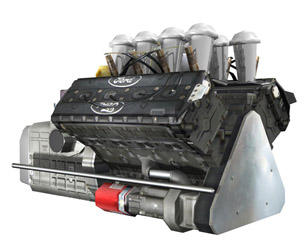
SMS have been releasing increasingly beautiful and detailed renders and shots of their content for pCARS. A quick look at their Lotus 49 shots shows a meticulous attention to detail (and an eye-watering poly’ count to boot), but ultimately it’s a purely aesthetic feature. Look back at the RL updates- particularly the one detailing the work that had continued on the modelling of the Ford DFV unit that is found bolted to the back of the 49 tub- and you discover that this wasn’t just an empty shell, a textured black box with unknown inner workings. When Tony said he had been working on modelling the DFV, he meant modelling practically every single piece of it. All internals were modelled and textured, and linked in a physical system where by each individual piece would wear with use and abuse. The engine could then be dismantled in the aforementioned garage for wannabe mechanics and engineers to inspect the parts and check for fatigue.

Glorious. Every gear, valve, piston and moving internal component is modelled.

Glorious. Ignore the relatively low poly count by today’s standards; every cog, valve, piston and moving internal component is modelled.

If all of this sounds like your worst nightmare, and all you want to do is drive, then it was all planned to be optional. But it was the kind of option I would have loved. The detail and passion displayed and conveyed by the West brothers was infectious, and you could sense many felt a similar level of affinity with the drive for the ultimate that they were pursuing. The simple inclusion of a working odometer in Shift made a car feel so much more personal to me. When today you look at the various sims we regard as being at the pinnacle, and in one or more they don’t properly model transmissions or brake temperatures and wear, allow you to stall or flat spot your tyres, you begin to realise just how much room remains for improvement, and how ambitious and ground breaking RL could have been across the board.

So, as with WSC, the question has to be asked: what happened? Whilst many, like myself, were hugely excited and positive about RL and everything the Wests were trying to achieve, there was a strange air of hostility that was always simmering away, often in the background, but every now and then it came to the fore. It’s a bit difficult to explain now as I never really understood it at the time. Certainly on the WR forums it was a few vocal individuals (some of whom were quite well known in the community for somewhat less than exemplary conduct) who, with every update, aimed derision and animosity towards RL and the Wests themselves. A few rifts brewed away on the forums, often between just a few members, but it regularly permeated further and tainted the mood and the forums as a whole. Some seemed angry at the Wests for posting news. There were accusations of hype building and thunder-stealing from other sims that were actually available or imminent.

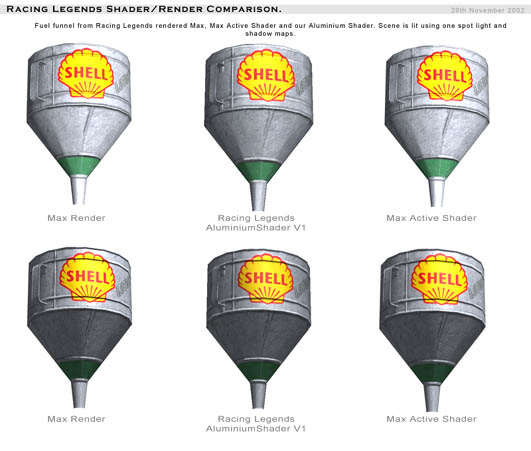
Shader tests on fuel funnels. Such attention today would be the exception; back the it was borderline bonkers.

Shader tests on fuel funnels. Such attention today would be the exception; back then it was borderline bonkers.

But this was how things had been since the beginning. What went wrong from where things were? Initially, it’s quite simple: the updates slowed and the feed of info dried up, and people grew impatient. Some, as is always the case, grew impatient if it had literally been a day over a month since the last update. Others demonstrated more patience, but by the time five months or so had passed since the last update, restlessness reached a peak. Some offered reasonable arguments as to why it would be in the Wests’ interests to improve their communication with the community. Others spouted vitriol and personal insults. The forums I had spent so much time on (I hold the perhaps dubious honour of top poster over on the WR forums), where I had met and chatted with so many people, some of whom I am in contact with to this day (I first met Mr. Denton and Mr. Simmerman over there), fell apart. Many people just drifted away, others decided to vent their anger and frustrations in less than diplomatic ways, whilst some of us tried to keep things calm in the face of growing unrest. But it became increasingly futile, and even the most ardent of followers slowly saw their resolve fade.

In hindsight, it was all a bit of a shambles. Chris and Tony (joined by physics guru Dr Gregor Vebles) were a small team working on a highly ambitious project. They had invested a lot of time, money, and energy into RL, going so far as to sell their house and cars. They really did put everything on the line to pursue the dream that WSC sadly hadn’t turned in to. As with probably every software release in history, but especially in this case, no one had more reason to want to see the product ship and be successful than the devs themselves (sounds an obvious thing to say, but you see the comments some people make and you have to wonder sometimes …). They were also perhaps somewhat naïve. The website and forums broke cover prematurely and unplanned. To their credit- though ultimately probably to their own detriment- instead of just shutting it all down, they let it remain up and running. The problem was that as soon as a community had formed, it demanded info, content and news for sustenance to survive and maintain itself.

The RL forums were a place where people hung out and discussed much more beyond just RL itself (I guess we kind of had to!); it was here where I first learned of NetKar, for example, and we talked about all other sims, real racing, irreverent subjects … It really was a mini motorsport and sim forum and community, not just a RL forum. However, RL was the reason that everyone was there, and it wasn’t going to sustain itself without RL info. Whilst some of us said we were happy for there to be no/fewer updates as long as we just had a little heads up to say all was well and there would be news when they were ready to share something, we were met, instead, with resolute silence. At the same time, others were getting increasingly irate and angry. The forums descended from a largely peaceful, friendly arena for like-minded individuals to discuss all and sundry into an aggressive, hostile place. The irony was that, apart from the odd dicktard, this was borne almost exclusively from a desire and passion for RL. Ultimately though, it must have just made the forums an increasingly unwelcoming place, and the desire for Chris and Tony to enter the discussion, regardless of intentions, must have dwindled quickly.

The community, and its desperation in the clamour for news and info, effectively destroyed itself. The last official news from the Wests on RL is the now infamous `Sorry’ thread posted on the forums. Pinned at the top of the `General’ forum board, it has now had the best part of 20,000 views. In it, Chris posted a lengthy, thoughtful apology and explanation for why the info had dried up. It addressed some of the issues that were becoming prominent in the forum, and generally tried to calm things down a bit. It reiterated the unplanned beginning to the forum’s life, the decision to leave them open, and also the lose-lose situation reactions to updates had put them in.

For many, this was absolutely fine. They read, understood, and accepted what was being said, and there wasn’t really an issue any more. For others, it was too little too late. They had either already burnt their bridges and walked away, or seemed somewhat insulted by the post. Whilst Chris’ words went some way to diffusing the situation and dissipating some of the ill-feeling, it ultimately was the end of the story. Had it come earlier … I don’t know, and no one can say, if it would have made any difference. After that, nothing else was heard from WR on RL. Nothing official anyway. A couple of times I caught Chris on MSN and asked how things were; genuinely meaning that, and not just asking about RL. I always got a positive reply, and I always just assumed things were ticking away behind the scenes. Given everything that had happened up until that point, asking `So, are you still working on Racing Legends?’ seemed a little crass, and accordingly I declined to do so.

Just look at it. Even today it looks wonderful.

Just look at it. Even today it looks wonderful.

But these events were a long time ago now. It has been nearly ten years since the site went live, and the `Sorry’ thread, the last official word on RL, was posted over eight years ago! So is Racing Legends quite obviously dead and buried? Is anyone who still holds onto a hope that RL will one day see the light of day a deluded fool who needs to wake up and familiarise themselves with reality? Whilst there has been no official news on RL since January 2004, there have been the odd tidbits, tiny slivers of info to hold onto. Both Chris and Tony have worked on numerous projects in the years since all went quiet with RL. Tony’s modelling and art work has found its way into a number of other projects, and similarly Chris has been busy and seems to be making good progress and enjoying success these days on a set of Unity plugins. Whilst that confirms they are alive and kicking, it doesn’t clarify anything about RL’s development. But amongst this other stuff, there are a few hints that appear. The odd bit of art work that unmistakably has its origins in RL cropping up in YouTube videos, little hints that certain things might be destined for implication within a sim environment. The problem is, when you have so much passion and hope riding on something, it’s easy to join the dots and draw whatever picture you want.

The fact that the RL forums and website are still up in place and the odd glimpse of some RL related artwork do not provide a particularly convincing or compelling argument that development is on-going. It’s the desperate speculation of someone who would love for it to be true. But what about a reliable source repeatedly confirming, year after year, that it is still in development? Todd Wasson (physics genius, all-round sim community nice guy and fountain of knowledge) has repeatedly said, quite openly on forums, that RL is still being worked on. Not only is he trustworthy, but Todd is about as well placed as anyone to know seeing as his VRC/VRC-Pro project is one of those which the Wests have, between them, contributed towards, with Tony’s typically rich graphics work providing the visual content for VRC.

gold_leaf2

Presentation and modelling ability was never something the Wests ran short of.


Whatever is or isn’t happening with RL behind the scenes, many might ask: until it is released, does Racing Legends matter? To many, the answer is `no’. To me, even if RL never developed beyond whatever state it was in eight years ago, the answer is a very big `yes’. RL has had a massive impact on me. In many ways it has made and conversely destroyed sim racing for me. It stoked my passion for simming in a way which no other title has before or since. It made me see simming in a different light. For all the developments that have happened over the years, and for all the effort by the likes of iRacing to turn simming from a dark-bedroom hobby into a respected, serious pursuit, for me it was RL that really shifted my attitude. I was already highly passionate about simming and very much hooked, but RL changed my perceptions of sims from simply being realistic computer games to something much more. It provided me with the drive and desire to be totally submerged in the virtual world, to really allow the boundaries between the virtual and real worlds to be blurred.

The problem was it didn’t come! And nothing else since has lived up to the expectations that RL allowed me to set. When you look at the hyper realism, detail and immersion that WR were aiming for with RL, and then you look at today’s sims, there is a massive, massive disparity. In iRacing you can’t stall and there is no dirt build up on the screen?!? Today’s sims do a lot of things very well, but it’s sometimes hard to not find everything a little … disappointing. Of course there is a huge difference between any of the other titles mentioned above and RL: they exist, they are available, and for any faults they have, you can actually use them and enjoy the things they do well. The RL I am comparing them to is not a real, usable product; it is an idea, a fantasy.

It is worth stressing Chris and Tony never made claims like `RL will blow everything out of the water’, they never blew their own trumpets. Similarly, they never slagged off or dismissed other titles; quite the opposite, a number of times I saw them speak very favourably of others’ work, and even put links to other projects on the main page. They were also modest, and seemingly quite uncomfortable at times with the stature they seemed to hold among a good chunk of their followers. They were just two guys with a lot of passion who aimed big and risked a lot to pursue their dream. Whilst they are undoubtedly highly talented individuals (Tony’s work speaks for itself, and a number of others have attested to Chris’s abilities), I think it was this uncompromising approach to their work that really snagged others and myself on the idea, the philosophy of RL.

Whilst some aimed animosity at them tied to the accusation they were simply hyping themselves and their work with little to back it up, I really think this is wide of the mark. It wasn’t they who provided the hype. They simply explained what they were working on and planning, and what they were hoping to achieve. The hype was provided by the community. People saw something special in WSC, and even more so in RL. It was a new and fresh approach. It oozed passion, love, and attention to detail. Just like each of those individually numbered cars and their leather bound packs, Racing Legends had soul.

It is arguably a stupid and pointless exercise to compare a piece of software that potentially doesn’t even exist with others that do, but it is an exercise I simply can’t help but indulge in. Every time a new title is announced, or whenever there is a `feature request’ or a `describe your dream sim’ discussion, the simple fact is that it is always RL that comes to mind. This is fruitless for many reasons. Ultimately I’m comparing real, tangible, usable products to an idea of perfection that RL itself, let alone any other sim, could probably never live up to. I’m quite aware of this. It just always was, and continues to be, hard to shake the feeling that if anyone or anything were going to get close, it was West Racing and Racing Legends.

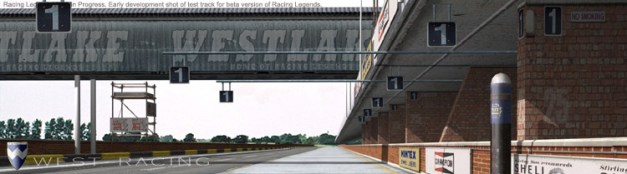
I literally dreamed about driving around the West Lake circuit.

I literally dreamed about driving around the West Lake circuit.

So there you have it: a self-indulgent trip down memory lane. Seeing the community once again whip itself up into frenzy as patience began to wear over the rF2 beta release reminded me of the journey that was Racing Legends and the West Racing forums. And quite a journey it’s been. To those unfamiliar with Racing Legends and its story, get yourself on Google, dig out the site and have a little look around. I don’t know whether new eyes will be pleasantly surprised or underwhelmed, but either way it’s worth a ten minute look. And to those who get their knickers in a twist because it has been three minutes since a dev’ last personally responded to your Tweet, or you’ve had to wait half an hour to get a download link: get a grip. You don’t know how good you’ve got it and, believe me, if the tides turn and the updates and interaction dry up, you’ll soon realise what you’ve lost.

So call me deluded and out of touch, but still I hold on to hope. Racing Legends remains my dream sim because, for me, it is just that: a dream.

In short: I wait it!

The dream lives on. It might just be a dream, but what a glorious dream it was and still is.

The dream lives on. What a fabulous dream it was and still is.

Assetto Corsa – Exclusive first drive.

Posted by shrapnel1977 on March 17, 2012
Posted in: Kunos Simulazioni.

Kunos Simulazioni have grown up in the public eye; starting with their first sim, ‘namie’ (freely available), they went on to code the highly respected and deeply flawed masterpiece that was netKar Pro (their first commercial sim), before maturing with the official Ferrari F1 Sim (Ferrari Virtual Academy). Now they’re back with their second commercial product, Assetto Corsa. Will they deliver on their talent this time?

Jon Denton was invited to take a sneak peak at development …

Kunos

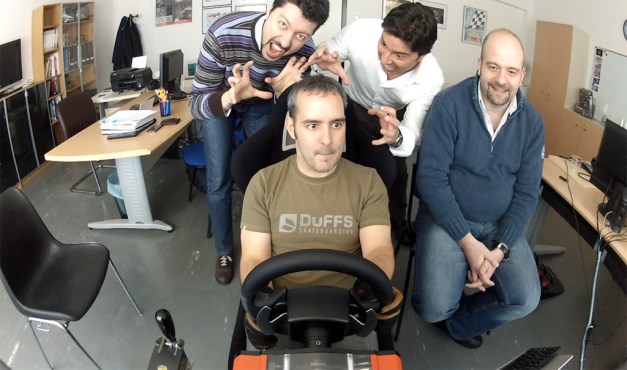
Jon Denton, centre, keeps his cool as he realizes the invitation to test this year’s most anticipated sim may have been a ruse (Aris Vasilakos, on the left, Marco Massaruto, and, looking calm, Stefano Casillo)

Campagnano di Roma is a peaceful Roman town in the Latium region of Italy. Dating back over a thousand years, it’s sleepy, confined streets reflect a calm solitude that must echo the distant, catastrophic wars of antiquity when the race fans roll into town. For this town is but a few short miles from the Autodromo Vallelunga Piero Taruffi, the sand oval track built back in the 50s and now, homologated by the FIA and expanded, scene of many an F1-test and where, this sunny spring time morning, I find myself ensconced in the offices of Kunos Simulazioni for a test-drive of my very own.

Kunos Simulazioni (Kunos) have been around the sim-racing world for quite a while now, and regular readers of AutoSimSport will need no introduction. Most famous for netKar Pro (nKPro)—regarded by many as the finest commercial simulator currently available (if by that one refers to driving feel and accuracy of the tyre model)—that was developed on a shoestring and a diet of boiled rice back in 2005, Kunos’ involvement with sim-racing can be traced further back than that—all the way back to the turn of the century and the original, free netKar (namie) which Kunos founder Stefano Casillo had developed out of his shed (metaphorically speaking) and on top of which sat the core of nKPro.

netKarPro was not well received on its release back in 2006, primarily due to problems with netcode, but not helped by a community that, at the time, felt that the moon on a stick should just be the beginning of what they deserved from a racing sim. Kunos was, and still is, a small team (but not, I add, just one man), and the reaction at the time came as quite a shock. Now, moving on to their new sim Assetto Corsa, meaning essentially ‘race setup’, they are moving forward with their eyes open much wider, buoyed no doubt by their professional advancement that has seen them swap the cold windy flats of Trieste for the more gentle climes of Southern Italy and now far more aware of what sim-racers might want from a title.

The first drive

Having A Chat

‘When I was making netKarPro, I used to look around on forums and I would see people talking so much about this or that feature, but the reality was different,” Stefano tells me in his clean, Italian-modern office. ‘We put in things such as the “full mode” where drivers would have to wait for repairs, or the pitboard being the only information for a driver in a race. These things were nice, but when it came down to it, maybe only twenty percent of players would use them.’

Does this hint at a lower focus on ‘hard core’ simulation elements in AC?

‘No, I don’t think so,’ Stefano says, ‘we are building the physics and graphics engines from the ground-up from scratch, and we are aiming for as much realism as possible in tyre behaviour and fundamental vehicle dynamics. Using an evolution of the existing netKarPro engine would have involved too much fudging, a ground up rebuild also helps us take more advantage of new technology, both in software and hardware.’

Aristotelis Vasilakos (Aris) joined the Kunos team last year to assist on working with the physics of AC, (you may know him from his work on the P&G mod for GTR2), and he felt this an opportune time to air his thoughts. ‘The first thing, for us, when we started to work, is that we need a physics engine that is workable across as many platforms as possible, and I mean car platforms. In netKarPro, the base physics were focussed on single-seater race cars, which pull high G-ratings and are very light, often using slick tyres with stiff sidewall construction. This meant that, when we started to introduce heavier cars that had more bodywork and overall inertia, we could not make them feel as good to drive as the original, single-seater cars.’

This was something Aris and I discussed in last issue’s piece on Ferrari Virtual Academy 2011 Adrenaline Pack, where the newly introduced Ferrari 458 Trofeo Cup car did not feel like a solid, planted GT car, but a little more spongy, like a road car.

‘Yes, as I said to you at the time,’ confirms Aris, ‘it was a balancing act to set that car up, {and} this is just the sort of thing we want to avoid. AC is an open platform for modders,’ he reveals, ‘and we hope, over time, to see a wide variety of cars being created in the community, but also, we plan to release a variety of different machinery in the core release. Every sim-racer has a different opinion on what is the finest race car or road car to drive—not everyone wants to race F1 cars or Formula Fords—so we want to offer a selection on initial release that will offer something to everyone’s tastes.’

AC WIP 1

Already then we can see a wholesale departure from the naivety of nKPro. So how, I ask, have they got around this limitation, what is the starting point?

The first thing we wanted to get right is a simple car,’ explains Aris, ‘a road-going, front wheel drive hatchback that can generate about 1-G in cornering forces on road tyres. If we started at this point, it should be relatively straightforward to move up the scale to cars with more power and grip.’ Aris turns with a grin to Stefano, who chirps up, “So we used my car! The Fiat 500 Abarth.’

At 165BHP and 1,035KG, the 500, or cinquecento, will represent a vehicle quite close to what many of us may have sampled on the road. In my experience, this is often where many sims fall down. There are sims on the market that can do a great job with lower speed road cars, but their physics model stumbles when presented with beastly race cars on slicks and with tons of aero grip. At the same time, other sims do the race cars well and come to pieces with softer sprung, road cars equipped with tyres more suited to comfort than speed. Arguably, from the sim-racer’s perspective, both are race-able, and both require very different driving styles.

‘Going back to what we were saying earlier, about the hardcore sim part,’ Stefano says watching me sip my fourth espresso of the morning (it was a 6AM flight out of London that had brought me here!), ‘what I came to realise with netKarPro is that there is a group of people in the community who want things as hardcore and realistic as they can get. They want to replicate what it is like to race cars in real life; but there are many who want a more open and free experience. Many don’t want to be penalised for a white line infringement, or made to wait patiently for a rear wing adjustment, and even among those who do, not all of them have the time to indulge in it. When you have to spend hours making a setup for a race, and practicing a track to have it perfect, sometimes sim-racing becomes a bit like work.’ A sentiment to which I can only agree, having spent enough hours on setup pages myself. ‘I am not saying that this is not something some people enjoy, but there should be a choice, and there is no reason not to make a sim with a hardcore physics model, but with gameplay elements that don’t force the driver into being an engineer, or having to take the whole thing so seriously; this is our hobby, our passion, it should be fun!’

Experience talking, and I can’t say I disagree; I remember talking to Stefano about such things in 2005, and thinking that making a sim as close to real life as possible was exactly what I wanted, but I can say that in my netKarPro ‘career’, I have raced using ‘full mode’ precisely twice. Both times I had to work on setups for hours and hours outside of full mode, and practice the circuit in question for hours to ensure I would not crash in the race. It was a challenge, but was it fun? The key, for me, is a sim with balance, where I can give myself that challenge if I so choose it, but if I want a more casual experience then it should be there as an option.

AC WIP 4

It’s generally regarded in the community that the best realisations of race tracks in modern sim-racing are the laser scanned efforts by iRacing, and Kunos have embraced this technology for AC. Marco Massarutto, production director for Kunos, feels that, for AC to compete in the marketplace, they need to invest in this area. ‘Really, aside from the driving feel and physics, the areas we want to improve over previous titles are the racing environments. We are working with an all-new DX11-based graphics engine, and so we really want to do justice to the circuits we have in AC.’

Those circuits that have been confirmed currently include Magione, Monza, Imola, and the slightly less Italian Silverstone. ‘We had to go with laser scanning, the bar for circuit quality was pushed forward when this technology was introduced, and we are very happy with the results so far,’ Marco tells me.

Big name licences such as Silverstone and Monza surely don’t come easily, and I ask him about the challenges involved.

‘Silverstone and Monza were great to work with, but you call up some circuits, and there can be someone on the end of the line who really has no idea what you are talking about, these people are motorsports people, they don’t know anything about video games. We’ve had people thinking we want to put on a race at their circuit, people thinking I want to paint pictures of their circuit, and on one occasion I had the phone slammed down on me!’

Some absolutely stunning WIP pictures have been posted around on the AC Facebook page, and the standard of graphical artistry being put into these tracks belies a deep passion for the pursuit.

‘We are very proud of some of the circuits we have, going to Monza for the laser scan was a special time for all of us, it is a cathedral to motor racing’s history, and while it may sometimes seem like a boring circuit, especially in a Fiat 500, when you are inside the circuit there is such a feeling of history and passion for the sport.’ Nuvolari, Caracciola, Rosemeyer, Ascari, Fangio, Moss, Hill, Clark, Surtees, Stewart, Fittipaldi, Andretti, Lauda, Piquet, Prost, Senna, Schumacher, Alonso, Vettel—since 1922, this place has crowned kings. ‘We really want to do it justice—if we can put just a piece of that special feeling into our simulator, then I will die a happy man.’

The Italian feel of the circuits on offer may not be a big surprise given that Kunos is a largely Italian concern, but the announcement of Silverstone hints that, as the development moves along, we may see more of an international feel to the sim. ‘I am working very hard on securing a good selection of circuits,’ confirms Marco. ‘It’s still early days, but it’s important for us to go to release with enough circuits to present drivers with a wide enough selection to keep them occupied.’

What about the flexibility of the racing environment? Can we expect a dynamic surface, wet weather, marble build up, maybe some leaves floating majestically in the breeze?

‘We’re not really committing to a massive feature set at this stage,’ Stefano replies, ‘we want to walk before we can run, {and} we are so early in the development process that the importance, for us, at this stage, is getting the basics right. It all depends on how things go with the implementation of the base, core simulator, and the solidity of components such as the physics, graphics and multiplayer components as well as AI that will determine what features we look at later in the development cycle.’

AI? So this won’t just be an online sim?

‘Not at all. I’m not sure I believe in going down only one route nowadays,’ Stefano muses. ‘People sometimes just want to have a bit of a drive around for fun against AI, where they can pause the game and setup things to their preference. The more serious online racer is not the only sim-racer out there, and we want AC to be enjoyed by as many people as possible.’

So, online serious simmer, offline casual simmer, what about the car nuts?

‘Well, we hope to have a good spread of cars in the initial release, hopefully something for everyone,’ Aris chirps, brightly. ‘We’re still working on many licences, but cars like the KTM X-Bow, Formula Abarth, Fiat 500, and Ferrari P4/5 Competizione already bring a good spread of differing machinery to the sim, and a vintage singleseater is something we’re working on too. The important thing, for us, is that they feel right, and so with the licences we have acquired, we have ensured full access to the machines in question, as well as all the data available on the setup and overall design of the cars.’

This bodes well for those seeking an authentic ride; unfettered access to the car in question is a must for accurate simulation, and Stefano confirms my thought when he says, ‘We don’t see ourselves making the sort of sim that comes out with three of four hundred cars, because with the size of team we have, and the attention to detail we want to give these vehicles, that could take years and years. Aris and I have recently spent an entire day just talking about and working on the vintage single-seater’s suspension. It was a good, productive day, but at the same time, we want to get the feel of these cars as good as we can get them, and for that we’re focussing on the details.’

There has been clear indication on the AC website that this sim will be open for modders to work on their own content for the sim—how much focus, I ask, eyeing another espresso, is being given to this area of the sim?

‘Because from the start we knew we wanted the sim to be moddable, we have built the software like a framework,’ explains Aris. ‘This means that we should be able to release some relatively simple tools that will let mod teams work on new content, or modifications to the sim or GUI. We want to make it so that modders don’t find it too hard to implement what they need. In the past, this was difficult as netKar was not built with any of this in mind. With AC, we want to introduce something that people can enjoy both as a racing sim and also as a launch pad for their creativity.’

It all sounds jolly grand, doesn’t it? The enthusiasm this small team have to create a simulator that is not just about racing, but also about driving, enamours me greatly. The, sheer, visceral joy of piloting a motor car is something they want to deliver to the home driver, and with their pedigree, you feel that they can do it.

Perhaps sensing that another espresso may have been a little too much, the lads from Kunos suggest I occupy my mind with something other than caffeine—do you, they inquire, want to have a go?

Having A Go

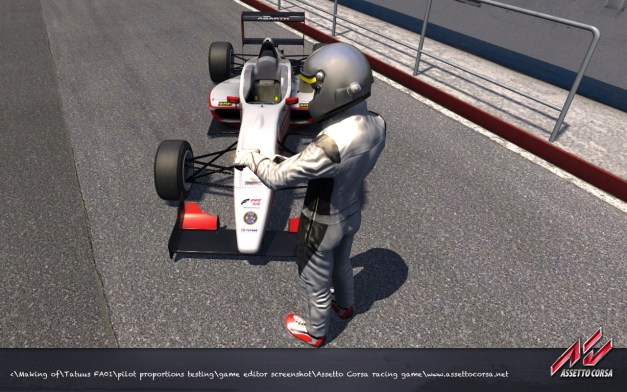
No sooner was it said than done, and I was thrown into their handy bucket seat and presented with a choice of cars and tracks. Now, being something of a veteran at trying sims for the first time with an audience, my focus was to pick up something with a manageable power-to-weight ratio and basic handling that I could easily relate to. Hmm, Fiat 500 Abarth, or Formula Abarth? After insulting anyone in the room that might own a Fiat 500, I promptly opted for the single-seater, at Imola.

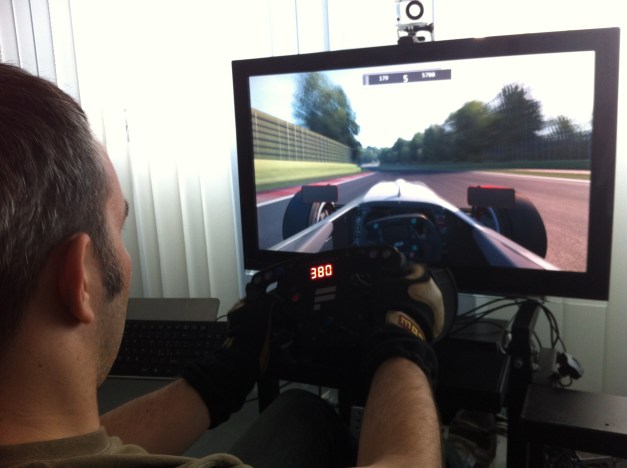
After a brief (rather impressively so) loading sequence, the car was dropped on the track, and immediately the rawness of this pre-alpha version of the sim was apparent. Modifications to the seat position and controller configuration had to be done via a ‘console’ within the sim, similar to that seen in first-person-shooters, and the car was positioned on the startline, rather than in a pit garage. Clutch modelling had not been implemented yet, so it was just me and two pedals. I clonked the sequential shifter into first, and set forth on my way, the first-ever test-drive of Assetto Corsa.

AC WIP 2

Gingerly arriving at Traguardo, the first thing to hit me was the solidity of the steering, the firmness of grip that feels so ‘connected’. There is no discernible controller lag and the force feedback presents the firm feel of a tyre contact patch reacting to the change of direction cleanly and decisively. This firm feedback gives me confidence, and I try to up the speed. Then, at Acque Minerali (named for a botanical park in nearby Bologna, and not Italian for mineral water as is commonly, and incorrectly, inferred), I fly into the gravel. My first experience with the Fanatec Clubsport pedals is granting me the first chance to try a load-cell brake pedal, and being used to a standard spring-based system (albeit a firm spring on my BRD Speed 7s at home), I was not hitting the pedal hard enough. Ok, something else to think about; ‘act like its real life’I tell myself as I scramble out of the gravel in front of my expectant crowd.

In these early stages, there is no damage turned on in the sim, which is a godsend as I take a few laps to get used to the feel of the load-cell brake pedal. When I start to arrive at corners at the right speed and push a little with the car, I find a trance-like feeling taking me over as I start to process the way this car works. The steering feedback is simply stunning; under hard braking, the car jiggles and squirms in a very natural way, but not in such a way as to be unpredictable. The planted feel of the car keeps surprising me as I come to expect ‘sim-like’ motions or snap oversteer on braking or heavy throttle. The car behaves, full stop. It is a racing car and should not be sliding and flying about the place, and this is what happens. The Formula Abarth has more downforce than it does power, and this shows. Admittedly, the early setup is understeery, not unlike what you might expect on a real car, and this means in the faster turns the back end stays well planted on heavier throttle and can be driven hard without necessarily kicking back. It takes me some laps to trust in this—many sims over the years have taught me to be wary of a sim-car’s behaviour, never quite trusting in the early laps what the back end might do. For AC, I had to train myself out of this behaviour, until you really start pushing; it is not tricky to keep the car on the track.

The feel of the contact patch on the front tyres, directly through the steering, became my opiate as I built up more and more speed with this little gem of a single-seater. Feeling the front tyre slip through my hands becoming more and more natural, I could easily initiate understeer by breaking the traction with a heavy steering input, then bring it back by releasing lock on the wheel, no hunting for grip, it could be felt directly through the wheel-rim, making small corrections to trajectory feel intuitive. In fact, they are so intuitive they are barely ‘felt’ at all, they just happen!

What this gives the driver is a remarkable feel for the car on entry, the weighting of the front tyres under brakes, the yaw on turn in, and deftness on controlling longitudinal weight transfer. Understeering towards the apex at Tosa or lasering into Piratella at high speed, with each passing lap this sim feels more and more glorious.

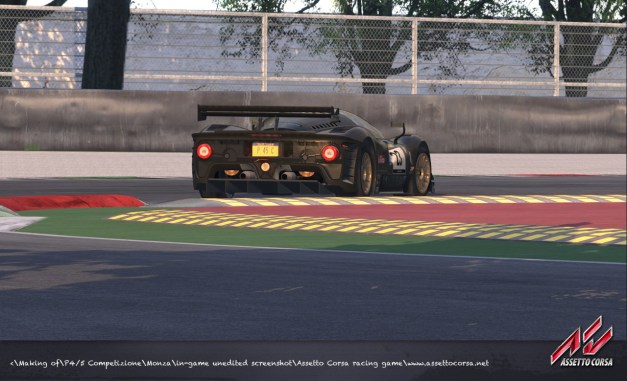
As Marco proceeds to post a few pictures to Facebook of my ‘concentrating face’, I decide to try something else. Slipping neatly into the P4/5 Competizione, a race-prepared and heavily modified Ferrari 430 in GT3 spec, and much heavier than the Abarth, I do so anticipating that it will feel quite different from the driver’s seat.

The same, clean, decisive feedback could be felt instantly in the P4/5, but the weight of the car meant a tidier hand needed to be applied on entries, and care taken not to overwhelm the chassis. Again, the load cell caused me problems, the extra weight of the car needing and even harder stamp on the pedal, especially as I took the car to Monza, where there are some seriously big stops. Starting to push in the P4/5, there was a clear feeling of much more weight in the car, and with it the added respect you have to give the controls. Smoothness was rewarded, and driving it like a Formula Abarth in the early laps mainly led to me having big slides on entry through being too aggressive with the steering. As I began to settle down and let the car have its head, rather than wrestle it, that trance started to come back, and the feel from the car began to become more and more intuitive. Provided I could get it stopped in time! The chassis would soak up kerbs with minimal fuss and started to feel like a very nice drive, if far more serene than the Formula Abarth. Pushing more and more made the car bite back, and sometimes quite hard. But a smooth hand on the steering wheel ensured no big surprises, and as the laps ticked away, I started to get a great feel for the slip of the front and rear tyres, diving deep on brakes into Parabolica, then hard on the throttle, no surprises, and gently drifting to the outside edge of the circuit for a full speed drag to the Variante del Rettifilo.

It was time for the big one—the vintage single seater. AKA the legendary Lotus 49.

The Lotus 49 seems to be making a major comeback in sim-racing recently (iRacing, rFactor2, and pCARS). Boasting 410BHP and weighing in at 600KG, I actually sense a mild trepidation when selecting this car; whilst everything so far has felt natural enough to drive for me, they all bear relation to cars I have driven in real life. This is a step beyond.

I take it to Monza figuring there are less corners to kill myself on.

Initially it feels … fine. Very stable, connected to the road and manageable. A reasonable foot on the throttle keeps the back-end in check, and once the speed loads up, you can be fairly heavy with the throttle and not expect wild, lurid slides. This is more like it. And the sound, woah, it sounds tremendous, the induction note on throttle so throaty and full of beef, while the off throttle wheeze makes me grin uncontrollably. I turn to Aris: ‘This is great!’

Again, the car is setup for understeer, and you can feel it through Curva Grande as the fronts scrub. But instead of ploughing off the circuit, the tyre model responds more deftly. Break of peak grip does not mean no grip, and so when the fronts break traction, they drag at the nose and skip over the track, slowing the car all the time. Let off a little and let the front grip come back in, and she responds, the steering comes back, and once again that glorious force feedback let’s me feel the grip available as I start to push on with this fine motor car. Maintaining a healthy fear on the throttle on exits, I keep hearing Aris in my ear saying, ‘give it more throttle, go on.’ But with limited laps, whilst I started to get a feel for the way this car can be driven on the throttle, it will take many more for my confidence to build to really get to grips with the vehicle. Aris duly leaps into the seat and shows me how it is done, driving the car confidently on the throttle, braking deep and letting the car yaw mildly, then getting on the right-hand pedal and deftly controlling the oversteer.

The feeling I get from AC is that each car is a very, very detailed model, and as such, one learns more and more about the machine with each passing lap. Cars like the Lotus 49 could bring surprises even after 2000KMs of running, the depth of the simulation is so remarkable that I get the feeling this could steal a lot of my time, even before any AI or online racing comes into it. Curiously, though, this is not through having to learn to drive the sim. The cars feel stable and usable easily at lower speeds, as they should. No one flies off the road in the pitlane in normal conditions, and most of us manage to drive a car from place to place on the road without having big slides or end-over-end crashes. But when you start to push in AC, the feedback from the car takes you in, and as you find yourself braking deeper and deeper into Rivazza, you gain a flush of endorphins as the car hooks into the apex. Getting it right and being quick is a challenge, but not an impossible one—the car is never unpredictable in its responses, it behaves itself, provided its driver does.

Most of my early ‘moments’ with AC saw me driving it as if it were a ‘sim’ and not like a ‘car’.  A curious response, but over years of sim-racing, we build pathways in our brain that tell us what a virtual car will do in given situations, and it hasn’t always been the same as a real car, even in the best sims on the market. AC requires you to train your brain out of this, and look at your own performance as a driver to analyse what could be causing the car to behave certain ways. As I found more and more pace in the Formula Abarth, after lunch and espresso, I started to recognise problems with my driving that were causing me to lose speed, and they were the same problems that affect my real life performance. My style translated across and, well, rather annoyingly, I developed the same habits that cause me to not always find the sharp end in real life racing. My tidy, smooth inputs in high speed stuff reflected in a glorious feeling through Piratella. But my tendency to overwhelm front grip and take more than one ‘bite’ at a corner in the slower stuff blighted me through Acque Minerali. I had to sit back and tell myself those fateful words that Alonso said to Massa at the Nürburgring in 2007: ‘You need to learn!’

Stepping out into the Mediterranean sun for lunch, I began to enthuse gently (whilst keeping my cool, you understand!) with Aris, but the information was still setting it, slowly, about this sim and what I had just tried out. Things were coming to me as I ate my Pappardelle at the Ristorante da Righetto (con ragu di cinghiale o di lepre, and yes, it was delightful, and yes, it was the boar not the hare), things kept coming to me as we drove back to the airport, and the damn thing was still stuck in my head when I was finally walking back through the door at 23.30 that evening.

Assetto Corsa, at this early stage, feels superb to drive, and the team admit that this was their first mission. The potential in, what is, a very early alpha of the software, is remarkable, and truly reflects to me the next generation of racing simulators that will come our way. There is a long way to go, and potential for this sim to get even better. As it stands, the laser scanned tracks in full DX11 glory look stunning, and run smoothly on hardware that is far from top-end. The driving experience, for me, represents the beginnings of a sim that could go on to great things. For now, we must all sit back and wait, and watch those tantilising shots appear on the AC facebook page as the weeks tick by. For me, it will be even more difficult as I contemplate that hot Italian summer and the warm Autumn until finally I will be able to embrace it again …

AC WIP 3


Remember when your sims came in a box?

Posted by shrapnel1977 on January 4, 2012
Posted in: General Simming. 8 Comments

Some of them still do, I know, but who can remember those huge, chunky cardboard boxes with a sleeve and a manual that weighed as much as a housebrick?  Where did it all go?

Ever since the late 1990’s there seems to have been a big focus in the simracing community for racing online.  It’s a natural thing, in the days of VROC racing with other humans in online races was a relatively new and exciting thing, and, for many of us, after racing AI robots for years this seemed the natural progression for the genre.  The result being that sim developers started to push more and more weight behind their online components, abandoning the way sims of old had been made for ten years or more.

The template laid down by Crammond in 1992’s F1GP was what defined racing sims for a decade after it. An immersive experience, where one racing series (In the case of Crammond’s game, Formula One) was reproduced in great detail, that allowed the player to  race alongside the same drivers they saw on TV in a full season of racing, set around the parameters they desired.  Simracing masochists, like me, could disable all drivers aids and set race distance to 100%, practice sessions to full length, and live a race weekend in their own home, going wheel to wheel with Schumacher, Alesi and the gang.

Not long after, in 1993, Papyrus Design Group arrived with their follow up to 1988’s “Indianapolis 500“, “Indycar Racing” (ICR).  ICR upped the game for graphics presentation and driving physics, but gave us that same structure of an immersive game where we could play the role of an Indycar driver in the current season, going wheel to wheel with Andretti, Fittipaldi, Scott Goodyear (I seemed to find myself mostly racing virtual Scott), and the rest of the pack.  I remember at the time being so immersed in my little world that I would think all the way home from school about how I was going to prepare for the next practice session, where I hoped to qualify, and what I was going to try with my setup.  These games had atmosphere, they let you feel like you were really taking part in a campaign that kept you focussed for night after night, your own private racing series.  Papyrus then went on to release Indycar Racing 2 and the NASCAR Racing series, each largely evolutions of one another in terms of the driving experience and the eye candy, but all offering this same feeling of immersion that defined what racing simulators had become.  Then came Grand Prix Legends, and with it’s great AI, historic tracks and endearing ’60’s feel many who had no idea about historic F1 fell in love.  That atmosphere, that sense of fantasy, left many finding themselves evolving their enjoyably rare diversion into a passionate hobby.

Jump to 2012 and it’s all change. With sims like Live For Speed, rFactor, netKar Pro and iRacing the focus moved away to multiplayer racing, with AI becoming a background interest for developers and players, or, in some cases, not there at all.  The online simracing community was born and leagues were setup, governing bodies established, forums filled with tantrums and obscenely acronymed magazines written.  So did we all stop playing offline?

The consensus would say not.  A rudimentarily hobbled together series of statistics I was made party to revealed that for every racer regularly competing online there are ten or more racing offline, but why?  Isn’t racing online fun?  Of course it is, but it comes with far too many constraints for the average human.  Not only do you have to turn up at a certain time, but you may have to obey certain rules, race for longer than you can, and put aside hours of practice to build up speed and setups so that you don’t disgrace yourself.  You may find that you are simply not fast enough to compete at the top level and race consistently for tenth place, you may find that your five year old kid comes in to show you his Lego mid-race, you might find that someone turfs you into the wall at the first corner and all that build up was for nothing.  You might find the whole thing, as a leisure pursuit, just far too stressful!

So where are Papyrus Design Group now, with their glorious offline sims that oozed atmosphere and immersion, covering the racing series we all wanted to fantasise about racing in?  Well, as I am sure you know if you’re bothering to read this, but they have made iRacing, which is without doubt the best sim out there for online racing.  It’s official races, rule base, licence structure, iRating, social networking features and hosted sessions are organised through a web interface, they have myriad licensed cars and tracks to race and even a huge forum where people can complain about things.  David Kaemmer and the team have embraced the online sim revolution and thousands of players enjoy their sim day in, day out.

But what about all those offline simmers?  Should they not get to enjoy the work of a development team that defined the genre for so long?  I found myself wondering why not.

iRacing have some major series licences: NASCAR, IZOD Indycar, Grand Am, links to the V8 Supercar series, American Le Mans Series and some others, can these not be exploited a little?

Could you cope with a boxed Grand-Am sim?

Would it not be great for a boxed sim or two to be released, using the base software that iRacing already uses to provide, say, a Grand Am simuator?  Using the template of the sims that came before and bolting in the laser scanned cars and tracks seen in iRacing, letting us race against AI in an offline simultation of the Grand Am national series?  Perhaps even with a Daytona 24 hours add on allowing AI driver changes and day to night transitions?  Sounds too much?  How about laser scan a few street tracks and give us IndyCar Racing 3?  I’d pay full dollar for that one.

Players could choose the length of their race, the time that they race, choose whether they want to get a stop/go penalty, and pause the sim when some Lego is thrust into their face.

This not only would allow the offliners to get some fun out of iRacing’s superb content, but also may encourage them to sign up for a subscription to iRacing as a whole.  After two full seasons offline against AI, many drivers may have had time to build the setups and pace they need to feel comfortable racing online, so why not make the offline sim bolt into the iRacing online component, letting drivers use the cars they already own in the online sim.  Perhaps even tie up their offline gaming career to reflect against their online Safety Rating and iRating?

Could this work? I think it could, and with a few doorstep manuals we could be back to living the sim dream of the 1990’s with the bonus of being able to enjoy the online simracing dream of 2012.

rFactor 2 – First drive.

Posted by shrapnel1977 on December 18, 2011
Posted in: ISI Simulators.

In the distant future, when someone decides to step from their hover-car contemplating writing a book about sim-racing in the 21st Century, there will undoubtedly be a large chapter devoted to rFactor and its gMotor2 engine.

Back in 2005, the sim-racing market was sparse with three titles dominating the scene. Grand Prix Legends, even then almost a decade old, enjoyed a large following—particularly if you were into road-racing—while oval racers were a little better catered for with Papyrus’ seminal NASCAR 2003. And then there was the sim that made SimBin, GTR. Aside from that, there was only darkness, and it’s ironic to recall that the community was never closer than in those grim days when all could unite behind a single sim—the one that no-one had ever made. When Papyrus went belly-up, and Crammond was sucked off the earth by a UFO, the darkness seemed complete.

rf2-spa

Michigan-based ISI, back then, was but a blip on the sim-racing radar. Yes they had developed various F1-derived titles in the years before 2005, mostly for EA Sports, as well as the superb (and largely ignored) Sports Car GT, and yes, it was on their engine that GTR (both the mod and the game in the box) was bolted, but it would have taken a brave man to suggest ISI was about to challenge the Kaemmer/Crammond stranglehold on the sim-racing community.

And then ISI released rFactor.

Fast forward to 2011, and it’s remarkable what rFactor has become. Developed as an open framework that provided a playground for modders of all abilities to create content, rFactor maintains a healthy player base to this day along with a head-swimming library of mods delivering every race car and every race track any sim-racer could ever want (or dream of): Want to race 1979 F1 cars at a modern Thruxton? Caterhams around Monaco? Huge, lumbering UPS trucks around Melbourne GP circuit? You can do it all with rFactor. And that’s not to mention the engine that was developed for rFactor (gMotor2) that has powered a plethora of other sims in the intervening years, everything from ARCA to Game Stock Car: Indeed, ISI’s gMotor2 went on to become the ubiquitous sim engine, the Ford Cosworth of the sim-racing world.

The good times, though, were not to last. rFactor’s longevity (and ISI’s stroke of genius) was the engine’s open nature, and the craft that it brought to modders’ desktops. This, at first, unveiled an astonishing array of tracks and cars and series before, ever so gradually, the promise of utopia began sinking into a dystopia of mismatches, poorly rendered mods, a modding community who, by and large, refused to allow any oversight, and a tyre model that, though very accomplished on release, was soon overshadowed. But it was the lack of coherence in the structure of mod delivery that resulted in sim-racers’ precious racing time being taken up by finding the right version of this track or that car. Anyone who was around rFactor in 2009 will have experienced that sense of frustration as they hunted the net in search of the ‘right’ version of a track (for which there existed perhaps a dozen versions made by a dozen modders) only to install and discover that it had been updated, and the update was available on a site that had gone down three months earlier. This, along with the notably varied quality on display in the mods, resulted in a growing exhaustion with rFactor, and many abandoned it to opt for more ‘pick up and play’ sims where mismatches never occurred, and racing was simply and cleanly delivered.

It was around then that we first heard mention of rFactor2, and as luck would have it, and as I tend to write about this sort of thing, I’ve been given the chance to try out the beta to ISI’s latest and greatest, their first full-blown sim in half-a-decade and a beta that you will experience soon. So, let’s dispense with this grinding and dull introduction and get cracking with the answer—is ISI back in the game with rFactor2?

rF2 - FRenault2

Releasing a new sim these days is not the work of a moment; the marketplace is replete with a number of titles that do many things well. rFactor’s USP has always been its sandbox framework, and the design brief for rFactor 2 (rF2) is to continue on this tried-and-tested model by offering an open framework where the community can put-out whatever content they want. But ISI have learnt their lessons too; they know they cannot restrict development or babysit content (that was a battle they—and the more sober elements in the community—lost years ago) and, instead, have opted to embark on a modular design that you can see upon starting up the software where, before entering the sim, you are presented with a feature called ‘Mod Manager’. From here, you can manage which mods are installed via ‘packages’; mod files are now easily managed as one file that simply needs to be dropped into the package folder. This makes it far simpler to keep track of what is or is not installed, and means that you will no longer have the problem of the sim being broken by a mod since installation or uninstallation now takes place outside of the main core executable. Once into the sim, you can also manage mod installation and removal, as well as implement GUI customisations and modifications to in-sim aspects such as HUD elements. Whilst these elements could be modified in the original rFactor, within rF2 this kind of modification to the core sim is managed through a GUI interface, making this a wholly more user-friendly environment.

For this beta, I was given the chance to try out the three mods which will be the components that’ll ship with the core build: Formula Renault 3.5 (a medium-to-high-speed single-seater), a Renault Megane Trophy Cup car (which is a heavier, rear-wheel drive hatchback), and the mod we’ve all been waiting for, the ‘1960s World Class Racing’ pack which not only gives us some fine ‘60’s racing machinery, but also comes packed with two splendidly realised tracks from the era in Monaco and Spa-Francorchamps. This will form the backbone of the beta release.

Tim Wheatley duly sent me the Formula Renault mod first, ensuring I didn’t immediately drive the historic cars, which was either a wise move or a fiendish ploy since this gave me some time to try out the new tyre model that has been developed for rF2 on a recognisable car before doing what most of you will probably do first—fire up the Ford Cosworth powered 1960s single-seaters.

Getting strapped into the car feels similar to rFactor, and any seasoned player of ISI-based sims will immediately be familiar with their virtual surrounds. Controller setup, however, is much improved, and whilst I did some fiddling with steering lock and force feedback settings, it wasn’t long before I was content with the wheel’s feel in my hands.

Gone is any need for the RealFeel mod, replaced by some of the cleanest, most communicative force feedback I have experienced. Lacking the confusion of some sims, the road is translated into your hands in a wholly convincing manner. The slick tyres of the Formula Renault provide an interesting starting point into the physics of rF2; where a road tyre will feel lacking in precision and be forgiving on the limit, a typical slick tyre, particularly on such a high-downforce car, is all about precision and directional stability. Loading up the front tyres on their stiff sidewalls into a turn allows you to feel this, and they stick on gentler slip angles, allowing the car to laser its way to apexes with minimal fuss. Be too aggressive with the steering, and the fronts can easily be overloaded, building up too much heat and minimising the precision in future corners as the tyres build up a waxy sheen that needs to be cooled in the upcoming corners. Hang on… that sounds like something I would write about real slick tyres … It was then that I took a break and tried to work out why things felt a little off. The answer was the feel of this sim; the graphical style, the menus, the in-car menu-screen, all of it shouts ISI, and consequently my first response had been to drive it as if it were an rFactor-derived sim. Turns out that’s not a wise thing to do: Yes, the look of it is ISI, but under the hood is a whole new engine that demands a more realistic way of interaction.

Firing it up again, I began approaching the experience as one would driving an actual car rather than driving a sim, and instantly I was transported into that sweet, special spot that happens so rarely in sim-racing. The car feels so much more connected than before, direct and a part of your input; after a few fast laps, things began to switch to a more intuitive driving experience. Peering into the middle distance, my consciousness of the steering-wheel in front of me began to fade as the combination of tactile force feedback and a precise weapon of a motor car pushed me into a sim-racing trance. When was the last time that happened to me in a sim?

The slicks, however, I found not the most forgiving of tyres (only natural on such a stiff car). But we know, from experience, where the problems with modern sims arise, and the car, at low speed, never felt too out of control; on the limit, over-exuberance was punished with the odd spin here and there, but I didn’t feel any sort of disconnect between result and provocation. The Renault Megane Trophy car, whilst being just the sort of car I would never touch in a sim, felt surprisingly communicative, too. Its slick tyres feel just as connected as the single-seater, and fiercely loquacious in their responses as you start to push the car into corners, its rear-end getting light on brakes and yawing on keen entries but being picked up with a smooth throttle application. Heavier cars like this often fail to feel connected in sims, feeling softer and floatier than they should, but this car feels like a race car on its grippy tyres and stiff suspension.

I was naturally keen to let Tim know how much I had enjoyed the experience and how, really, I was ready for something new. Something a little more challenging …

rF2 - Monaco

Many of the ‘old school’ sim-racers grew up on GPL and have been seeking a replacement for that seminal sim ever since. Ultimately, though, GPL was about more than just the cars and tracks—it was the box, it was Steve Smith’s manual, it was the self-enclosed world that seeped history and oily overalls. But having said all of that, there is still the little matter of the cars, and for some, historics will be all that matters in rF2. For them, the package for the soon-to-be-released beta contains a smattering of generically named (licences are still in the process of being procured) F1, F2 and F3 cars from the mid-to-late 1960s. Once booted up, the first thing I did was to remember that I am a superb driver and GPL veteran and despite Tim’s warnings, I knew I’d have no problems leaping into the F1 cars and searing in some sizzling laptimes …

I should begin by saying that adapting to these cars will not offer the same kind of ‘this is fucking impossible’ reaction we all got from the initial moments with GPL. The tyres give-up very little grip, it’s true, but the delightful force feedback is still with us, and as a result, the spongy, cross-ply, treaded tyres can be felt through the wheel in much the same way as in other cars. This still leaves one forgetting quite how little grip and braking bite these cars had in comparison to their power output. Once one begins to brake early, though, and avoids using full-throttle even when it feels safe to do so, one can start stringing together the odd lap or two without spinning or drifting wide into some gravel. Unlike the days of GPL, the tyre modelling and feedback is so much more advanced, and that means catching small slides and sometimes even big ones is intuitive and grin-inducing. The tyres respond to your input and—provided you calm down and treat the controls with respect—it won’t be long before you find laptimes coming down and driving becoming a purely visceral experience. The trance comes back, and then the thing ran out of fuel.

The Formula Renault and Megane were tested at Mills Motorsports Park, a fictional track that shipped with rFactor and has been given a graphical overhaul for rF2; it’s a fine test track but it does lack for flow, with too many fiddly second gear corners. It was time for me to branch out; it was time to take to a track upon which these cars were destined to compete, and this meant one of the two historic tracks that will come with your beta. Monaco? Hmm, tight confines, no grip, 400BHP? Perhaps not. Despite feeling more comfortable with the car, I was still finding myself in the midst of some startling and unexpectedly lurid powerslides, and re-learning 1960s throttle-control would take a little longer, and probably needed a little more open space, than Monaco.

Spa, anyone?

Many will remember the full, eight-mile Spa-Francorchamps as quite a challenging and ultimately fast track with some not so challenging corners meshed-in with a few bits that literally scare the shit out of you. I remembered it as ‘the easy one in GPL’. Oh dear.

Thus follows the transcript of my first runs at Spa in the historic F1s:

—Denton sets off, lights up rear tyres in pitlane, and smashes into a parked VW Beetle.

—Denton is away and into fourth gear on the Kemmel Straight when the car snaps on power oversteer, tips two wheels onto the grass, and proceeds to fly up the inside bank and spin into the trees, ending its trajectory with no wheels and on fire.

—Denton exits Les Combes and understeers wildly on the fast chicane at Haut de la Cote, proceeding down a bank and dies.

—Denton indulges in a dramatic tankslapper on the exit of Malmedy, spins at around 150MPH into some catch fencing, and comes to a serene rest in a field next to a cow. The cow remains nonplussed.

—Denton plunges off the road at the Masta kink which results in an aerial accident of grandiose proportions until a concrete post abruptly halts the car’s progress.

—Denton almost completes an outlap but then pushes wide onto the grass at Blanchimont, coming to a rest in a mangled wreck with a horse laughing at him.

You get the idea. It was these numerous excursions, before achieving some semblance of competence, which allowed me to appreciate the sheer detail of the racing environment. One very notable thing about the way rF2 feels is that it is fast; the sensation of speed is considerable, the countryside tears past you at phenomenal velocity to the degree that your heart starts to race, made the more astonishing by the wheel that churns and spits wildly in your hands. But when your smouldering wreckage comes to rest in, say, the doorway of a hotel in Stavelot, you begin to realise quite how beautiful this rendition of Spa is. Motion blur is superb, and that, added to this rich environment, facilitates a feeling of speed that is rather adrenaline-inducing as you squirt about in squirreling slides and counter-locks. Another piece of the fabric of rFactor 2 is experienced when you pull your roaring DFV into the pit and kill the engine; swallowed in the sudden silence, you become aware of the atmospheric ambient sounds that accompany the splendour. Whilst I felt that Mills was cluttered and had a rather airport-approach-path feel about it, Spa feels alive, like a place where you, in your insane metal cigar-tube, are not alone. Like a sim-racing Skyrim!

Horses

Yes, they are laughing at you…


Meanwhile, back at Spa, more and more heavy and violent crashes made Denton note more and more movable objects; hay bales, fence railings, cows that wander about chewing on grass, and all of it makes for a believable environment in which you can gently sink into and explore both in simulated reality and in your imagination. There you are, in this rich textured environment, trying to handle a car that feels so very alive as it skips over bumpy Belgian roads through villages and barns, focussing two hundred metres ahead, trying to stay alive, and you’re thinking—this is brilliant …

This dynamism doesn’t just stop at the visual, either. As we all know and have been anticipating for some time, weather is a key ingredient to the rFactor2 universe, and it = functions to make the race circuit a living, breathing beast. Subtle changes to temperature, or the time of day shrouding parts of the track in shadow, bring gentle changes to grip. As a pilot, you negotiate the grip instinctively, and the final result, the lap time, is no longer defined by those staples of sim-racing speed—setup and talent. Simple testing reveals that a grey day at 16C makes for lap times considerably slower than sunny days at 26C. No doubt each track has a sweet spot, but these changes to the circuit mean setups need to change along with those grip levels as the balance can easily be upset, making the process of racing in rF2 a constant learning process as each practice session counts towards understanding car and track. Not only do you start to feel where the cambers and bumps make for the best lines, but you also start to sense how the track changes with the temperature, the wind direction, the time of day, and this is before it has even started to rain. One could easily dedicate hundreds of hours to running with just one track in various different conditions as the weather makes for alternating lines and speeds.

This, again, brings us an accuracy that steers us away from what we have learned in previous sims—that everything isn’t just about having a great setup to set that definitive lap time. The dynamic nature of the track means that the personal best lap time you set in one ‘sim day’ may never be repeated, as the conditions on the next ‘sim day’ may never tie-up with your setup, just as it doesn’t in real-life. One can hope that this helps to swing sim-racing away from its infatuation on ‘killer setups’ and world lap time rankings and becomes more about the driver adapting to conditions.

The more laps I completed in the F1 car, the more I began to feel at home in it, and the tyre model, allied to the superb force feedback, continued to astound me as I felt more and more a part of the car. I built in some understeer to the setup to make for a car that was a little less lively, and really started to push. Then I started to run laps at Monaco, playing with the throttle in first and second gear, and finding myself in glorious slides and drifts through the principality. Delving into the tunnel on a cool morning, so dark I couldn’t see the dashboard, I felt the yaw in the car as I powered through, and correcting instinctively to the oversteer, I felt the edge in the steering.

Two key areas have become something of a bête noire in most sims over recent years; the ‘low speed issue’, in which traditional Pacejka-based tyre models ran into trouble as speeds get lower, exhibiting curious loss of grip at very low speeds and, in some cases, lateral movement when stationary; and the other, more complicated issue that deals with what happens when the tyre loses grip and then regains it.

Anyone that has driven on-track or too fast on the road will have had this happen, and the common theme in racing sims for years now is that a tyre can feel as good as good can be up to the point that it breaks grip. What happens after that is a grey area, and the area in which all of the last generation of sims broke down. Many forum posts have been made stating things such as ‘it’s not right’, and ‘I spun out in a totally unrealistic way’, and this is usually on the basis that, as drivers, experienced or otherwise, the feeling of ‘losing’ a car at speed and ‘catching’ it is a largely intuitive and instinctual process. Whilst it is a truism that many an inexperienced driver will say similar things in real-life, the experienced racing driver will always seek answers to these questions, and those answers are usually out there in the telemetry.

In sims they aren’t, and so people often tend to blame the physics modelling for being at fault. More often than not, this is actually the case. What astounded me in what was admittedly a relatively limited running of rF2 is that at no point did I feel as if I lost control of the car for no reason; spins, understeer moments, scary Spa-based 150MPH tankslappers, all had a basis in the vehicle and tyres responding to my control input in a feasible fashion. That, for me, makes me want to keep driving rF2 until the virtual fuel runs out. ISI have claimed rFactor2 will be a big step forward. In terms of physics and tyre modelling, I believe that their claims are born out by this beta—a beta that will become reality for many of you in the next few days.

Grand Prix 4 revitalised.

Posted by bobsimmerman on December 11, 2011
Posted in: General Simming.

Damnit!  Off again, and this time there aren’t enough laps left to catch Massa. The weekend got off to such a great start, too: I secured pole … and then was promptly relegated to the back of the grid as the motor let go on the cool down lap. No problem, I thought, my 2006 McLaren has plenty of juice for the rest of the field with the backup lump, and, as I told the press, a good start was not as crucial as staying out of trouble: The rest would come courtesy of my faster car which would scythe its way through the field all the way to a glorious win.

That was the plan. Before the rain came.

The Nürburgring. I love this track. I am a god here. And no-one will get in the way of my destiny. Not this day. And that is exactly how it panned out—oh yes. I got a hell of a start and made my way from the back row to about fourteenth as we came out of T1. Within ten laps, I’d made my way into the points and after twenty I found myself third, running lap times about a second per lap quicker than the leader, Massa … but I was running out of time, and needed to get by a clearly vodka’d-up Räikkönen before I could attack Massa. His one-time seven second advantage was now down to just under three, and with ten laps to go at a second per lap faster, well, even I could do that math. This one was mine.

And then came the rain.

GP4 -1

At first it was nothing to worry about, just a smattering here and there, mere dots of water on the track and my visor. Soon, however, the surface became greasy, slippery, and with only a handful of laps to run, I didn’t dare dive in for intermediates. Besides, I was still making up ground on Massa, now less than a second ahead, like a fly in my vision, a fly I was about to swat.

I decided to wait for the NGK chicane before I made my move as I knew I could outbrake him there. A late-race pass was on the cards, and my fans would speak of this day in awed wonder for decades to come: Oh yes, victory was mine. I made my move, braking deep as I approached the chicane and quickly slid by … not only Massa, but the chicane, the track, the marshals, and about half the infield as well.

Damnit!

I got back in shape, but by now the track was soaked, there were only three laps to run, and Massa was gone. I did the best I could to keep the car on the extremely wet track, but on the last lap had another off at Dunlop. Fortunately my lead over fourth was such that I was able to make it back in the right direction for a third place finish. Not the victory I had hoped for, certainly not the one my enormous talent and vast good looks deserved, but then again, it wasn’t the last place finish I’d managed the last time I came face to face with rain. And anyway, as I told the press after the race, if God had intended for Yanks to race in the rain, he wouldn’t have invented NASCAR. So shut up.

This race took place two nights ago on my blazing i7 Vista rig, and it simulated the 2006 Formula One World Championship. Yes, you heard me right, 2006 F1 on the PC. How? Well, first, thanks to Crammond’s ageless Grand Prix 4, and second, thanks to the ‘F1 2006/2007 (beta)’ mod for Grand Prix 4 by the equally ageless and massively talented Tony, and the crew at GP4Italia. Regular readers of this magazine will by now know that Tony is a living legend in the GP4 modding scene, and gentlemen and ladies, he’s done it again: Not that it’s any secret, as the final version of the mod, released in 2007, has nearly 190,000 downloads at the time of this writing.

Yes, you heard right, 190,000. More than most of our sims have managed to garner since, well, GP4 itself probably!

 GP4 -4


Grand Prix 4

I have been out of the Grand Prix 4 loop for quite a while. With my lab work, writing duties, and work as a researcher on a full-length feature film of the documentary genre, I simply haven’t had the time: And then, of course, I’ve switched to a home built i7 rig sporting Vista, and I had some lingering doubts in the back of my mind as to how well Grand Prix 4 and Microsoft’s (not so) finest would play together.

When all was said and done, however, I had little to worry about. Not only did GP4 play perfectly, out of the box, but the installation, configuration, and final use of the mod was a walk in the park. Even my wheel setup worked exactly how it always has—for some reason I have always had good luck with wheels and GP4, no idea why, could it be something related to well designed code?

No need to go into an extensive and detailed multi-page GP4 install and mod guide; no, this time it is pretty darn easy. Hell, I bet even Alex could pull it off!

Go to this link and do everything it says; that’s pretty much what I did before I found myself at the helm of what I truly consider the best F1 experience I have ever encountered. And on a seven year old product to boot.

Tony, GP4Italia, the ZaZ tools guy, to call them geniuses is to fall short of an adequate description. These guys work miracles, and what they have done with the (at one time) controversial and difficult to use GP4 is magnificent. Even Vista coughs up! Watch the video, do what it says, and in no time at all you will have your way with not only the 2006 F1 season, but an extensively fleshed out beta of the 2007 season.

Installing the 2006 Track Pack rounds it all out with stunning representations of the, yes you guessed, 2006 season tracks.

A brief examination of the mod specifications reveals that an awful lot of work must have gone on here. GP4 is considered by those who know to be ‘difficult to mod’, but when you look at what is included in this mod, you’d think they just woke up one day and shoved content into the damned mod. And then you see the quality …

We should recall that it was Tony who ably assisted shutt1e on the initial phase of what many consider to be the best mod ever created for rFactor—the ‘F1 ’79’ mod—which began as a GP4 mod. Indeed, we’re in the presence of one of the world’s best modders here, my friends: And he’s keeping the faith with GP4.

The change in look and feel alone, when compared to the out-of-the-box version, makes this mod an instant must-have if for no other reason than just to see it: Just to see what a well-made mod should look like. Yes, we’re concerned with how the thing drives—no worries there as the reworked physics and performance specifications are top-notch and thoroughly fleshed out (if you are driving around in the Super Best Friends car, odds are you won’t win, but it will still be one hell of a good drive as it is, after all, a full blown Formula One car, albeit a bit down on a few bits’n’bobs)—but I just cannot for the life of me get over how it just … looks.

The track surfaces, meanwhile, in the track pack, are modeled with extraordinary precision; bumps, undulations, dips, elevation changes, and moisture on the track are all clearly felt through the wheel as you drive over them or lock the brakes on them. The car has a great feel to it (whatever that means these days!) and while I always found the original game just fine in the physics department, warts and all, the new physics developed for this mod are substantially improved in terms of ‘feel’, weight transfer, acceleration, and braking: Everything has received dollops of refinement, and what we now have is the definitive F1 simulator, period. I will say it again: F1 sims do not get better than this, no matter the platform. End of story.

One of the original sim’s strengths, of course, was the way in which it represented an actual Formula One weekend; that is, it created a believable atmosphere of the event that went a long way to suspending disbelief and making you forget you are in the basement, screen blazing in the darkness. Things like being able, in a practice session, to hit the director camera key, sit back, and watch an ever-changing broadcast type of display as the game switches from one car to the next, one camera angle to the next all on its own, with TV overlay graphics to boot, made the immersion of Crammond’s final sim something truly rewarding. Things like being able, during qualifying, to pop-up a data screen much like the drop-down screen on a real F1 car as your vantage point—the screen displays a multitude of items including watching drivers in real time, or checking the timing information before you make your own run—makes GP4 stand-out amongst today’s sims, at least when it comes to its ‘immersability’.

GP4 -3

I’d forgotten, to be honest, what immersion was all about until I fired up GP4 and this mod: Seriously, after five brief minutes, I found myself thinking how amazingly distant out current generation of sims have come from the days when developers actually cared about scene and place …

Like any great mod, the good points of the sim being modded are enhanced, and in the case of the atmospherics of an F1 event, the 2006 mod pushes the bar a few miles higher than the original: And that, you will gather, is like, dude, erm, higher than, like, the stratosphere!

The TV overlay graphics, for example, now closely resemble their real-life counterparts. In addition, the brilliant AI and best-in-class weather of the original remain as they were—just fine. Dirt and grime, meanwhile, cover the visor, and the cockpits all feature enhanced detail and picture-perfect steering wheels, all of them car-specific.

Of course, since the Car Set Manager (CSM) is being used, customization of the mod by the user is but a few clicks away. Sporting an integrated GPxPatch utility in the main UI of CSM, tons of things can be changed (such as those overlay graphics) by simply clicking a box and browsing to a different version. Sounds, physics, performance files, processor affinity, these are just a few of the settings that can be altered in seconds.  I must say, the CSM, no doubt mentioned in a previous issue somewhere, has taken a lot of the hassle of installing a GP4 mod out of the loop.

As an example of this, once you have the CSM installed, installing a mod involves nothing more than selecting the ‘install mod’ button, navigating to the CSM compatible file, and selecting it.  That’s pretty much it, no messing around with those pesky .WAD files. Once installed, the mod itself is easily configurable, offering  complete control of driver choice, track, type of race, difficulty level, texture resolution, track loading method, steering wheel type, mirrors on or off, visors, Lo2k’s Speedo and Rev Counter on or off, pit boards, LOD selection (select lower for better performance), type of rim, 2D or 3D, and two selections for GP4Tweaker—real-time editing, and head view movement. In addition, the customization that GPxPatch offers is, as it always has been, extensive, and it has been thoughtfully integrated into the CSM main interface.

That done, I was ready to roll away the hours as Crammond and Tony transported me into my fantasy-world where I was, for a few hours, a world-class Formula One driver chasing the title.

In reality, meanwhile, I was playing a hardcore modern day Formula One sim with great AI, great weather, and some of the best offline racing this side of Grand Prix Legends.

But all of this improvement does come at a price, and those with lower end PCs may need to reduce a few details here and there in order to maintain a Processor Occupancy value that is always below 100 percent, else odd things with timing may begin to crop up. Even with my relatively fast i7/HD4870 rig I was able to really slow things down to the point of nearly slow motion, but by turning off the heat haze and the video walls, things got real snappy again, and this is, with dynamic environment maps on with the frame rate counter set to forty, plenty for a silky smooth GP4 experience.  Of course, your mileage may vary, but given the ease of installation provided by the CSM, the odds of a great experience are much improved over the ‘good old days’.

If you have Grand Prix 4,  you owe it to yourself to give this mod a try and find out what nigh on 200,000 other fans have already discovered: just simply extraordinary.

Since we don’t yet know what a Codemasters license of Formula One means for the PC crowd—but God we can only imagine—Grand Prix 4, much like Grand Prix Legends, will no doubt remain the greatest achievement for an F1 sim on the PC for a long-long time to come. In fact, I doubt it will ever be beaten, unless Crammond makes a come-back, or John Henry buys the license for Dave Kaemmer.

Until then, though, we have Tony and friends. Thanks guys! This really is it!

GP4 -2

More info and support can be found at grandprixX.com and GP4Italia.org.

Volvo the Game – Review

Posted by Eliot on December 3, 2011
Posted in: Reviews, Simbin.

Eliot Earle on SimBin’s freely-available Volvo game: Now you, too, can be a tweed-wearing English Professor at a semi-respected minor college

Volvo-1

Introduction

Volvo have done what BMW did a year or so ago—released their very own free game featuring their latest and greatest, a shiny NEW concept car, and some old buckets that were not-quite laser-scanned from the nearest mall. SimBin made the actual game though—just like the BMW one (though, actually, that was the ‘other’ SimBin, but you know what I’m saying). So, as you can guess, it’s pretty much rFactor—I mean “GTLR2 Racing Newt”, or whatever it is they make these days.

To say the game is uninspiring would be to do an injustice to the lack of passion with which Volvo lovers around the world view their cars. The game is partly what you’d expect, and partly much, much less. But, one should also add that this is a perfect synthesis between form and content: One would be astonished to find glitz on a Volvo product, and SimBin—no doubt aware of this—have created the perfect game that instantly makes you feel what it is that Volvo owners around the world feel on a daily basis: Acute boredom.

Still, enough of my wanton opining for now—more of that later. What do you actually get for your $0? The website proudly boasts:

Two tracks: Gothenburg Eco Drive Arena in Göteborg, Sweden, and Chayaka, outside Kiev in the Ukraine (no, I’m being serious, actually). Some of the cars, meanwhile, include: the C30, S60, S40, 850, 240 Turbo, and the highlight of the game: the NEW S60 Concept Car in race and regular configurations.

The Middle Bit

And here’s my own list of the features in the game, as you won’t find on the website:

What it has: Some Volvos; two tracks I’ve never heard of; Time-Trial mode; Race Mode; Online Competition.

What it doesn’t have: Any kind of damage modelling or effect on handling; weather; hills; a sane interface.

Obviously, the NEW S60 Concept Car—which comes in standard and race flavours—is going to be the best of the lot. I mean, what would the point be if you released a marketing ploy like this if not to show off how fantastic the concept car is going to be when they get round to making it and sending it forth into the heady world of Touring Car racing?

Volvo, never a group to be bogged down by conventional wisdom, have decided to ensure that the concept version is less tuned than the S40, and is slower, whilst also handling oddly. A concept car allied to a brilliant concept: Brilliant all round then!

Volvo-3

Handling oddly, though, is something that rear-wheel drive old buckets do. The Force-Feedback seems to be trying to pull the wheel in two directions at once, making for a very strange and not entirely pleasant experience.

The proper S40 is a dream though. That’s more like what you’d expect from a racing game. It’s fast, it pumps you up, and makes you actually want to attack the track, or a friend in a similar car, with proper anger. In fact, I would go as far as to say that this was the car that they made the game for, and everything else was a bit of an afterthought. An afterthought almost certainly had in the pub after a few shandies (or whatever it is that Volvo owners drink) too many.

The S60 and C30 are basically the same car with slightly different gearing, as far as I could make out.

What really strikes me as odd, though, amidst this ocean of oddness, is that all the cars are front or rear wheel drive. Now, I don’t know if that’s a limitation imposed by the Touring Car Championships they run them in, but I would have expected an AWD model at least: I mean, when I think of Volvo, I think of cars built like tanks that drive off all four wheels at once … well that, and a street in North London where I once lived for a while.

Volvo-2

I must confess to having developed a bit of a liking for the Chayaka circuit. Perhaps it’s just the sound of it as it rolls off my lips— Chayaka—it’s like an ancient war-cry from a long-forgotten tribe of cannibal-pygmies, isn’t it? Chayaka! Even though it’s completely flat (as in nuclear-annihilation flat), Chayaka has some nice fast bits with some tricky corners. I’d very much like to see this track make an appearance in a proper race sim.

The lack of weather and damage, meanwhile, isn’t really all that surprising in a racing game. You’d expect more in a current, or next-generation racing sim, but that’s clearly not what this game is about, which is a pity, really, because it feels as if it’s almost so very nearly there when you’re sitting in the S40 and hurling it round the track. And you so want it to be. I feel that careful driving should be rewarded: someone who doesn’t crash every lap should have more of a car to race with at the end of the race.

The graphics and sounds are what you would expect: lovely. The game looks good, and the individual sounds of the cars—with the notable exception of the concept S60—are interestingly different and exceedingly well put together.

But the interface … oh lord, what were they thinking?

In the options screen, sliders don’t. You get an up and down button at each end, and a nice percentage number in the middle, but nothing to grab and drag when you’re not fine-tuning.

When you are heading off to your game play session of choice—in my case the time-trials for this game—you start off with telling it what you want to play, then where you want to play it, then what you want to play it in. Oh, and then who you want to pretend to be. Maybe I’m just used to the rFactor way of doing things, but it seems like a lot of menus you have to click through just to get where you want to go.

There are no car setup options either. You drive what you’re given. I’m not saying that’s a bad thing, but it’s definitely … a thing. I know there are some people out there who don’t like to have to bother with setting up their cars for every track they race at—Volvo owners, that is—and with only two to choose from, maybe it’s not important. But I also know that, as there are about as many different ways of getting a car around a track as there are sim-racers, some of us like to have that little bit of control over how the car handles to make up for our differences.

The amount of advertising in the game is about as heavy handed and constantly in your face as what you get in the cinema when you go and see your average young person’s Hollywood blockbuster. I know advertising is the entire point of the game, but really – having to click 5 buttons to get through it all just to leave the game from the main menu is excessive.

Volvo-4

Conclusion

If you’re the kind of person who skips through a review to the end just to read the conclusion, then I say this to you: this is the best racing simulation ever written, and you should go get it now and stop playing everything else.

Another Bit On The End

I honestly can’t imagine why Volvo paid SimBin to make this game. However, I am glad they did. The models are great, the S40 would be fine in a proper sim, the tracks are nicely done, and the sounds are splendid. It’s a nice enough game, and I’m sure there’re plenty of Volvo-loving kids out there who will derive a lot of enjoyment from it.

I can’t give it a score though, as I don’t think it’s worthy of being called a racing simulation.

Ferrari Virtual Academy Adrenaline Pack, the last stand of netKar Pro

Posted by shrapnel1977 on November 12, 2011
Posted in: Kunos Simulazioni.

FVA - Fiorano 458

The original Ferrari Virtual Academy (FVA) was a curious sim. Perhaps not really wanting to compete with the mainstream market, Ferrari opted to join forces with Kunos Simulazioni to create a special little nugget of racing-sim memorabilia that people almost definitely wouldn’t be playing for years to come. And so to prove me right, they decided to offer us with a seasonal update, the so-called Adrenaline Pack.

What FVA’s Adrenaline Pack gives us is a chance to drive this year’s Ferrari F1 car, the F150th, bolting onto the 2010 version of FVA which gave us the far more competitive F60. Both cars are meticulously realised, both in sim terms and graphical terms, and can be driven across three laser-scanned circuits (depending on which tracks you shelled out for): Fiorano, Mugello, and the Nürburgring GP. Laptimes, as before, will be uploaded to a central server at Ferrari.com for entry into a competition that will give the winners all manner of things and stuff. This package also includes a more ‘normal’ car in the form of the Ferrari 458 Trofeo Cup, which will appeal to many as a more drivable vehicle. Whether the contest is important to you or not, the important thing to note here is that this sim, whilst derived from the very capable physics engine used in netKarPro V1.3, is a hotlap sim. There is no racing, no wheel-to-wheel, just you, the cars, and the tracks.

For some people this will be an immediate switch off, as there is limited appeal to running around a track on your own, and if you are ‘most people’, and have been driving racing sims long enough, you will know you are not fast enough to set the fastest lap of anyone the world over. Yes, you. So why buy this sim? A good question. The marketing decision not to include an option to race any of the cars on the beautifully realised tracks in the package makes little sense to me, and what will limit long-term interest even more is that each comes with a fixed setup, so even the tinkerers amongst us will not be sated.

For me, this sim represents the peak of what the netKarPro engine is capable of. F1 cars present a unique problem for sim developers: they are exceptionally fast, with minimal suspension movement, and very high torsional stiffness and that all combines to produce a large focus onto the tyres. Thus, any car this fast and stiff will highlight any problems with the tyre model. The tyre model in netKarPro is widely regarded as one of, if not the best, tyre model available commercially. So, the chance to drive such a gem is a feast for the senses; not only is this the first time a high performance, GT-class supercar has been modelled in this engine, but also the differing F1 cars, from 2010 and 2011 respectively, are showcasing very different tyres (Bridgestone and Pirelli respectively).

FVA - F60 Fiorano

As many of you will know, the change from Bridgestone in 2010 to Pirelli in 2011 has been the talking point of the year in F1 circles, and FVA gives us the chance to feel that difference, with a sim that has been tested and approved by drivers such as Giancarlo Fisichella, Felipe Massa, and Fernando Alonso. So let’s go back a bit and rephrase what we said: Yes, this is just a hotlap sim. But it also happens to be a unique a chance to compare yourself against F1 drivers in one of the most accurate commercial simulators of this generation. So let’s get cracking.

First of all, I’d like to take the Ferrari 458 Trofeo Cup for a drive. This car, derived from the road-going version, is a stiffer, lighter race-bred GT car used in the European one-make ‘Ferrari Challenge’ series enjoyed by many a playboy. The car features a semi-automatic, seven-speed paddle-shift gearbox mated with a 4.5 litre V8 pushing out 562 horsepower.

Pulling onto the track, my first thought was how comfortable and easy to drive this car is for such weighty specifications. With traction control disabled, it is easy to get the tail wagging, but the torque curve, peaking at the top end of the rev’ range, means that a relatively gentle foot will see you right, and the deftness of the tyres’ slip curve allows supple manipulation on the limit. This starts to become a joy as laptimes start being ignored in favor of controlled four-wheel drifts; though overheating the rears can become an issue, the tyres seem to cool very quickly. This ‘feature’ of the sim is based on the hotlap nature, and there is no damage if you go off, and minimal tyre wear.

Nonetheless, the more I lapped in this car the more I liked it, and subsequently found myself running lap after lap until the fuel tank was dry.

As the laps drew on, it was interesting how the car developed for me. I jumped into the car at Mugello initially, and was instantly missing braking points, taking brakes too deep, and carrying too much speed into corners. This oddly let me learn quite a bit about the car as I started to get a much better feel for its front end. Too much speed into a turn would easily overload the fronts and foster an almost terminal understeer, but more precision, and getting the car slowed in time, allowed me to start slicing into apexes. This felt like the forward weight transfer was causing a heavy dive at the front, as may be seen in a softer road-going car, so the development of style to a more smooth entry yielded notable benefits in times.

FVA - 459 Trofeo - Mugello

This link to a road car feel reminded me of a drive I took in real life in a Ferrari 360 Modena a few years back; the suspension is compliant but usable, with the front tyres being easily overloaded by too much entry enthusiasm, the back-end getting wayward with a heavy right foot, but nothing resulting in anything too ‘uncatchable’. In the sim the tyres behave superbly as they break grip, and then the subsequent return to grip as the moment recovers feels precise and natural.

So after a few laps of understeering, I started to balance it properly on entry and not overload the fronts, getting smoother and smoother as I went, and before I knew it I was having the car moving around gently around me in a delightful way. The final corner at Mugello, indeed, started to become something of an adventure in controlled four wheel drifts. I can’t remember a sim where it felt so natural and easy to put a car into this condition and not fear that it would kamikaze into some insanely exaggerated oversteer moment; modulating the throttle and making sure the rears didn’t get too hot meant I could keep this up for lap-after-lap.

Under brakes, the 458 also feels absolutely superb. The way weight shifts on initial application, the way it feels as it squirms around, is well done, as it is in netkarPro V1.3, with the subtle touches of feedback through the steering wheel making for a clean and visceral experience. The only thing, and I will come back to it again, that took a while to adapt to in this car was judging turn-in grip levels, and how loaded the front tyres were, or whether indeed they were too overloaded and would not turn. This is something I find quite common in cars with power steering, as the steering does not weigh-up sufficiently to feel the amount of grip available. This is usually the hardest thing to judge in any car, as one usually finds out when one takes the first ‘bite’ at the wheel. However, the steering in this 458 does not give enough feedback for my liking, which may well be a complaint I would find in a real-world 458.

Upon investigation and discussion with the guys at KS, it seems that this ‘road car feel’ that the Ferrari 458 has in this sim is something of a limitation of the engine. With the 458 Trofeo Cup we have a car that can generate 1.6 of lateral g-forces, and yet the feel is one of a road car: It does not always feel well connected to the road, and at times feels a bit ‘floaty’.

Trying to balance the car between the setup and physics point of view was like lying in bed with a short blanket was how the KS team explained the process. You try to cover your head and your feet get uncovered, then you try to cover your feet and your chest gets uncovered. So when setting up the car, if you try to give it more front-end bite, you get too much oversteer, and vice versa. It’s hard to find a sweet spot because the tyres themselves are a little unstable.

This is not an issue on light single-seaters (the main cars that netKarPro evolved with as a sim), and you don’t feel it at all with the F1 cars in FVA. But as the weight and the inertia of the car rises, and the grip lowers, this issue surfaces, and the car can feel softer and less connected to the road than you would expect from a race car. This is not to say that the Ferrari 458 in FVA is not superb fun to drive, and would be a blast to race.

The KS team is all too aware of this limitation to the engine, and at present is moving forward with development of a completely new, ground-up rebuild of their physics engine to combat such problems. By focusing on the small details of the engine, one by one, and addressing them at the base, they are hoping for a far better feeling in future titles (and yes, some big ones are already being worked on). netKarPro, admittedly, had many problems, but the fundamental driving ‘feel’ remains its strong point. With their new project, KS are taking this aspect to a whole new level. By starting out making a light car with ‘road’ tyres that generate around 1 to 1.2 of lateral g-forces, and getting this right as a benchmark, is the first priority of KS moving forward. Once a low grip car, road car, feels connected, then anything else, moving up the scale of overall grip, becomes easier and will feel better.

On to the F1 cars, and time for a comparison. Anyone who drove last year’s FVA and the Ferrari F60 will have an idea how the car feels in this sim, and to my mind it remains the best example of a commercially available F1 simulator around. This physics engine feels made for this, and the nature of the experience in FVA closely approaches instinct as you push more and more in a car than can carry obscene amounts of speed through corner after corner. Catch a slide there, mount a kerb here, it feels like the link between you and the car is inseparable.

Where the two cars differ is in the tyres; the difference between the Bridgestones on the F60 and the Pirelli’s on the F150th makes for a surprisingly different driving experience.

The Bridgestones are precise, and favor a smooth style as the driver needs to gently load them up on entry, avoid carrying brakes too deep, and not overload the fronts as the turn-in phase becomes a tight-rope moment. As balance transfers to the rears on exit, it can similarly be easy to overload them and face a big drop off in grip as you power out of a turn. This all adds-up to lend the Bridgestone tyres toward a precise style, with clean, balanced turn-in and smooth throttle application.

The Pirellis, in stark contrast, feel overall lower in grip, and very ‘waxy’ on the limit as they respond better to being heavily loaded-up and considerably more forgiving when pushing outside the envelope. As a result, the driver can be much more aggressive with the Pirelli tyre, giving much firmer steering inputs as the tyre will take the ‘abuse’, though preferably via an earlier turn-in to allow for the lack of precision as the tyre loads up.

Getting speed out of the two differing tyres is achieved via distinctive ends, making for fascinating laps as you learn what works for the two tyres. Swapping between the two cars therefore becomes tricky quickly too as, whilst the vehicles themselves are not radically different, the rubber they are wearing certainly is. The F60 requires a far gentler touch on the wheel than does the F150th, for which the same gentle touch is simply not aggressive enough to make the tyres perform; with not enough load, the Pirelli lacks grip. Comparatively, to be this heavy-handed in loading-up the tyres on the Bridgestone-shod F60, results only in the tyres being too heavily loaded too quickly and dropping off severely in grip.

From this, we can start not only to understand but to experience what we have heard from many F1 drivers concerning their tyres in the last couple of years. And this, really, is the best way to assess FVA: One of the best sims on the market for sheer driving, but with a lack of content and game modes, it has limited appeal. Driving for some fun laps for a while in each of the cars can be a worthwhile diversion, but I cannot see myself booting FVA up too often in a year’s time just to do some fun laps. It’s a shame in many ways, because if there was a relatively simple online racing component to this sim, it would become a long-lasting cult classic that could continue to have DLC added for years to come. Still, a better F1 racing sim doesn’t exist commercially, and if you’re at all curious to experience these ultimate machines, and don’t have a few million to buy a seat, this is as good a place as any to try them out. As it stands, this will remain as a shining diamond that never quite reached its full potential.

FVA - Mugello

Stefano Casillo on netKar Pro (part 1)

Posted by shrapnel1977 on November 12, 2011
Posted in: Kunos Simulazioni.

Stefano Casillo:  Hey, Jon.  If we have to do that thing today it has to be before Napoli’s match in the Champions League…

Jon Denton: Sorry, forgot to get in touch, I’ve been crazy today!

Stefano Casillo: It’s okay, we can reschedule.

Jon Denton: No, no. No, let’s start— so if I am correct, the first public release of a driving sim you made was netKar namie V0.9.4, right?

Stefano Casillo: namie was 0.9.9. Before that there were eight releases … long story …

Jon Denton: Did they all go public? I think the first one I drove was 0.9.8, at Newbury, there was a Formula Renault, Mini, and the Toyota Supra GT.

Stefano Casillo: That’s right, yes.  They all went public, the netKar free stuff is all from 2002 to 2003—I started work on them a few days after 9/11.

Stefano - Monza 2011

Stefano Casillo takes the pilgrimage to Monza in 2011 for laser scanning.

Jon Denton: Then 2005 was when we started talking about netKar Pro.

Stefano Casillo: No, April 2006.

Jon Denton: Yes, the public release was April ‘06.  We did a few interviews through 2005 for AutoSimSport and I got the beta from you in September 2005 for a test drive.  Then we did some online races with Marco (Massarutto) and Simone (Trevisiol).

Stefano Casillo: We announced it at the end of 2004, yes, that sounds about right

Jon Denton:  So at the time you worked for Quantel in the UK, a company that designs and manufactures digital production equipment for broadcast television and motion picture industries, based in Newbury, Berkshire.  What was it that made you start up the idea of a racing sim after 9/11?  Bored at work?

Stefano Casillo: No, not bored. I always had some kind of gaming project going in my own time.  A racing sim was one of the things I thought I could actually do from start to finish.

Jon Denton: I seem to remember you released a Tennis sim too?

Stefano Casillo: Yes, that was right before I started with netKar, I also made a space sim! Usually those are the sort of things I get into.  But the racing sim idea was cool because the simracing community at the time was awesome. I like unique things.

Jon Denton: So would you say you were, or maybe still are, a keen driver? At the time you had a new Mini?

Stefano Casillo: My Mini at the time was very a unique car on the road.  I was working as C++ developer in the UK which gave me pretty decent pay so I could afford it, sadly I didn’t have the time I would have liked to enjoy it.

Jon Denton: Did you ever think about going racing in cars?
Stefano tennis sim

netTennis


Stefano Casillo: I never had the financial background to even get into karting. It’s not something that people in the south of Italy really do.

Jon Denton: Where are you from, exactly?

Stefano Casillo: Napoli. Which in English is Naples.

Jon Denton: My Italian teacher says that people from the south are very pessimistic, I’ll add that he is from Sicily!

Stefano Casillo: Nah, I don’t think pessimistic is the right word.  I would say people from the south tend to think about life as something that is already planned out in advance.  Of course, I don’t consider myself the typical man of the south, considering my history of constantly jumping into the unknown.

Jon Denton: You moved to the UK to pursue a career as a developer in C++; was there a plan to work for a large company, or did you have no plans when arriving here?

Stefano Casillo: I moved there because I got the job offer from Quantel.  It wasn’t a game company, which was what I had been looking for, but after visiting Newbury I loved the environment there. Coming from a messy noisy city like Napoli, it looked like a fairy tale town.

Jon Denton: Yes, very quiet and peaceful (This author lived in Newbury from 1990-2006.

Stefano Casillo: I would see lots of guys at lunch in the canteen, and they were not the twenty-something developers, in the job as a stepping stone to something better, they were experienced “grown-up” software engineers.  It felt like a good company to be in for a long time.

Jon Denton: But your real dream was to be in game development? Or, at the time, did you foresee growing old at Quantel?

Stefano Casillo: Yes it was my dream, but I felt I couldn’t get into it.  In Italy I was rejected after interviews with Milestone and Ubisoft.  I got very close to a job with ISI, but there is no real game development in Italy, and the stuff Quantel does is as cool as games.

Jon Denton: Yes, true.  Certainly from a technical point of view.  So, when you started to develop games in your spare time, did you ever think it would go anywhere, or was it just a hobby?  As in, was it a desire to find a way to a different career, to get noticed, or was it just an outlet?
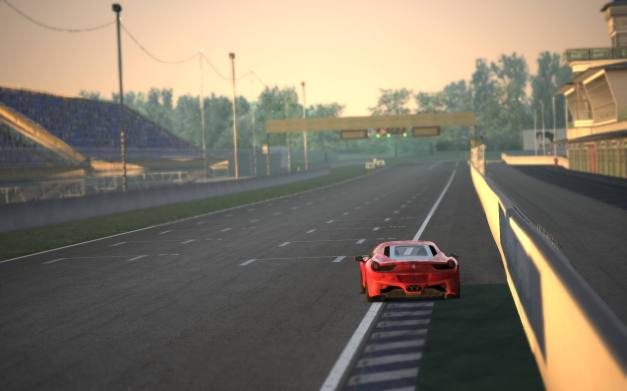
The famous Newbury circuit, the first to feature in a Kunos based sim, has been ported by modders into Assetto Corsa

The famous Newbury circuit, the first to feature in a Kunos based sim, has been ported by modders into Assetto Corsa

Stefano Casillo: No, it was just for me really. I never thought it would end up the way it has ten years later.

Jon Denton: So you started to push your work out to the public: was netKar the first game you went public with, or did netTennis go online?

Stefano Casillo: The tennis game was, maybe still is, on sourceforge.net.  Open source was quite big at the time, 2001 was supposed to be the year of Linux on the desktop (this is an old joke that slashdot.org readers will understand), but there was no community for tennis games.

Jon Denton: Back then very few games had much community around them, online was a relatively new thing.

Stefano Casillo: For racing sims, Drivingitalia was huge. So it was very natural for me to get involved there, I was already part of that community as a gamer.

Jon Denton: Was DrivingItalia the birthplace of netKar, or did it go out on sourceforge too?

Stefano Casillo: netKar was only on DrivingItalia (DI). I never had the idea to go open source.

Jon Denton: As you said, you were around on DI for a while, were you racing online before netKar came along?

Stefano Casillo: Yes, with VROC a lot (For those not old enough to remember, Virtual Racers Online Connection, or VROC, was the third party application that allowed online internet racing to take place in Grand Prix Legends).

Jon Denton: So the first version went out, what was the initial reaction? And what did it entail in terms of cars and tracks and online?

Stefano Casillo: It was really nice. I think the first version had the Toyota Supra GT car and the original Newbury track which I modeled in 3D myself.  The reaction was immediately very positive. The original, free netKar’s development had been supported with positive karma from the community.

Jon Denton: Did Newbury have the racecourse building back then?

Stefano Casillo: Yes sort of! It had my house at the back of the last hairpin, too!

Jon Denton: Were there online leagues and sessions right away? I seem to remember most of the coverage on DI was in Italian back then, and there was no English forum, so the audience was mainly Italian I suppose?

Stefano Casillo: No, there was no multiplayer until version 0.9.9 of namie.  That is why namie is what most people know of nowadays.  But the history of that release is crazy; I hit the ‘compile’ button for the last time while a removal person was pulling out the plug of my PC because I was leaving my house to go to live in Tokyo.  I sent the build to Aristotelis Vasilakos and he had to sort out the mess and close a release that became 0.9.9 namie.

Jon Denton: Ah, so Aris coming back into Kunos again now is like competing the circle.

Stefano Casillo: Totally.

Jon Denton: The early days saw netKar as just a hotlapping sim—versions 0.1−0.8 I mean. How did you develop the tyre model and vehicle dynamics? Do you have a background in engineering, or was it a case reading lots of books?

Stefano Casillo: Lots of books. I lasted thirty days at university—schools are not for me.  It took me seven years to get out of highschool, instead of the standard five. I just couldn’t be bothered.

Jon Denton: So there must have been quite a deep interest in vehicle physics? Learning this stuff is no walk in the park. I presume you had followed F1 racing and motor sports for a long time?

Stefano Casillo: Yes, but most of all there I had a love for Dave Kaemmer’s work: From Indianapolis 500 to Grand Prix Legends — not to forget IndyCar Racing, one of the finest.

Jon Denton: And Geoff Crammond?

Stefano Casillo: Of course, him too. I remember trying REVS on my C64—‘wow you can spin!’

Jon Denton: I had it on BBC Micro. My Dad could never understand how I could spend so much time on it!

Stefano Casillo: I come from a family that had a passion for F1 and Ferrari.  On Sunday it was race day, early lunch and then watch the race.

Jon Denton: Good times, some things never change.

Stefano Casillo: I remember my parents didn’t have the courage to tell me Gilles was dead because I was crazy for him.
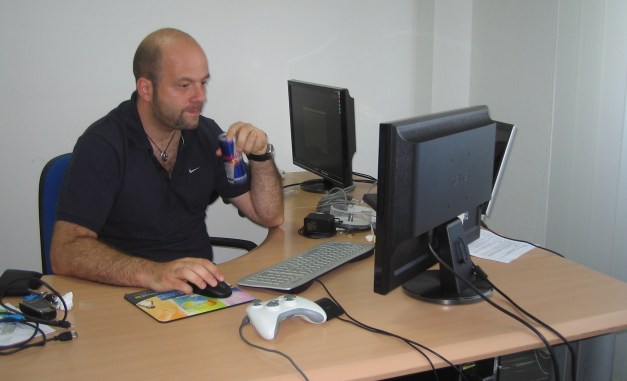
Working the metaphorical lathe

Working the metaphorical lathe

Jon Denton: I was a little too young to see much of Gilles.  Senna was my hero, sadly I watched him go.

Stefano Casillo: I remember: with time I stopped being a Ferrari fan, I could never bring myself to cheer for Schumacher.

Jon Denton: Yes, I have only recently, with Alonso, re-found a love for Ferrari.

Stefano Casillo: It was also because I loved Alesi—I loved Raikkonen, too.  I was in London when he won the title, it was amazing.

Jon Denton: Kimi was one of the biggest talents of the last decade.  Such a shame he gave up caring.

Stefano Casillo: Yes, so true, such a character, but my wife likes him too much, so I’m glad he’s not appearing on TV that often anymore!

Jon Denton: So as namie v0.9.9, the first online version of netKar, was sent out into the wild, you moved to Tokyo, was this work related, or life?

Stefano Casillo: Both, really. Such a big change has to be about life, but Quantel made it happen so it was the easy way in.

Jon Denton: You worked for them in Japan?

Stefano Casillo: Yes. They have offices in Tokyo, but they don’t do development there, so my job was quite different.

Jon Denton: Namie brought us a raft of new cars to try too; was this when it opened-up to a wider audience as well?

Stefano Casillo: I think so. There was a car for everybody.

Jon Denton: And the English forums opened at DI…

Stefano Casillo: Yes, and there were websites like RaceSimCentral (RSC – At the time run by Tim Wheatley) that always followed netKar.  I think, maybe, at that time RSC was the centre of the sim-racing community.  That and the West Brothers forums!

Jon Denton: West Forums in 2001 was big news! Yeah, and High Gear, back in the day.  I think that was where I heard of netKar originally.  Around the time everyone was looking for something other than GPL to drive. Viper Racing was fun but not really good enough.

Stefano Casillo: Yes, you’re right, High Gear was where I started out, and met some people that are still friends today, crazy to think of it now.  It’s a shame new sim drivers can’t experience the community feeling that was going on back then.

Jon Denton: It’s difficult to understand what has gone away really.  Those of us there in the beginning are all much older now.  Younger people have grown up with the internet. I seem to remember people’s online personas just had more respect for each other back then.  So was it all positive karma coming in, or was there much in the way of moaners?

Stefano Casillo: Feedback was always good with netKar namie. Of course people started to get sore at me because I had to disappear.

Jon Denton: The move to Tokyo halted development I assume.  We had namie for, what, four years before nKPro? What was going on during that time?

Stefano Casillo: Well, work in Tokyo was just too much to even consider having the time to develop netKar.  Then when we started work on netKar Pro, it took much-much longer than I expected to get it done.

Jon Denton: Were you still in Tokyo when you started work on Pro?

Stefano Casillo: No, I had moved back to Italy and started here.

Jon Denton:  Moving from bustling Tokyo to sleepy Trieste?

Stefano Casillo: Yes.

Jon Denton: A nice quiet town, miles to walk for bread. Must have been a big change from the madness of Tokyo?

Stefano Casillo: Absolutely!  And I was really living in the middle of nowhere.  It was very, very hard to adapt to that lifestyle after the glamorous days in Tokyo, and that was a huge problem for the development of netKar Pro.

Jon Denton: How so? Surely software development likes quietness?

Stefano Casillo: Yes, but I kept thinking it was a mistake to leave Tokyo, and my job there, it got pretty dark and depressing at times.

Jon Denton: Did you know people in Trieste? Or was it a big step into solitude?

Stefano Casillo: I knew Alessandro Piemontesi, who was in the Kunos team by then and helped me to move.  He ended up leaving the team though, mostly because of my dark moods, and I lost many months in this constantly drunk state.

Jon Denton: You mentioned the team:  Who is the team? I know Marco Massarutto has been around through thick and thin, was he there at the beginning?
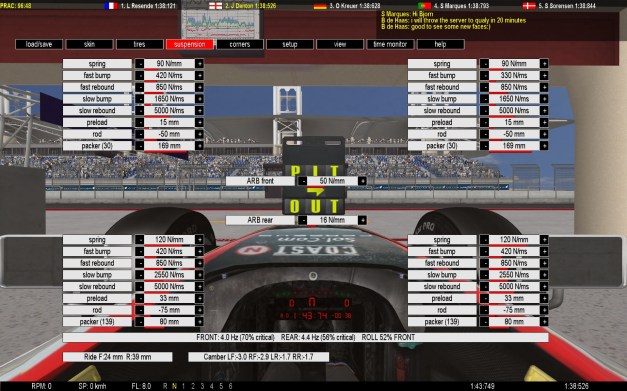
Was netKar Pro too complex?

Was netKar Pro too complex?

Stefano Casillo: Marco was the first person I asked to join the team when developing netKar Pro along with Alessandro and Aristotelis Vasilakos who also ended up leaving.  So we asked Simone Trevisiol to join, and the three of us have been pretty much the core.  Aris is back now, and we have more graphics guys around that we use, support, administration, etc.

Jon Denton: And who does what, broadly (I guess you all do a bit of everything to some extent)?

Stefano Casillo: It’s starting to resemble a software house these days, even if many of us are not physically in Rome.  Marco is mostly in contact with graphics artists, checking their work schedule, and making sure that we’ll have that track or that car ready for that deadline, and that it looks as our content should look.  Most of his work is hidden to netKarPro users at the moment, but he is Kunos Simulazioni for all our customers on the professional side. Simone is our track modeller guy, but he also modelled the Vintage for netKar Pro which is pretty good for a first time effort.

Jon Denton:  And he works in Vallelunga, too.  I guess the way technology is now, you don’t need to be in an office, unless you need to whip people!

Stefano Casillo: True. But face-to-face discussion is always clearest.  It’s so easy to get the wrong impression by using voice chat or, even worse, text chat.  Aris will now be in charge of car development, so basically I will sit on the beach and swim.

Jon Denton: It sounds good.  You have earned it!

Stefano Casillo: Not really, of course. I’ll have more time to code and fix bugs, and I can work harder and deeper on physics development because Aris will be able to put that work into effect on the cars.

Jon Denton: Okay, going back to the dark days of Trieste. When things started to lighten up, it was you, Marco, Alessandro, and Aris.  Then Simone came on board.  What was the thought process behind netKar Pro’s development? At the time the sim-racing market was still quite bereft of any ‘killer’ titles.  What did you want to achieve with it?

Stefano Casillo:  Alessandro and Aris left pretty early so it was me, Simone, and a guy who can’t be named.  The original plan was to take namie and make it into a solid sim.  Then we started what we call the ‘taliban process’ in which we tried to make the sim as realistic as possible, not only on the physics side, but also with respect to the entire approach to the product.  So in car HUD-style graphics were abolished—want to know your position in the race?  Learn to read the pit board when you pass.  Full mode was established, where repairs to the car after damage took time, setup adjustments too… What were we thinking?

Jon Denton: Well, you were thinking brilliantly! That giant pit board is still easier than a real one! But yes, the lack of an option to change it was maybe a little harsh.
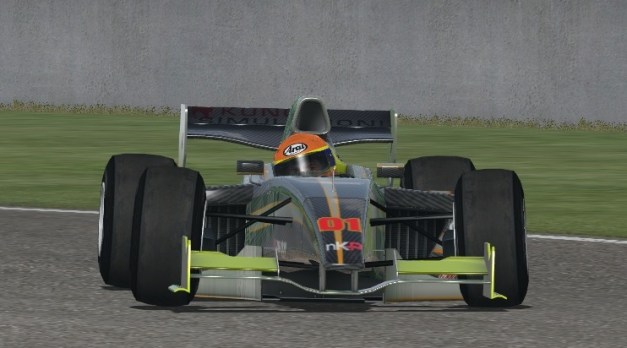
Formula KS2 - T1 Newbury

Stefano Casillo:  Yes, but honestly, I enjoy racing online now.  I can see where my friends are, what lap times everybody is doing real-time, and so on.  As a developer we should try to bring the fun of racing to the PC, not just the frustrations of it.

Jon Denton: Maybe, but when I’ve raced in real life, I don’t have those things, I don’t have the time to think about that.  You know the car in front of you, and hopefully the one behind is too far back to see, but yes, you have a point there.  I am a bit fascist with these things though.

Stefano Casillo:  I understand you.

Jon Denton: So the plan was to go with ultra-realism, to push what had come before with GPL (Which also insisted on “pit board only” in car).  I guess around then we had GTR on the market from Simbin, too.  The main core of the community wanted realism, I think, back then: it wasn’t until they got it that they realised they didn’t like it!

Stefano Casillo:  The idea was that nothing could top netKar Pro—if you were serious about sim-racing, you would have to go to nKP, no compromises.

Jon Denton: How did you come to the decision to go down the single-seater-only route?

Stefano Casillo:  Differentiation, and the fact that you could stay true to reality without having to come up with a “Perrari G360”.  After all, the entire netKar Pro project was funded using my savings from Japan, so there was no money available for licenses.  During the last two weeks before we started the pre-order for netKar Pro I was also out of food.  Just plain rice for two weeks.  That’s living on a sim-racing project.

Jon Denton: And did you consider the “Perrari” or “Boyota Supra” option?

Stefano Casillo:  We had lots of harsh meetings about the Perrari option, yes.  Let’s say I won the argument, but history shows I was wrong because netKar sales went much better once cars like the Fiat 500 and the Vintage appeared, so if you’re doing a new sim, don’t rely on minor single-seaters.  I love single seaters, but many don’t. People seem to want something that handles more like a car they understand.

Jon Denton: This surprises me.  Some of the most popular cars in sim racing seem to be some of the most staid and dull road cars.  Not something that makes sense to me.

Stefano Casillo:  I love single-seaters.  The only car I really love in nKPro is the FF1800.

Jon Denton: The 1800 and the KS2, I love the KS2 so very much.

Stefano Casillo:  I think if you don’t have an F1 car, then any single-seater is seen as a surrogate of that.

Jon Denton: And if you do have an F1, it’s too hard to setup, and to drive at top pace for the majority of players.

Stefano Casillo:  Let’s just say it’s not very inspiring to drive.

Jon Denton: Was there any thought to go to F1, or to scale the single-seater ladder higher? Why was the Formula 3 car the top end?

Stefano Casillo:  We thought there would be more people who wanted to race cars like the F3 car because it’s a good car for online racing.  I always thought F1 is too extreme—even the KS2 for that matter—the speed deltas are just too high.

Jon Denton: Overtaking becomes very hard.

Stefano Casillo:  But you get addicted to the speed.  After working on Ferrari Virtual Academy, it was hard to go back driving the 500!  And that’s why we thought, let’s do the KS2 in netKar Pro.

Jon Denton: It’s true: I skipped from the KS2 to the F2000 over this weekend, and it was like going into slo-mo.  Tell me a bit about the tracks in netKar Pro.  How ‘designed’ were they?  All named after towns in Italy, of course—do you think they reflect the feel of the areas they represent, or were they names out of a hat?

Stefano Casillo:  They do, actually, some of them.  Aviano is a NATO base with F15’s and F16’s taking off, and it feels as if you’re flying a fighter jet somehow—it fits.

Jon Denton: It feels open yes, like an airfield circuit, the light feels that way.

Stefano Casillo:  Prato…  I have no idea why it’s called Prato …I think I was watching the news about Prato, and there you have it.  Aosta, well …what else? It’s in the Alps!
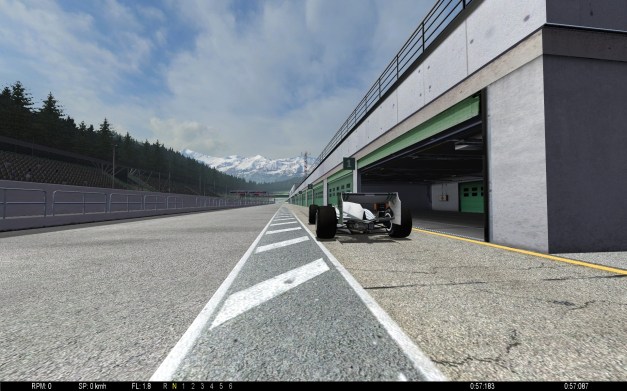
Bella Aosta

Bella Aosta

Jon Denton: I wish it was real and I could go there, it’s beautiful!  So getting back to namie—you started to adapt the engine, how much more advanced did things start to get?

Stefano Casillo:  Oh, how I wish I didn’t do it! But it’s too easy to say that now.  The major difference was the implementation of the shader technology.  Also, the entire car data structure changed—it went from a ‘code-driven’ approach in namie, where every car was a totally separated entity implemented into a .dll, to a more traditional data-driven approach where the code stays the same and the car is defined by a data file.

Jon Denton: The physics become more defined in a ‘world’, and the objects within it set their parameters?

Stefano Casillo:  Yes, and the process was better.  We started to have tools to implement tyres, car suspensions and so on.  Now people can see a small part of that with Koflite (netKar Pro’s track editor software), but the real netKar is all the other tools behind it that allow the physics level to be where we want them to be.

Jon Denton: The tyres developed so much further too.  Netkar Pro was the first sim to really give a feel of the lifecycle of the tyre, even visibly.  Were you working with tyre manufacturers to get the data for this, or was it based more on theory?

Stefano Casillo:  Tyre modelling is a constant process for me.  It’s very, very hard because even testing the real thing is hard to do.  NetKar Pro went through four tyre models in five years.

Jon Denton: Four tyre models before release?

Stefano Casillo:  No, four tyre models since the release: Verions 1.0 to 1.0.2 are based on a Pacejka model, 1.0.3 is based on a model called the ‘similarity model’, 1.1 is based on the brush model, and 1.2 is based on a new tyre model I was working on for, <ahem> a new piece of software and it was so good that I thought “I can’t keep this on my HD, this has to go in netKar straight away.”

Jon Denton:  I know Pacejka, and I have heard about brush, what is the similarity model?

Stefano Casillo: Similarity is a simplified Pacejka model developed by Hans Pacejka and Milliken.

Jon Denton: And the latest build does feel so very good, too, though it is surprising to hear this because the similarity between the models in different circumstances is quite remarkable.

Stefano Casillo:  Yes, there was one single change in the equation for the final version 1.3 that made it better; that was supposed to be our ‘next gen’ tyre model, now it’s gone so I have to come up with something ‘next next gen’!

Jon Denton:  There is always more to learn. As far as I can tell people are still learning when it comes to tyres in real life, let alone sims.  The early releases with Pacejka had well documented problems at very low speed, if I recall—I remember the early models felt very good in some situations and a bit strange in others.

Stefano Casillo:  Which is the nature of the beast if you work with a curve-fitting empirical model.

Jon Denton:  It breaks down the closer to zero you get?

Stefano Casillo:  Yes, because you always have the velocity appearing in something like X=Y/V so as V goes to zero. X goes to indefinite.

Jon Denton:  And the world implodes…

Stefano Casillo:  And people die and the ones who survive flame on the forums and ask PayPal for refunds!
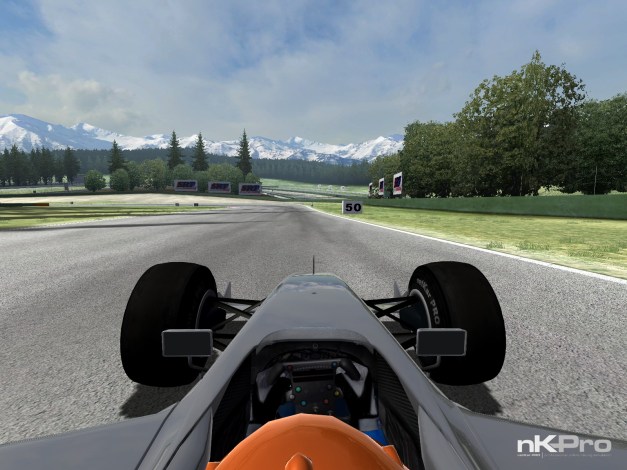
Formula KS2 at Aosta Sport

Jon Denton:  So the brush model is used in a few other places I think. I did not know netKar Pro ever used it, I think we had an interview with the guys who did Virtual Grand Prix 3 telling us it was revolutionary: Amazing in the world of sim-racing quite how many things have been a revolution!

Stefano Casillo:  Differences are very subtle right now. I mean, think ten years ago, the difference between an arcade and a sim was huge: now you fire up Gran Turismo 5 and it feels very, very good.

Jon Denton:  So this development was to be a big step, but at which point did you put a cap on what you were doing? Surely you could go on forever, adding more and more features, or developing physics more and more and never release anything? It was mid-2005 when you let AUTOSIMSPORT have a go with a test mule-build, at Newbury with a carbon effect Formula Target car. How close was this to something you felt happy with? And presumably you had had other people try it out before that? Racing drivers? Or just close friends?

Stefano Casillo:  The driving experience in netKar Pro was always something all the guys felt very solid about: going from one tyre model to another just shows me that, at the end of the day, we’re not that far off.  Things don’t really change that much.  There are things in physics I keep coming back to; tyres and differentials are my favourite to work on when I have some time available, but lately I feel like I am pretty much exactly where I want it to be, so I end up experimenting with something different.  The first release of netKar Pro was so bad, bugs wise, because we didn’t have a real beta testing team.  Things got much better once we started working with Jaap Vagenvoort on the 1.0.3 release, and with the RSR guys for the latest releases.

Jon Denton:  Well, and me, Alex, and Bob for a short while! Was it just the three of you testing in the early releases then?

Stefano Casillo:  Yes, as crazy as it sounds, that was the case.

Jon Denton:  Only so many configurations or situations can come up.

Stefano Casillo:  I think we were very naïve in thinking: “well after all, it’s still netKar namie on steroids, and if it doesn’t work, people will support us as they did since back in 2002.”  That of course wasn’t the case…

Jon Denton:  I think the public suddenly changes their feelings on these things when you ask them to pay for something.

Stefano Casillo:  It’s true—and mostly right too, it was just a bit weird for us to become like Microsoft in a day!  Everybody hated us and wanted a piece of us.

Jon Denton: Yes, this was when suddenly it all changed for netKar didn’t it?

Continued in Part 2…
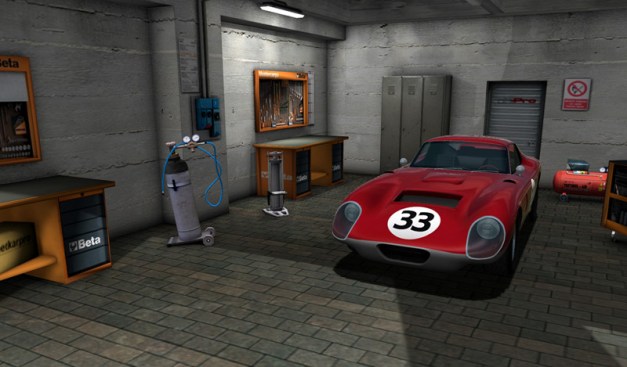
The Vintage

The Multi-class debate.

Posted by shrapnel1977 on February 26, 2011
Posted in: iRacing. 6 Comments

A hotly debated subject over at iRacing this week seems to be the issues encountered with multi-class racing.  As previously covered, the iRacing Grand-Am sportscar series provides the chance for Riley Daytona Prototypes to be on track at the same times as the considerably slower Ford Mustang FR500S.  As with many classes of sportscar racing, there are two races on track at once, and everyone has to get along.

It’s just that, well, they don’t.

This has been exacerbated as the series moved, this week, to Lime Rock Park.  A small yet fast circuit in Connecticut, 1.53 miles (2.46Km) in length, with some very fast corners and tight confines, this track quickly fills with traffic and makes any race a challenge.  Additionally the place just feels a bit too small for a car as fast as the Riley and so fast laps can leave little margin for error, throw in some slow traffic and you’re hit with one of the biggest challenges of the series.

Some of us, like myself, relish this challenge.  Running amongst drivers of varying ability is one thing, working with traffic in a car almost 15 seconds a lap faster than those being passed, all the while being chased by competitors, is a genuine skill that will get the sweat dripping down anyone’s brow.

So what’s the problem?  Everyone loves a good race, right?  People would only enter a multi-class series if they understand how it works, right?

The main problem, it seems, would be that some people don’t seem to get it.  Where the closing speed is massive from a Riley to the back of a Mustang, some Riley drivers forget how to use their brakes.  Some feel that they should not have to lose time stuck behind a Mustang and that the Mustang should perpetually drive around the outer edge of the circuit so that they can cruise by in their Riley.  After all, they are the only person in the race, surely.  In fact, maybe they are the only person in the world.

In some cases, this seems to even manifest itself in Riley drivers feeling that they, as the most important human ever, should not have to use the brakes to avoid other cars at all.  They should pinball into car after car as if they were simply not there.  In the below video we see possibly the worst piece of driving I have ever seen in iRacing.  The first view is from the hapless Mustang driver, who gets turned around into turn one.  We then see it from the point of view of “our hero”.  This Riley driver is the way and the light, he shows us how it clearly should be done:

We can all learn from this, clearly, that if there is ever someone in front of you braking before you want to, all you have to do is smash straight into the back of them, and when a pesky Mustang thinks it has the audacity to ever think that it is part of a race that it should be shoved into a spin like the damned nuisance it is.

If only Fernando Alonso has had such a fundamental understanding of this remarkable form of racing, he could have simply pushed Vitaly Petrov and Nico Rosberg into the unrelenting Abu Dhabi wall, cackling as he powered on to the 2010 World Championship.

Except that this just isn’t how motor racing works.  When people crash, they get hurt, if they don’t get hurt then expensive machinery gets damaged, someone foots a bill.  No one is happy.

The fact is that when people race for real they avoid crashes, they respect the people they race with and try their best to avoid making mistakes.

Where this has led is to a situation where Mustang drivers don’t know what they should do.  They have a race to run, they cannot spend all of their time being off the throttle, the faster car should have the speed to make a clean pass on a relatively straight part of the track.  However, they end up losing time because whenever a Riley is approaching from behind they don’t know what to expect.

It could be that they are going to be passed cleanly by a normal human who understands how motor racing works and entered a mixed class series understanding the challenge that awaited them, someone with respect for other people.  Or they could be being approached by “our hero”, who will seemingly just drive right into them as if they were not there.

This brings about a militancy in the Mustang drivers, where they start to become less co-operative.  Not surprising, if every race or session I entered saw me being punted into a wall and losing SR I would be pretty disenfranchised too.  For the Riley driver this adds a level of unpredictability too, will the Mustang you have to pass be co-operative?  Will they chop across your nose and cause you to leap on the anchors?

Of course, this unpredictability is part of the game, this is racing, we’re all trying to make the chequered flag as soon as we can.  Incidents can and will happen but surely we all try our hardest to avoid them?  Or do we?

This seems to be the odd part, for me.  Finishing a few places lower than I feel my ultimate pace could achieve may be saddening, but finishing the race in a hedge in a smashed up car is far, far worse.  Having then to contend with the inevitable redeye rage of whomever you’ve pointlessly shunted in a thoroughly avoidable accident is a stress level that no hobby should be causing.

Drivers like “our hero” seem to miss the classic cliché “To finish first, first you have to finish.”

This business has also brought about a feeling of shame amongst the many clean Riley drivers out there.  Those that drive in a normal manner, who have to read thread after thread of anger from Mustang drivers who’ve spent too long digging their cars out of the gravel.

Reading this from Mustang pilot David Duda:

…In a Mustang I have to know if the guy behind me is the one who will run over me to avoid losing time, or the one who expects me to hold a predictable line.  Needless to say, after one practice session I elected to not even try a race.  There was a total lack of respect to the point of asking me to get the Mustang off the track so they could run Q laps.  The DPs can have the track.

Saddened me greatly.  When qualifying for a multi-class race has people actively trying to exclude the other car class, it points to a kind of absurd elitism that only serves to prevent Mustang drivers from bothering.  Multi-class racing becomes single class racing, and the series that many drivers entered to enjoy running in traffic and improve their abilities and skills by challenging themselves, becomes a farce.

So, what can be done?  If a Riley driver can never be sure if the Mustang driver thinks they are some disrespectful buffoon or someone that wants to act like other people in the world deserve to exist, how can we potentially avoid accidents via misunderstanding?  Everyone makes genuine mistakes after all.  Some people even apologise for them.

How can this communication between drivers take place.  In real life there can be hand signals or indicators.  Perhaps, if multi-class is to become a solid feature of iRacing going forward, which I sincerely hope it is, then iRacing should implement indicators in the cars that have them, so that drivers can indicate which side the passing car should go to.  With clear instruction in the drivers briefing to ensure that this communication is understood.

Either way, there’s always going to be trouble if people in the faster cars have such a personally enforced superiority complex that they ask Mustangs to leave a session so that they can qualify.  Anyone coming out with such boorish obnoxiousness should not have entered a mixed class series in the first place.

Alas, Lime Rock was always going to highlight this issue, hopefully as the season goes on people will get more practiced with both passing lapped cars and being lapped cars.  Everyone’s got the same deal out there, perhaps the best thing is for a little bit of understanding, and remembering that a wrecked car is no use to anyone.

Posts navigation

← Older Entries
Newer Entries →
  • Recent Posts

    • Mercedes-AMG W13 E Performance – iRacing December 23, 2022
    • Grand Prix Legends is 20, a legacy that created a genre. December 8, 2018
    • “I have a car simulator project that might spark some interest”: My Summer Car August 26, 2016
    • iRacing’s McLaren-Honda MP4-30 Hybrid December 17, 2015
    • A driving title with a difference: Jalopy November 27, 2015
  • RAVSim on Facebook

    RAVSim on Facebook
  • Follow us on Twitter

    Tweets by RAVSimulations
  • Categories

  • Post Archive.

  • RAVSim Authors

    • bobsimmerman's avatar bobsimmerman
      • Simbin RaceRoom Racing Experience Interview
      • F1 2012
    • Eliot's avatar Eliot
      • Forums: A Survival Guide
      • Volvo the Game – Review
    • ljmagyar's avatar ljmagyar
      • Taking a seat in the HumanRacing GT Chassis
    • shrapnel1977's avatar shrapnel1977
      • Mercedes-AMG W13 E Performance – iRacing
      • Grand Prix Legends is 20, a legacy that created a genre.
    • spamsac's avatar spamsac
      • “I have a car simulator project that might spark some interest”: My Summer Car
      • A driving title with a difference: Jalopy
  • Feeds.

    • Create account
    • Log in
    • Entries feed
    • Comments feed
    • WordPress.com
  • Enter your email address to follow this blog and receive notifications of new posts by email.

Create a free website or blog at WordPress.com.
Privacy & Cookies: This site uses cookies. By continuing to use this website, you agree to their use.
To find out more, including how to control cookies, see here: Cookie Policy
  • Subscribe Subscribed
    • Race and Vehicle Simulations
    • Join 49 other subscribers
    • Already have a WordPress.com account? Log in now.
    • Race and Vehicle Simulations
    • Subscribe Subscribed
    • Sign up
    • Log in
    • Report this content
    • View site in Reader
    • Manage subscriptions
    • Collapse this bar