Race and Vehicle Simulations

Bringing you in depth coverage of Vehicle Simulations

  • Home
  • Index
  • Writers

Mercedes-AMG W13 E Performance – iRacing

Posted by shrapnel1977 on December 23, 2022
Posted in: iRacing.

“I think this car will always have a special place in our collection…”  Mercedes F1 team principal Toto Wolff mentioned to Autosport just last week “…very far back.”
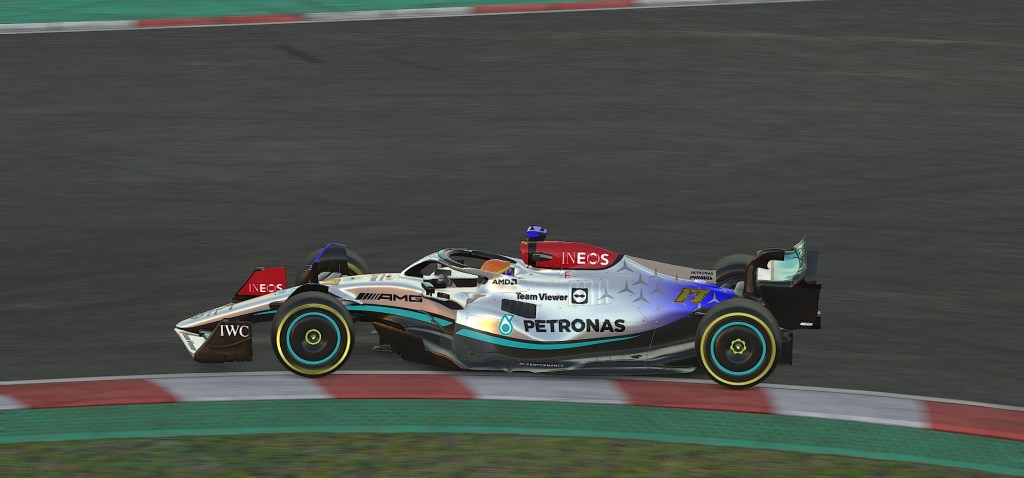
Such has been the success of Toto’s team over the last eight seasons, a car that takes seventeen podiums, one win, one pole and finishes third in the constructors championship is considered a failure.  

The nascency of the “Mercedes-AMG W13 E Performance”, or just “W13” if you don’t mind, began with what turned out to be a rather radical approach to the new era of Formula 1. 2022 introduced one of the most significant changes to the F1 ruleset seen in some time, perhaps ever, in which cars were forced into a design that favoured underbody aerodynamics to create downforce using ground effect technology. Ground effect in F1 was originally invented in the late 1970’s and outlawed.

The premise of these changes was led by a desire within the sporting governance to provide better racing by allowing cars to run closer together. With these new 2022 cars, barge boards were banned, changing the way teams had to deal with the turbulent aero wake from the front wheels, favouring intakes on the front of the sidepod floor area that feed air into underfloor venturis. This went hand in hand with a mandated rear wing design to push the car’s wake upwards and reduce “dirty air” for the following car.

There were many other changes but this, along with a move to 18 inch wheels, was the most significant change from a design perspective that sent all of the F1 team designers back to the drawing board after five years of relative rule stability.

At the second test of the year, on the 10th March 2022, Mercedes unveiled the W13’s full aerodynamic package to gasps up and down the pitlane. Where most of the cars had opted for a wider body around the sidepods, Mercedes’ sidepods were “slimline”, pulling in tight to the rear of the car, with a wing mounted upon the homologated crash structure at the leading edge of the sidepod managing airflow from the wake of the front wheels over the top of the rear floor component and onto the rear wing. Where barge boards behind the front wheels had been used in previous eras to manage this wake, this wing mounting appeared to be managing this airflow, this design looked to be a potential work of genius.

Rival teams raised eyebrows, but when the car took to the track any concerns they had about this radical design approach’s potential seemed to ebb away.

Once running it was clear that the car was suffering with almost terrifying amounts of aerodynamic porpoising, as well as bouncing in the suspension, two phenomena brought on by ground effect’s general requirement for running the car as low to the ground as possible to gain performance. The Brackley based team were in crisis.

This of course makes it fascinating that the W13 was already slated to be coming to iRacing as a virtual steed long before all of this came to pass. With the 2021 constructor’s championship winning W12 already in the service, Mercedes had struck a deal with the US based sim developer we all know and love to bring their 2022 challenger into our virtual garages long before they knew how their season would go; giving us the chance to enshrine another genuine F1 curio within the virtual world.

Taking to the track in the iRacing W13, one of the first things to strike me is how stiff the vehicle platform is when compared to its predecessor. The provided setups for each of iRacing’s F1 aligned tracks are designed to provide a gentle learning experience, in as much as is possible with such a complex, rapid machine. The car is stable with a bias towards understeer that becomes more pronounced as the driver’s confidence grows.  

The tyres provided, noted as Soft, Medium, and Hard in keeping with F1 nomenclature, simulate Pirelli’s C4, C3 and C2 grades of tyre softness. For my first foray, I take to the Barcelona circuit with a set of hards (The 2022 Spanish Grand Prix utilised the C3, C2 and C1 compounds, so the iRacing Hards are equivalent to the Mediums used in reality) and a full tank of fuel to get a feel for things.

Stiffness is crucial to create a stable aero platform to optimise the airflow field into the diffuser from the front of the floor; if the floor is considered a “wing” then the more consistently this wing is presented to the flow field the more consistent the aerodynamic downforce created will be. Also, running the car lower will effectively constrict this flow and thus speed it up and create downforce in greater numbers.

Whilst my initial impressions involved adapting to the stiffness of the platform, I am ever mindful that the default setups provided are configured with considerably more compliance than will undoubtedly be required to extract maximum pace from the W13, so we have a long way to go.  

Handling wise, it is a little cold in Catalunya today and the hards are struggling for temperature without some amendment to pressures. In fast corners the W13 is producing a staggering amount of downforce; the rear sticks and sticks with the rearward centre of pressure showing its hand. Conversely, the fronts start to scrub when leaning on it through turns three, four and nine.

At slow speed, the understeer is more pronounced and I start working with the various tools within the car to try to help get the car into corners. In-car brake balance configuration features brake migration, to manage the balance dynamically as speed bleeds off (as has been seen in many other sim-virtualised modern F1 cars), and the obligatory amendments to entry, mid-corner and exit differential locking are available. Nevertheless, with a heavy fuel load and tyres outside of their optimum range, the car is cumbersome at low speed, with so much low end torque delivered by the Mercedes M13 V6 hybrid power unit it can be rather too easy to spin up the rear wheels in the lower gears and find oneself pointing the wrong way. Luckily, this happens to me only once: exiting turn ten after almost twenty-five laps with no one in the empty stands able to bear witness.

As the opening Grand Prix of the season dawned in Bahrain, Mercedes were still quite some way from understanding the problems that they were having with the W13, and were fortunate to score a three-four finish behind the Ferraris as a result of reliability trouble in the Red Bull camp. Saudi Arabia was worse, with the cars lining up sixth and fifteenth and scraping through to fifth and tenth in the race. The Melbourne circuit in Australia did not appear to see the car suffering so much with porpoising, perhaps due to the nature of the circuit requiring a higher ride height, and they were once again fortunate with attrition to score a three-four.  

Dire as it may have appeared relative to previous seasons, most of the teams were suffering with getting their all-new cars to work effectively. Mercedes were remaining a clear third best outfit, but the porpoising had to be solved.

In a porpoising scenario, the car ends up with a phase shift between its front and rear aerodynamics, instigating pitch in the aero platform. The phenomenon was first talked about in F1 circles in 1979 when Lotus introduced their Type 80, which aimed to push the ground effect concepts of the Type 79 further. In many ways it did: it did generate more downforce. But with it came porpoising, which made the Type 80 borderline undrivable.

Porpoising tends to occur when there is instability in the underfloor airflow field. When this instability occurs, the diffuser can stall the airflow, resulting in the rear suspension going into heave, raising the rear ride height and moving the aerodynamic centre of pressure forwards as a result of the pitch condition. The flow field then re-attaches to the diffuser, reversing the situation, and pulling the centre of pressure rearward once more and putting the front suspension into heave, resulting in a reversal of the pitch. This happens repeatedly, and very quickly depending on speed, creating a violent pitch oscillation which is not only very uncomfortable for the driver, but makes for an unstable aero platform and very unpredictable handling.

For the Emilia-Romagna Grand Prix in Imola, Mercedes brought changes to their diffuser, sidepod inlets and lower rear deflector endplates in an attempt to tackle their porpoising woes. With qualifying taking place on a drying track after morning rain, the Mercedes pair did not make Q3. Lining up eleventh and fourteenth on the grid, and with the car looking skittish, barely controllable and slower than it had been all year, they still walked away with a fourth place finish. Miami saw only one car make it through to Q3, but a strong fifth and sixth in the race kept the points flowing in.

At the Spanish Grand Prix, Mercedes introduced a much larger upgrade, with an all new floor featuring revised edge detail, a lower deflector endplate on the rear corner in advance of the rear wheel, and a bib vane added to the floor body. These changes were aimed at improving flow conditioning into the diffuser to reduce instability, as well as increasing load. There was also an amendment to the front wing endplate to aid airflow to the rear of the car. Immediately, the W13 looked far more comfortable on track, with the smoother surface of the Circuit de Catalunya allowing the car to run as low as it needed to without suffering porpoising. Mercedes ended Friday just two tenths off the pace. This margin increased somewhat on single lap pace, lining up fourth and sixth on the grid, but they came home third and fifth in the race. Most encouragingly, the W13’s fastest race lap was just a tenth away from the fastest time set by a Red Bull. Smiles started to appear in the garage.

Whilst it appeared that Mercedes had made good progress ironing out its issues regarding underfloor flow field instability that led to porpoising, the W13 continued to suffer from ‘bouncing’ – a heave motion response caused by the underfloor aerodynamic instability – at the next two races. Monaco and Azerbaijan, both bumpy street tracks, would put frowns back on faces in the Mercedes camp.
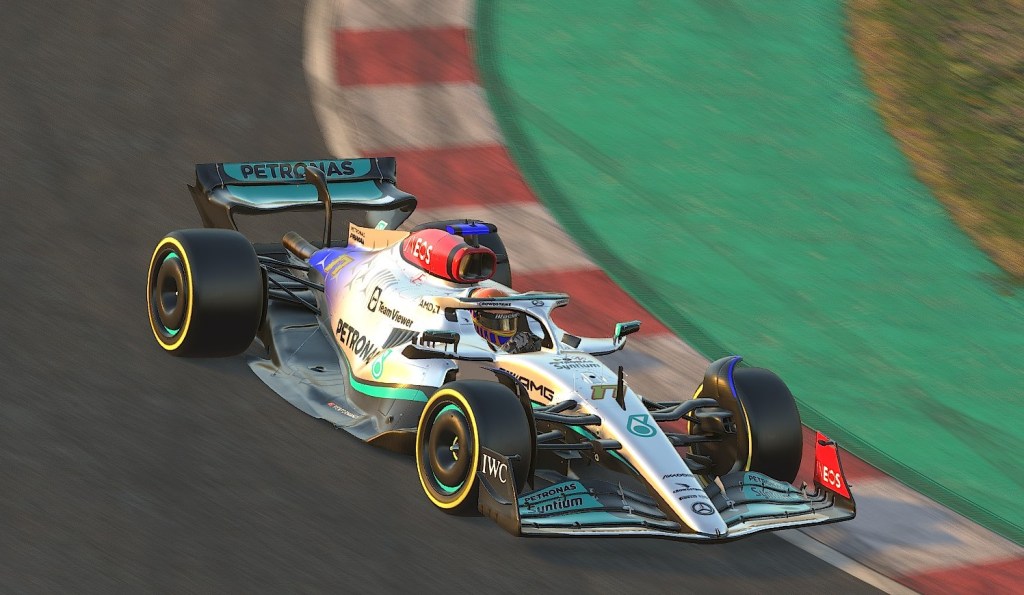
For the afternoon session, I bring the fuel load down to one-third race distance and switch to the Mediums, the C3s. I Bring up the tyre pressures all-round, particularly on the underused right-side, and lower the ride height front and rear at speed to as low as I can get away with.  iRacing’s “setup calculator” allows the “ride height at speed” setting to be assigned directly, rather than via packer adjustments and judicious telemetry study.  

Right away the car is more alive on the lower fuel load and the rear is even more nailed to the ground; so much so as to create something of an imbalance and I am soon back in to put more front wing flap on to better balance out the high speed behaviour.  

The grip is intoxicating through the first sweeps of turns one and two, and I seem to be able to brake deeper and deeper every lap. Turn three is flat-chat full throttle and I feel like I am lifting purely for my own confidence to tuck the nose in on entry to turn fournine.

At the lower speed turn five it is still hard to get down to the apex, but the benefits I am reaping in the high speed sections are making laptimes tumble. As I am pushing harder, just as I think the rear has seemingly unbreakable grip, I get a snap on the exit of turn four, then the rears give out under traction on the kerb out of turn six; I am getting closer to the limit.

Bouncing… This catchily named term is noted when you see a car literally, well, bouncing on all four corners. Mercedes Technical Director Mike Elliott talked with RaceCar Engineering magazine in their December issue about it and had the following to say:  “Bouncing issues are complex. The aerodynamics put energy in the vertical motion of the car due to a phase shift between the aerodynamic load and the car’s ride height position that gives a net energy input more than the dampers can deal with. The fact we have to run these cars so low to the ground, with so much downforce on them to be performant, means they must run really stiff , and that’s a huge contributor to these significant consequences.”

F1’s move to eighteen inch rims with lower profile Pirelli tyres have an impact here, Elliott goes on:

“The new tyres want slightly different things to get them into the window that works when compared to the previous thirteen inch ones. Though this isn’t the way to solve the challenges we’ve been facing with car behaviour. You have to put it in perspective. The tyre is not particularly stiff , and then you’ve got stiff suspension springs and, in parallel with the suspension springs, you have stiff dampers. In reality, these cars are inflexible, so it’s hard to dampen the motions and take a lot of energy out of the car’s movement.”

While the pain felt in the pair of street races was lessened somewhat by both cars scoring points in both, it remained the case that the Mercedes occupied a no-mans-land in performance terms; comfortably ahead of McLaren and Alpine behind, but significantly behind the faster Red Bulls and Ferraris ahead.

The Canadian Grand Prix appeared a far more competitive outing as, after qualifying fourth and eighth, the two Mercedes finished third and fourth once more; this time only seven and twelve seconds behind the leader, respectively.

At Silverstone they were on the podium again, suffering the first DNF of the year with the other car due to a gruesome startline shunt. Another notable update was brought to the car for the British round, modifying the front suspension design as well as modifications to the sidepod inlet to aid flow conditioning under the floor. Changes to the floor body added downforce load and aided flow conditioning, and a re-profiling of the rear wing tips would reduce drag on Silverstone’s long straights. Hamilton’s Mercedes appeared to be in the mix for the win, ultimately finishing third just six seconds back.  

In Austria, promising practice pace was somewhat squandered by both drivers binning it in Q3, but competitive drives once again secured a three-four finish. At the mid-point of the season, the best result for the W13 was third place and the constructors’ championship looked well out of reach. 

The W13 struggled with bouncing in Paul Ricard, despite a revised nose, but managed a double podium with a season best second and third place finish. The same result was repeated in Hungary, where a first pole position of the season had offered the hope of a win.

Belgium’s fast sweepers saw another downturn after this strong run, with the vagaries of the Spa-Francorchamps circuit forcing a compromise on ride height through Eau Rouge. In qualifying, the W13 was further away from pole than it had been all year. Another DNF struck after a first lap incident, with the remaining car coming home fourth, albeit almost thirty seconds back. Pace was strong in Zandvoort however, proving that the track layout was causing quite large swings in relative performance. They took the flag second and fourth, but then once again in Monza the pace dropped off. It appeared at this stage that to take a win with this car was going to require a dose of good fortune.
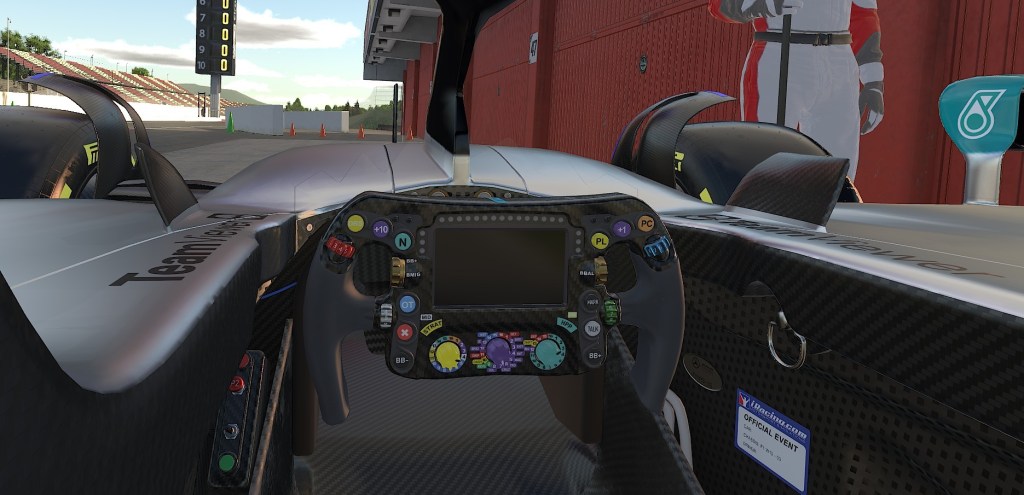
For my final session of the day, I start to experiment with stiffening up the heave and roll rates to try to solidify the underfloor aero platform and hopefully pull more performance out of the car. Once again I see immediate gains in rear downforce that require balancing out with front flap adjustments. We’re maintaining a thirty kilogram fuel load as I pop in and out of the pits; iRacing’s cost-capless environment granting me a fresh set of tyres each time.

When looking at configuration of the hybrid systems in the W13, it is once again clear that iRacing have dumbed things down from the real-world car. As they did with the W12, and with revisions to the McLaren-Honda MP4-30 in the service, they present basic options for the ERS recovery and deployment such as “build/balanced/attack.” Most of my running is on the “balanced” setting to allow me not to give it much thought. With a limited amount of  changes allowed even in private practice, based on competition regulation, it can be painful to experiment with these settings. On the whole I am not in favour of these simplifications; a simulator should aim to replicate the controls and systems of the real world vehicle as accurately as possible, and this has historically been an area where iRacing have excelled. I can understand the need to attract players to online races, which in complex cars can be tough given the learning curve, but it would be nice to have greater verisimilitude as an option in offline or hosted sessions at least.

Nonetheless, running in “balanced” mode did not present much trouble. With the system potentially changing the deploy mode on the fly, there can be a danger that you could enter a braking area at speed without a solid idea of the retardation available to you; something I had suffered in the aforementioned McLaren. Yet, in over ninety laps of Barcelona, and seventy laps of Imola, I had no such problems with the W13.

I did start to have trouble, however, with my push for stiffness making the car become more and more edgy. When the tyres were fresh and up to temperature they would hold on, but as the rears began to wear they started to cry “enough”, and after a few “brown trouser events” through turn four and turn six, I head back to the garage to loosen things up.

A chaotic, wet Singapore Grand Prix masked how close the W13 was to the leader’s pace; they were in the hunt for pole and set fastest lap in the race. Rain also fell in Suzuka, where the car’s aero deficiency saw their pace drop away from the top teams in the drier sessions.  

In Austin, for the United States Grand Prix, Mercedes fitted what was planned to be the final upgrade to the car: a new front wing, floor fences to once again aid flow conditioning, and revisions to the floor edge and rear wing endplates to increase overall load. These were met with strong performances; Russell taking fifth and Hamilton almost stealing a fortuitous win on the way to coming in second.

Mexico saw the W13’s second and third on the grid, but fall back somewhat on race pace to finish in second and fourth. Strong results, and outpacing the Ferraris, but not quite there. Through the season one thing had been clear: even if the W13’s pace was inconsistent track to track, it was able to look after its tyres better than most of the other cars. Perhaps this would be the advantage it needed in the final stretch.

The samba beats from the crowds rang out at Interlagos for the Brazilian Grand Prix, which featured a sprint event on Saturday. This meant limited practice running and, right away, it was clear that the Red Bulls were not happy with their front end. Everyone was struggling with tyre wear, and there was only one practice session before qualifying to do anything about it.

Then the rain came for that qualifying session, and a shock standout performance for Kevin Magnussen put him on pole for Haas. The Mercedes lined up third and eighth for the sprint; George Russell would win that event, with Hamilton fighting up to third. This would be where they would start on race day and the smart money said that this one was theirs to lose. The sprint had demonstrated that the Red Bulls were struggling and had dropped behind both the Mercedes and Ferrari on pace due to the nature of the circuit.  There was an air of calm confidence emanating from the garage of the Silver Arrows, which proved to be justified as Russell dominated from pole to take the win, with Hamilton close behind in second – the team’s first one-two since Imola 2020.

The season ended at Abu Dhabi where a grid lined up two-by-two and a representation of the season looked to bear up; the W13s firmly fifth and sixth. Russell would end the season with a solid fifth place, while Hamilton would suffer the W13’s first, and only, mechanical failure of the season and DNF.
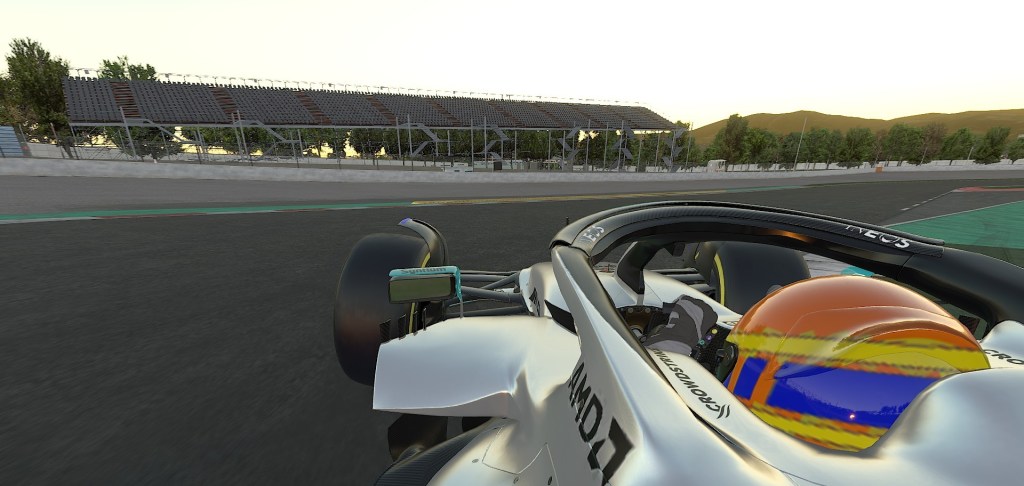
As I continue to pound around the sun starts to drop low in the sky over Montmelo and, with it, the track temperature starts to fall. At the track’s peak I record a time that was around seven tenths away from the time set by George Russell in FP2 during the Spanish Grand Prix, and feel happy enough with this pace. As the temperature drops, I never manage to match that pace again, whilst continuing to pop in and out of the pits to further experiment with setup. The colder track surface makes it harder and harder to maintain temperature in the tyres and the fronts increasingly scrabble to hold their line where previously it had been solid. I revert to the setup that yielded the peak laptime and head out for a final run, despite my shoulders and arms advising me that they’ve had enough of wrestling this direct drive wheel.

The next day I take the car to Imola, a circuit that the Mercedes team struggled with in real life, to see how the car compares.  Right away the track surface is more tricky to deal with, and the car becomes more skittish over bumps as we lower and stiffen it.  As a circuit Imola requires one to use the kerbs to extract decent lap times and on almost every turn I wince at the sound of the car smashing into the ground as we land.  Setup provides options to adjust heave and roll rates but we simply cannot get away with roll rates as stiff here as we enjoyed in Barcelona.

As we saw in Catalunya, getting a good high speed feeling involves continual adjustment of these spring rates, while the front flap and rear gurney fine tune the balance; but where the smooth sweeps of Barcelona made the process relatively straightforward, Imola is a trickier customer.  Every change gives us a different feeling, it may feel better in Rivazza but terrible in Piratella, try to fix that and we lose precision in direction change and every Variante is a nightmare. Ultimately laptime is all, as over two hours I fail to get the car feeling comfortable around this circuit; sooner or later you’ve just got what you’ve got!  After sixty-five laps of Imola I finally have my first crash, after asking too much on the turn one kerb, I am spat into the wall that the Ayrton Senna monument looks down upon. Time to pack up.  

The W13 is demanding to drive, especially on the limit, but like many F1 cars its sheer speed can really pull you in to keep running it more and more. Nothing quite compares in simracing to pitching a modern F1 car into a high speed corner and finding yourself exclaiming at how much sheer grip the machine has.

At Barcelona I could not get myself into a position whereby I had the car porpoising or bouncing, however I did experience what appeared to be some bouncing at Imola on the main straight, but it was not severe.

It is unclear to me what specification the W13 model in iRacing is representative of, and I was unable to obtain an answer to the question at the time of writing, but as we’ve seen, the car was upgraded notably throughout the season. The 3D model, particularly around the exposed rear floor area, seems to suggest an early season specification, but the aerodynamic stability seems to suggest that the physics implementation may be more apposite to the late season aero package. 

After six or so hours in the car I feel like I have only scratched the surface of the depth on offer; setup options are not as extensive as some other offerings, aero adjustments are limited to high, medium and low downforce packages with no finer control of what these entail.  Once a package is selected one is left to adjust the ride heights and heave and roll stiffness to manage the floor optimisation, with the rear gurney and front wing flap adjustment the only options for overbody aero, iRacing in general do not bother with cooling so there are no adjustments there that might present a drag trade-off.  When it comes to suspension we can adjust static ride height offsets, cambers and toes, alongside the aforementioned front and rear roll and heave spring rates. There are no configuration options for dampers or anti-roll bars, the W13 of course has both of these components so omitting them from the setup options seems strange, especially when dampers can be so critical in managing the underbody aero platform stability. In the garage the differential and brake-by-wire configurations offer the same electronic controls as are available in the cockpit, again, it seems surprising that the engineers would not have more options at their disposal.  iRacing have typically been very good in providing a thorough series of available setup options in their other complex cars, so I am somewhat surprised to see the W13 appearing so simplified.

That said, the sensitivity of the car to setup changes and the varying demands of different track layouts leaves us replete with experimentation potential. The demands of the W13 will present fascinating challenges for a while yet.

This is the first F1 car from the modern ground effect era to be officially implemented into a racing sim and I must commend the hard work iRacing have clearly put into it, and also thank the Mercedes team for granting the licence and letting us get a taste of such modern machinery. All too often these unique cars fall away from our consciousness as the season ends, but now the W13 is with us in virtual form for years to come.

Back to Toto:  “…I think that hopefully the next few years will do her justice, because the learning curve with that car was enormous. Our fundamental understanding of aerodynamic, vehicle dynamics correlation, has gone through a step change of learning.”

The W13 may not be remembered as the most successful Mercedes Formula One car, but it certainly won’t be forgotten.

https://www.buymeacoffee.com/shrapnel1977
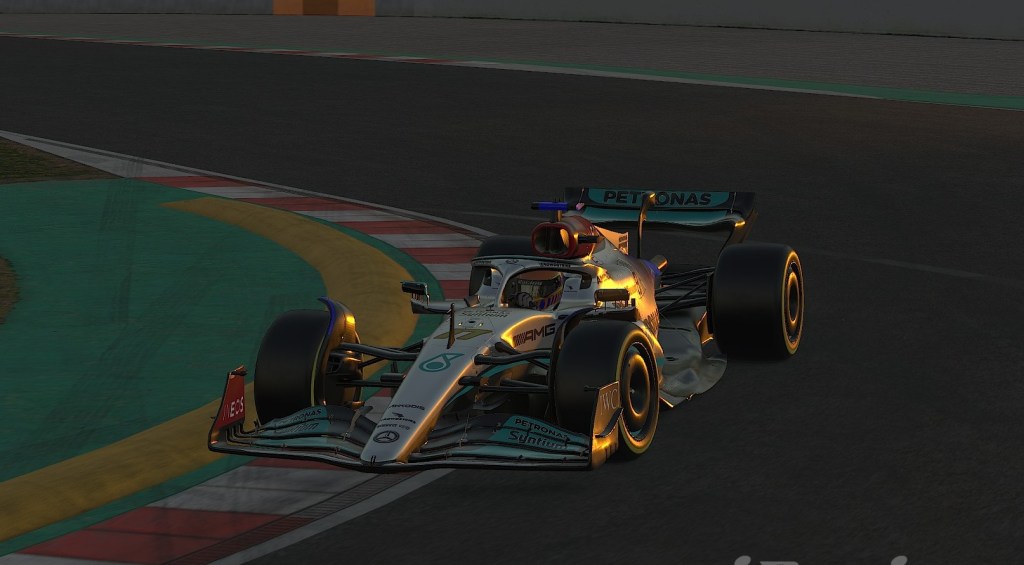
Grand Prix Legends is 20, a legacy that created a genre.

Posted by shrapnel1977 on December 8, 2018
Posted in: General Simming, iRacing.

20 years is a lifetime to some, just a chapter to others. For some it feels like the elapsed time since this blog was last updated with an article.

They’d be wrong, of course, for only 2 small years have languorously rolled by since the halls of RAVSim were strolled; if that period of lassitude makes you feel old then what is to come may have you reaching for your medication.

Grand Prix Legends is 20 years old this year. There, I said it, it’s happened, it cannot now be unsaid. For anyone reading this who can remember that day around Halloween in the vivacious year of 1998 when they went to a real shop and bought a real box with a real manual and a real CD-ROM of a video game that changed their life, the phrase “Grand Prix Legends is 20 years old this year” will strike profoundly. For those reading this who cannot remember that day, those that may have been teeny-tiny children at the time, it will strike rather less of a chord.

You see, for someone that is celebrating their 21st birthday in the Autumn of 2018 the concept that a video game is 20 years old is not new; but for those of us that were deep into the trench of living a grown-up life in the Autumn of 1998, complete with Nokia 6110, Fiat Bravo and enormous B&O 28 inch TV, video games were a new and exciting thing. Each new release of just about any video game, let alone racing sim, was a technological step. To imagine what a world it was to live in one need only compare the physics and graphical complexity of 1978’s Night Driver on the Atari 2600 to Grand Prix Legends. 20 years is a long time for technology.

I was 21 in 1998, a fact that will allow the mathematically savvy amongst us to calculate how deeply old and decrepit I have become. When I was 21 I was obsessed with motor racing, and had been for most of my life. For years I had sat with my father watching Senna, Prost, Piquet and Mansell go at one-another on track, and ever since many failed attempts with REVS during the late 80’s I had sought a way to reproduce those battles on the family PC.

By ‘98 I had moved out, I was living in my own place and working to make ends meet. I had a PC of my own and at times booted up either Crammonds Grand Prix 2 or Papyrus IndyCar Racing 2 but it was not a focus in my life; the pursuit of fast cars, pretty ladies and as-yet undefined levels of weekend drunkenness were. Any gaming was on the Playstation, with more friends around the place than chairs, late night Tekken tournaments, Worms marathons and endless-endless-two player battles on Gran Turismo.

The PC gathered dust. Keeping up with new graphics cards or CPU technologies was too far beyond my price range when real petrol had to be bought, real late-night kebabs had to be ingested.

But I remained in the loop, and in quiet moments at work (broadband was not a thing yet at home, and dial-up was far too labourious for all but the most crucial of matters) I would head to the newsgroups and see the discourse on rec.autos.simulators (RAS), the place to be if you wanted to be on the forefront of racing sim news. There would be the regulars, with an almost daily discussion comparing the revolutionary physics within the simulators of Geoff Crammond and David Kaemmer, talk of various open source projects and usually some spirited discussion about the work of the West Brothers (you had to be there). 20 years ago this newsgroup was the simracing community, and some of those regulars (of which I guess I was one!) are people I have close friendships with today. Some have moved on to heroic work, some are simracing developers, some, sadly, have passed away. But all of them were there and crazy about racing sims in the 1990’s.

In 1998 there was talk of something new from Papyrus, not just another NASCAR sim, but something with a new and reworked physics engine. The talk was about SODA Off Road Racing, which was the first game using this new engine, and it was only released in the US. I made it a vital task to try to obtain the demo. I was able to download it from work, then split it across some floppy disks, then take it home, then re-merge the floppies onto my hard disk, then run the installer (things were simpler back then). At some point later that evening I was driving. I was initially somewhat crestfallen as the pristine photorealistic graphics that SODA offered were too much for my ageing machine, and keyboard control was exceptionally difficult. But with trial and effort I started to feel something special deep within the handling of my off-road truck, something almost mechanical. What I felt there and then took me back to the newsgroup, where I reeled off exciting paragraph after paragraph. “Just you wait…” said one of the old guard of RAS “…for GPL.”

I was going to need a new PC.

The hands of time passed, and no new PC came. A heavy workload left the PC once again gathering dust until issue 60 of PC Gamer found its way into my hands which headlined, alongside a polygonal Lara Croft: “Can Grand Prix Legends snatch pole position from Grand Prix 2?” I read every word of their preview, over and over. Before long there was a playable demo, this time on a magazine cover disk, the install was done… But I still had a terrible PC.

I played the demo using a CH joystick with the graphics on minimum. It was near unbearable but I could still feel something special beneath. This new physics engine not only modeled every individual wheel speed (many earlier sims had only modeled the front and rear axle, assuming that right and left wheels were matched on speed), every suspension component and even the drive train. For the first time we had to think about where we were changing gear, where we were braking, and what the track beneath us was doing. The demo dealt us Watkins Glen, but not the ‘Glen we’d enjoyed in Papyrus’ NASCAR titles to date, but rather the Glen from 1967. Crown in the road, terrifying inclines and sweeping turns; it was just a shame I couldn’t see where I was going.

It wasn’t until mid-1999 that I was able to upgrade to a new PC, what with a new job and accompanying pay increase. I start to wonder, looking back, how much of my motivation to change jobs and bring in more cash was driven by my need to make GPL playable; to really understand what everyone on RAS was saying. I’d bought the full game and read through the comprehensive “Four Wheel-Drift” drivers manual written by Steve Smith, I was positively aching to drive the sim in a meaningful way. When the time came, and with it a new machine (including a 3DFX card and a Microsoft Sidewinder Precision Racing Wheel), I was living the dream.

Living the dream

What, of course, followed was a missive about crashing lots of virtual cars, or being overwhelmed by cars so difficult to handle on such unforgiving tracks. The sort of stuff that every GPL retrospective has said for years. But GPL was so much more than that; it was a step back in time to Grand Prix racing as it was well before I was born; it was a simulation of history as much as of racing cars. The atmosphere afforded by the evocative sounds of the cars, the grey hessian tracks and the retro user interface was something a sim of modern cars could never create, and the performance of the cars when you got it right was so satisfying that it pushed you on and on to get it right every time.

RAS was suddenly devoid of arguments as the community of simracers the world over could all agree one thing: This sim was the one; what we’d all been waiting for, the one sim to rule them all!

We were all learning so much, about how to drive with a practiced finesse, about how these old circuits came to be, about the heroes that drove these fearsome cars. RAS would feature regular posts from excited simmers about what they had been researching, be it Hewland gearboxes, the Honda RA300’s exhaust design, I even remember someone typed out almost a full chapter on driving craft from Piero Taruffi’s The Technique of Motor Racing. A year before I didn’t know what any of these things were. What we’d been waiting for was such a simple thing back then; it was for a sim that really felt like driving a car, and that fired our imagination to learn more and more about a pastime that was rapidly becoming our passion.

It changed everything, and it changed my life. I would spend unreasonable amounts of hours driving the sim, my neighbour baffled at the strange noises from my back room. One lap of 1.23 felt special around Kyalami, until the next night I did a low 1.22, then a week later I was pumping out 1.20s. As the pace grew so did an almost trance like state as my interaction with the virtual car through my hands on the wheel and feet on the pedals became instinctive. Weekends became race weekends; calling in pizza, friends be damned!

But it had barely begun. In 2000 the cable operator threw in a 512Kbps “broadband” constant internet connection and those friends from RAS were all around me as various sites were popping up with forums to discuss GPL, and of course Virtual Racers Online Connection (VROC) arrived.

VROC put me into a chat channel with all those guys from RAS (and now other forums), and then out on track with them. Largely allowing me to realise that I needed to get much faster! Racing online like this had been a dream for us all for years, now we were doing it. Online simracing…

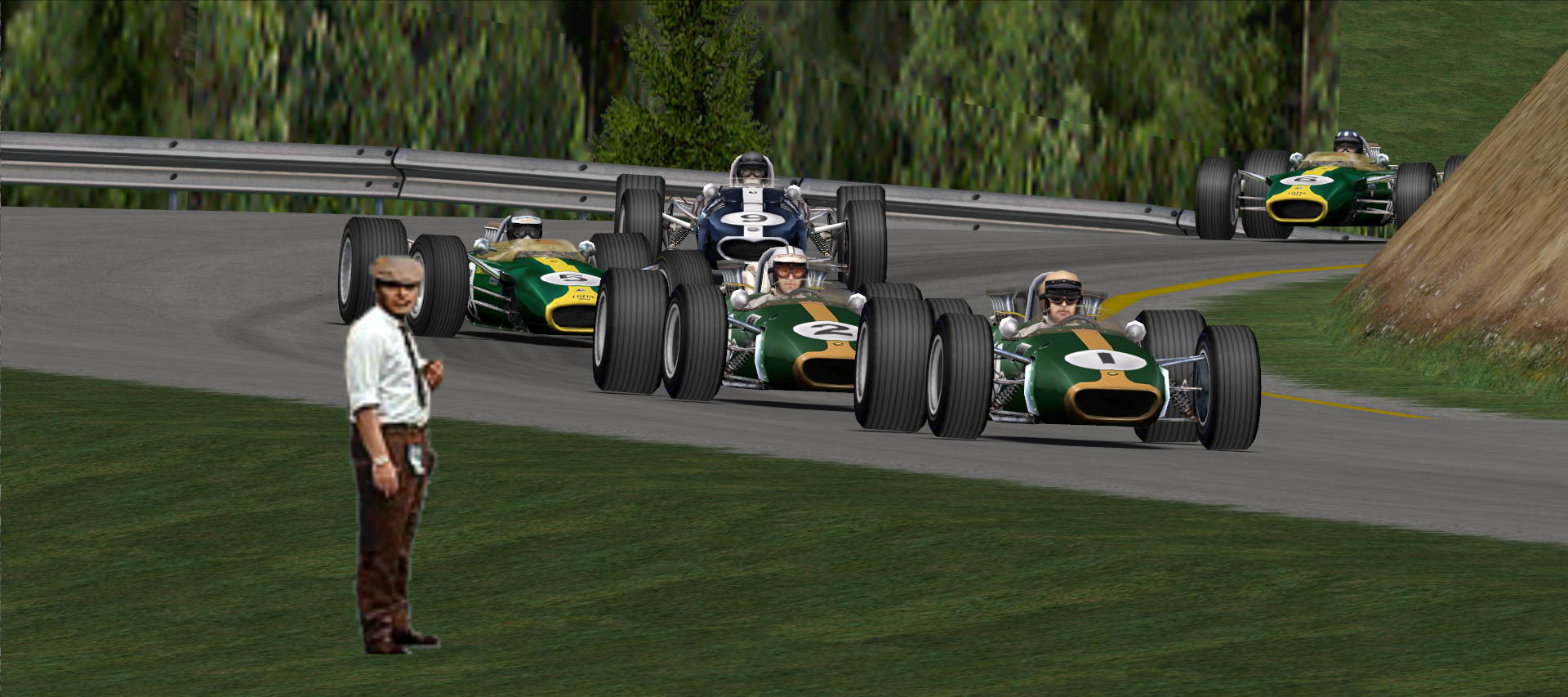
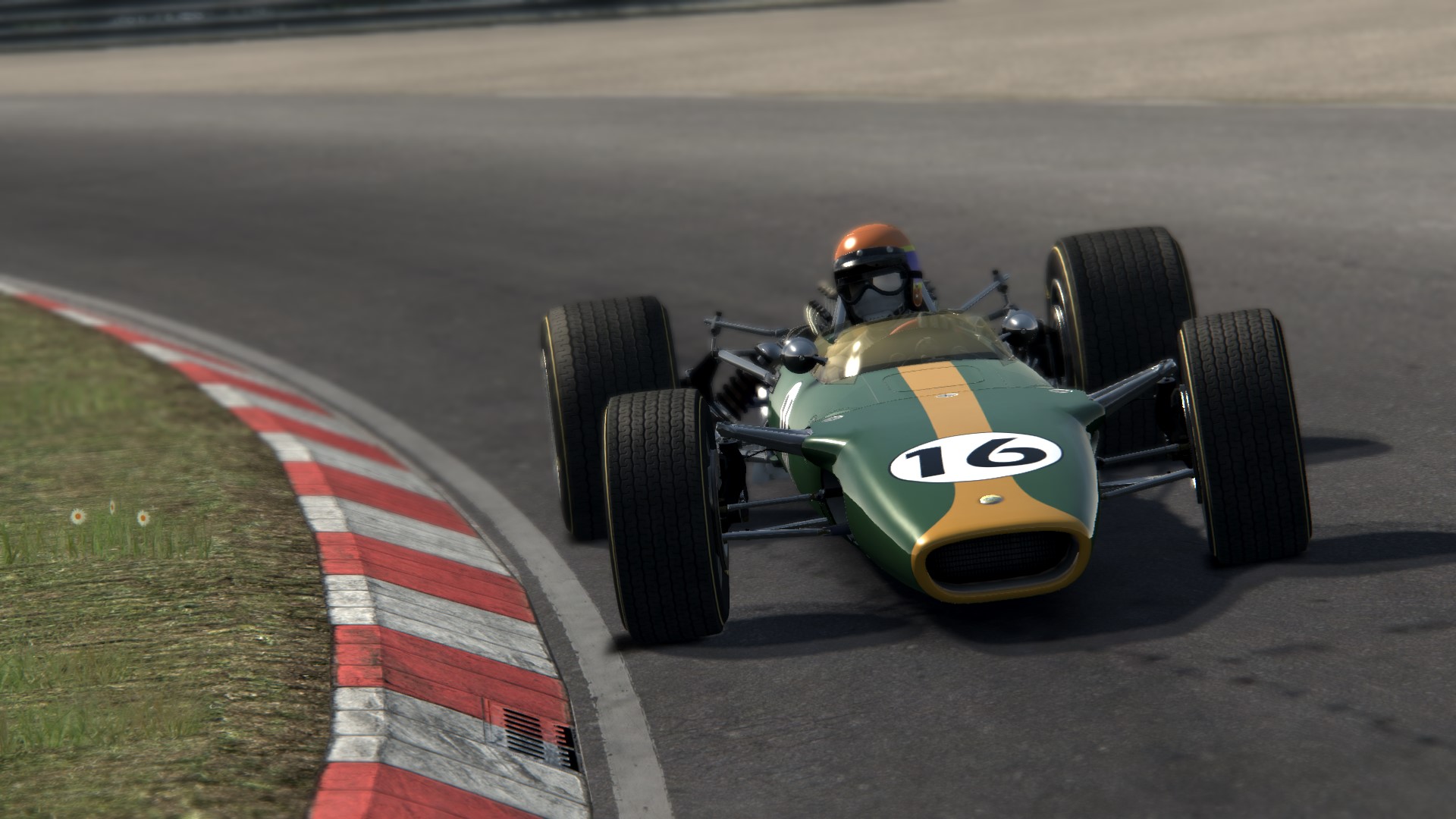
Jack Brabham, Denny Hulme, Jim Clark, Dan Gurney and Graham Hill pound onward while spectator looks the wrong way.

This was a seminal time. In the late ‘90’s video games were a thing you did for fun but your Dad always told you that grown-ups didn’t do it. Yet here we were, living grown-up lives where we played video games. The first generation of kids to grow up with video games in the home were becoming the first generation of young adults playing video games with each-other online. We were passionate about simracing, as it had become termed, I remember nights where I raced on VROC for half an hour but talked with everyone in chat the whole night. Sharing setup tips, talking about races, reading people eulogising in depth about the fabulous cars this game gave us.

Largely the passion of this relatively small group of enthusiastic individuals led us onward to create the community as it has become. Tim Wheatley founded Legends Central which then became Race Sim Central, before moving to the US to work for both iRacing and ISI; Dom Duhan formed the legendary virtual racing team Team Redline; Greger Huttu would win in VROC and then become multiple iRacing world champion… The list goes on…

In 2005 Alex Martini created AutoSimSport, an online magazine covering the developing simracing community. I joined as a writer and the magazine ran until 2011 as we covered everything we could. Months of our lives ensued where our “real jobs” took a sideline to frantic editorial meetings and deadlines. Almost every day of my life involved meeting or talking to various people about racing sims, be they industry insiders, hardware creators, software developers, publishers or people that ran news or league sites. We would talk endlessly about what was coming next, about complexities of vehicle dynamics or tyre modelling. I learned all about Hans Pacejka, about ground effect aerodynamics, and about how dampers work.

Simracing became indelibly stamped upon my life with GPL in 1998, and when I talk to all the friends I made online at the time, friends now for 20 years, they all tell the same story.

Today so much has changed. The world inexorably marches on in its quest, and the people that we are take on their own quest. My eldest nephew, born in 1998, is a keen simracer but is only vaguely aware that GPL ever existed; to him it appears as aged and weak as the arcade cabinet of Night Driver may have appeared to me in my youth. He will never know the experience of a sim that doesn’t quite feel like driving a car but does a bit, he will never know the crippling pain of driving a 78 lap Monaco grand prix using the keyboard. Today Max Verstappen wins real Grand Prix having grown up enjoying rFactor and iRacing in a plush simracing rig, all the while online communities have grown to become vast and barely manageable.

In 1998 there wasn’t such a thing as “online friends”, the internet was young, simracing didn’t really exist, and the idea that a video game could be 20 years old seemed impossible.

Do you have a GPL story to share? Head to our Facebook page and get involved.

“I have a car simulator project that might spark some interest”: My Summer Car

Posted by spamsac on August 26, 2016
Posted in: General Simming.

For some time now, we have espoused our desire for someone to take a different approach to vehicle simulation. As tyre models, aero modelling, graphics, audio etc. continue their inevitable and unrelenting march towards converging with reality, it would be an understandable conclusion that simulations are rapidly diminishing the boundary between virtual and real world. And yet for all the undeniable advancements and progress made within the genre, some aspects have all but stood still, if indeed not gone backwards.

For many, the type of detail and involvement of experience we have discussed in the past will not be of interest nor appeal. Which is, of course, fine. But it is perhaps too easy to dismiss such content and approach as simply “grind”, as something which “gets in the way”, and all too easy to miss what this can actually add to the driving experience itself.

I first became aware of My Summer Car over two years ago when an email dropped into my inbox with the enticing title “I have a car simulator project that might spark some interest”. Its sender, Johannes of Amistech Games, had read some of our articles and felt his creation might scratch some of our itches. A look over the linked twitter feed introduced me to a wonderfully unique title with, frankly, a brilliantly terrible website, which quickly convinced me Johannes wasn’t wrong. Fast forward two years and development has continued, and initial release is on the horizon; the perfect time to have a chat with Johannes about My Summer Car and find out what it’s really all about.

03

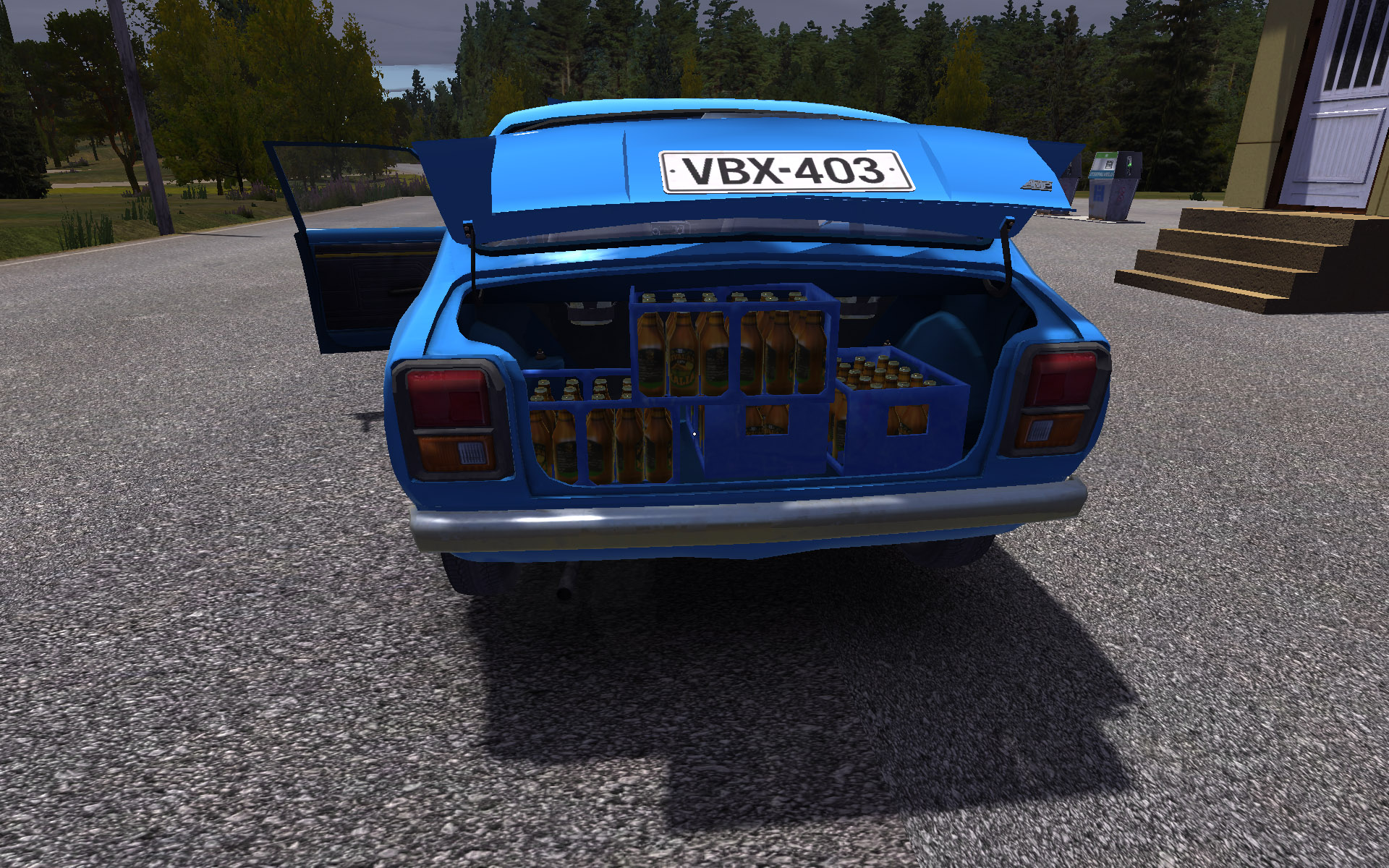
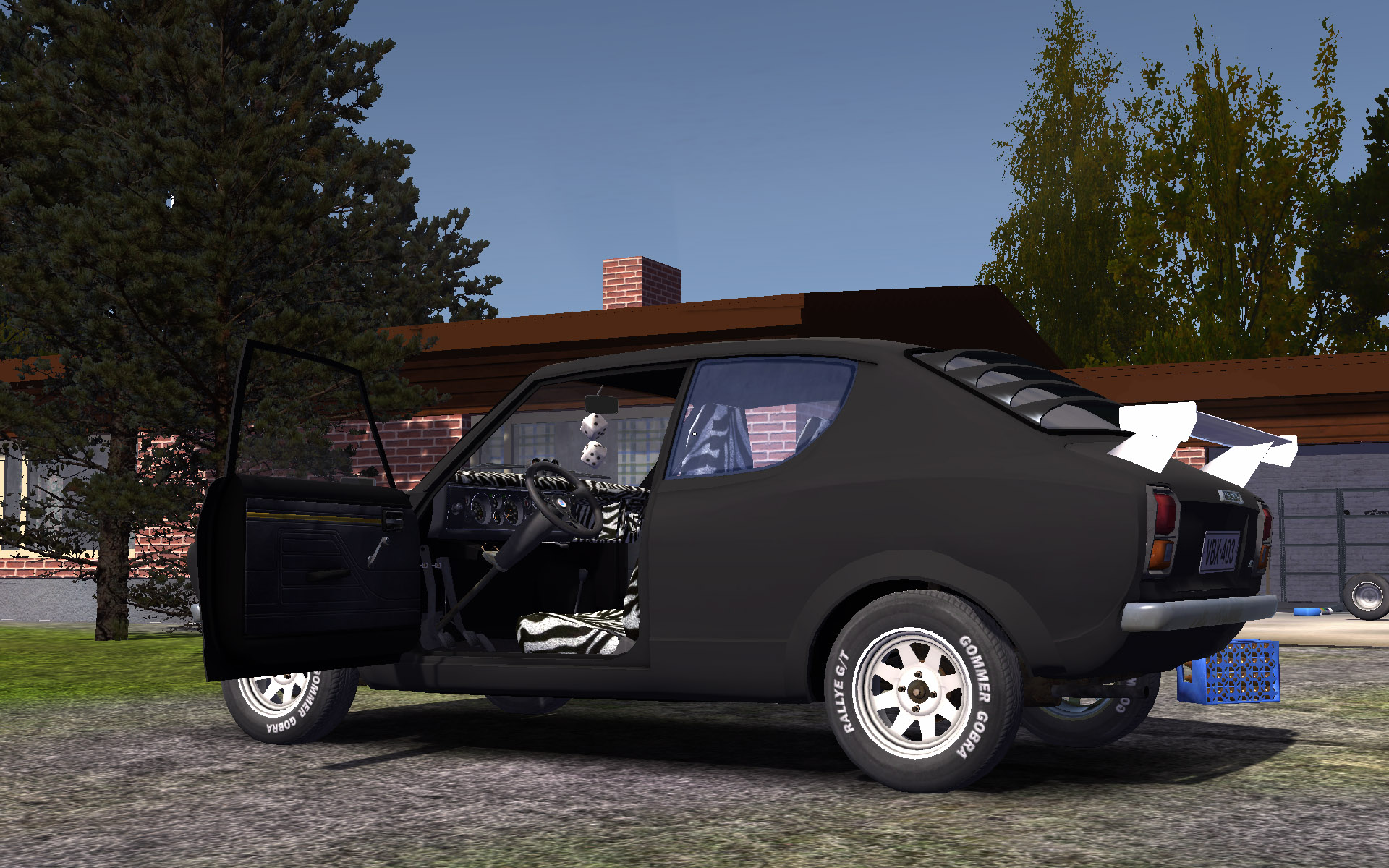
A picture that sums up My Summer Car beautifully: a fully functioning car, and a boot full of (100% physically handled) beer cargo.

My Summer Car has been in development for some time now. How did the project start, and what was your goal?

“I guess we need to get back all the way to mid 90’s when I started to mod car and racing games starting with original Stunts 4D Driving and Papyrus’ NASCAR Racing. Even I loved many of those games I played and modded through the years, I also knew that they had many shortcomings especially when it came down to realism as a whole. Many of those things were details that could not be added through modding, and it really started to frustrate me until early 2010’s when I just quit for good. I couldn’t fix those games to my liking. You could say that I gave these games 15 years to develop, but it never happened.

At that time, through happy accidents, we formed a game project with a few friends which introduced me to Unity3D engine. Well, what happened to that game is another story, but during that time I used my free time to explore Unity as the basis for car game development. I found a very nice plugin that has some car physics basics in place and found out that, modifying it and building from it, I could develop pretty much anything I wanted. Then I realized that I was actually able develop my own car game. It was a big thing to me. I could try to bring to life those ideas and philosophies I had developed in my head all these years.

The actual idea for My Summer Car came quite quickly. As I was sole developer back then, I knew I can make only one car properly with all the mechanical detail I wanted. And the theme for the game formed quite easily around that restriction. Many of us had that one car in our life that either was our first or special in some other way. And the game is about that car. As growing up in the countryside with those short but intensive Finnish summers I knew that’s the setting for the game. It all came together just like that, not really having to give even a proper thought. Also, our Finnish culture is not a very used theme in our local gaming industry so I wanted to give that a try. Sometimes we should embrace what we have here and not always look outside the borders.

That aside. The core focus still was in the inner life of a car and in the fact that the car would need to be assembled as well, before it came available for drive. So why punish players like that? Attachment. It gives the game a whole other level when you actually need to assemble the car, learn how to tune and maintain it. It stops being just a another car in another car game. Never ever has first start of the engine felt so good in games. Player really learns to care about the car and the way he uses it. But that’s not enough, player needs to be punished from reckless driving as well. Something that never happens in car games. Your avatar will die. It is tough I know, but when the game progresses into actual rally racing it starts to give chills down your spine. This is not your another game where you crash 160kmh into trees and re-spawn back on road. Although you can improve your chances with proper safety gear that, funnily so, is not enforced. This is what I believe the game is all about, attachment and danger. Combine those two together and they boost each other.”

For a long time people have argued that, along with the lack of physicality, it is the lack of any sense of fear that “limits” the genre and player behaviour within the world. Perma-death wouldn’t mean much in most driving games, but the level of investment in the vehicle preparation side of things in My Summer Car perhaps presents a unique opportunity. Is this approach (i.e. severe punishment) something you’ve long had in mind, or was it an idea that came to you later in development? Is it simply a gameplay mechanic, or is it about you trying to change the way the player approaches the experiences, and in turn what they get out of it?

“Perma-death was idea that has been there from the very beginning. The concept has never been tested in car simulators and I wanted to see how it would play out. But like you said, for it to have any meaning there has to be feeling of total loss. That’s why working on the car and making it run goes hand to hand with perma-death. The main idea behind it is to evoke fear or suspension. Car games don’t do that, player does not fear the upcoming crash as he knows that basically nothing is lost. But the fear also teases to push it even more. It feels very good when player actually avoids disaster. The biggest dilemma here is whether I should make it possible for the player to choose that feature. I know some would turn it off, and some would try it, but when that option is there to begin with, it lessens the idea.”

01

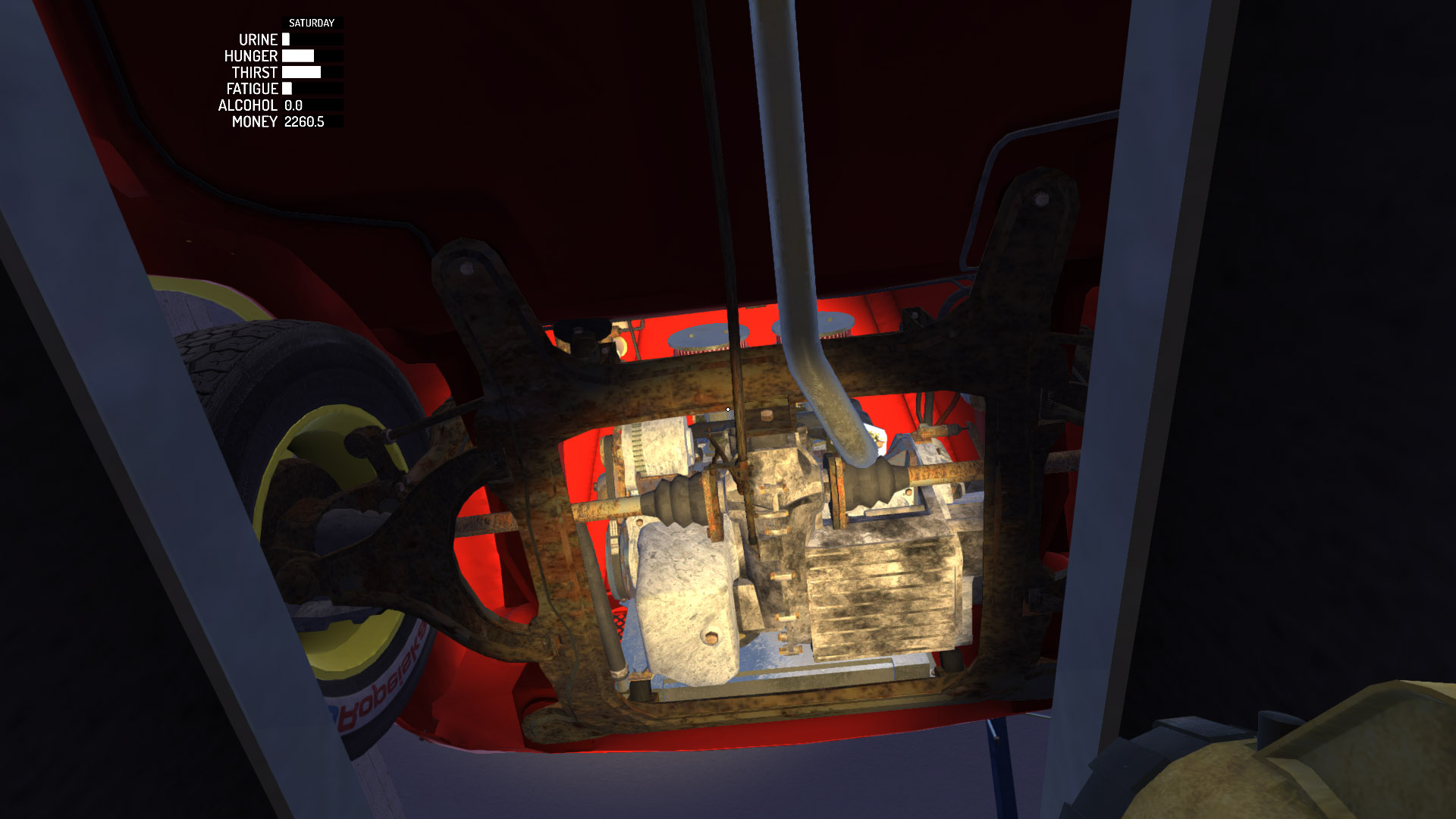
The player’s garage has a pit for accessing the underside of your car; making your life easier as you drain the oil and try and figure out what the hell is wrong with it.

The title seems to be something really rather unique, bringing together some elements more commonly associated with disparate genres. Was there always a clear vision of what the game is and isn’t, or is it more of an evolving project emerging from experiment?

“The name for the game formed very early as well, I can’t really remember how exactly. But it was conscious choice to not have typical car/racing game title. As this is not typical such game. I wanted to have good name and distinctive logo and I think that’s something that came out really well. The game theme and setting is well presented in the title. It is sort of a joke how casual vibe the logo has while the game is nothing like that. Life is tough I’d say.

I also wanted to avoid the word “Simulator” in the title as that has become quite a meaningless word. Don’t get me wrong, I love simulators. I strongly believe that simulator is the only interesting gaming genre these days. But too many times, so called simulator falls very short in what it tries to represent.

The vision for this has been rock solid at all the times. Everything folds around the car. Maintaining and using it costs money and money can be earned from doing various jobs. And everything else is all the things that happens on Finnish summer between car building and working. Sure the game has grown larger than I expected originally, but it’s always well within the vision. Original idea was just to assemble the car before in-game store closes so that you can get there to buy beer and sausages. Well we have that already, but also tons of other stuff as well.”

Underlying the humour and vibe of the title is obviously the vehicular elements themselves, namely driving and vehicle maintenance and modification. Is this a driving sim at core with sandbox/real-world elements thrown in to enrich the experience, or are vehicles more a tool to allow the player to experience the world?

“I’d say this is driving sim with the sandbox environment. One part having a big impact on the game is the avatar and its physical needs. You have to eat, drink and sleep. It is there to make things more difficult but also more meaningful as well. Player is forced to move at least to get groceries. And moving equals opportunities for failures and danger. Failing in this game is fun. Forget to add motor oil? Tough luck. Everything is also linked to in-game clock, so player needs to consider when to move and how much time there is left to do that. Some things need to be planned and not just do everything randomly.

I believe that a car game should be more than just the cars and track. There is so much things happening leading to the actual driving performance. This game could be compared to racing sim, which does not only simulate the race but also the week and race weekend leading to that race. All the preparations, tuning, fixing, testing etc. That has never been done in racing sims. While this game is not your regular track racing sim, it has a rally-sprint race every Saturday you can participate in. To be able to register for that competition, player needs to be in the right place at right time, car has to have passed car inspection and then entry fee is required to pay. So it is not easy. When the actual driving part begins, player feels great accomplishment and fear at the same time. This is what computer racing should be. Also, top-three finish will grant player a trophy and prize money. That trophy is an actual in-game object that can be carried home and placed onto the book shelf or where ever. One idea a tester came up with is to expand the rally event to be a two day event, where the player is required to sleep overnight at the event camping area. I would really like to make that happen.”

09

How your engine may look quite a bit of the time. Thankfully you can work on it in the car as well as out.

Rallying currently sits at the top of the achievement list in terms of car tuning and application. How far do you see that going; will it very much remain club level in lower tier machinery? Have you plans for other forms of motorsport?

“It is definitely club level thing because of practical reasons. It is less work to do. Currently there is only one special stage, if I expand to two day event then it would hold two stages. The rally is more just a setting to really have a reason to push the car and player to it’s limit. And that is what it does really well. The game also has a small airport that holds quarter mile drag strip. It has realistic starting and timing procedures and is very good way to test out performance. Only problem with it is that the staging is very difficult without proper clutch and throttle control. So players with gamepads or keyboards will have hard time to get staged. That is one reason I haven’t expanded it to similar event as the rally where player would race against AI drivers. As a drag racing fan myself, I think I eventually work something out with that too. I have also some ideas how player could engage other tuned AI cars into illegal road races. Some time ago I also tested a “folk racing” in the game, not sure yet how much work there would be to implement it but that is something I would like to have for sure.”

04

Looking the part with twin-carbs and racing radiator, the level of detail is beautiful to behold. Whether or not it runs is a different matter altogether, however.

You’ve used the word “realism” a lot when talking about the title in the past. The (wonderfully) anal vehicle mechanics, and the whole car-ownership/maintenance elements, certainly point towards a more realistic vehicle experience than the “sit in perfect shiny new car and go” offered by nearly all driving titles. Where does the realism extend to in terms of the actual modelling? Are the physical behaviour and function of the myriad car components included being realistically represented, and do they form part of an ostensibly accurate driving experience?

“Surely I can’t compete with top of the line racing simulators when it comes purely down to the driving and tire physics fidelity. That is something I had to admit from the beginning, I have what I have and I want to make most out of it. However I believe that’s my greatest strength as well. I am able to focus on the ‘actual realism’ which I feel is important as well. Or even more so.

We can start with the mechanical simulation of the car, which is affected by how player assembles, tunes and maintains the car. The car consists hundreds of parts and several hundred of individual bolts, which all are affecting the usability, strength or performance of the car. For example parts can drop if they are not well assembled, engine internals can grenade completely just because player left one of the main bearings little loose, plus the infamous valve and carburetor adjustment to get every last HP out of the engine, or just to adjust fuel mixture. Car has so many dynamic fail states that even I am not aware of everything any more. When it comes to engine itself, bear in mind this is a ongoing development process, everything meaningful is being calculated. All the car fluids and how those affect air and fuel densities, individual combustion of four cylinders, motor oil grades, cooling efficiency, exhaust breathing, main electrical circuit, drivetrain, brakes, etc etc. You can for example drive the car with just battery for some time if alternator belt snaps due to improper assembly. I love to study various aspects of a engine and implement those into this game. It is also fun when the seat breaks while you’re driving.

Apart from the main car there are other cars and vehicles as well. Player can’t work on them so they do not have such detailed mechanical simulations as the main car. But they can be driven and need to be refueled. Also all them have distinctive driving physics that are based on real life values as much as I can find such data. It is always fun experience to drive different vehicles. For example the cargo van is very handy when picking up post packages from the store. That’s a real life usefulness. The fun little detail is that cargo is affecting the driving physics of the car as well. Twenty cases of beer crammed inside the car feels just like that. One solution is to drink from the cargo, but driving under influence can lead to serious trouble. Most likely player just gets stuck in the ditch, but might also get caught by a police and worst case, die of course. So sometimes there is police to make sure you drive sober, within speed limit and your car has been inspected. Quite likely jail time will be implemented.

One goal is to have every knob in the car dashboards to be clickable and usable. I like to have that flight sim style approach on that. It is especially fun with tractor and truck which have all sorts of functions on board. Those will be all simulated properly. Of course some functions can be assigned to steering wheel controller as well. But like for radio buttons, I like to keep them mouse only as there is just something there when player adjusts radio volume and veers into oncoming traffic.”

08

Money doesn’t buy taste. Lack of money doesn’t either.

At what level would you put the driving model itself; is it a solid if not particularly intricate model that provides a robust and believable enough experience, or should prospective players prepare for a driving model which in itself very much plays second fiddle to broader game mechanics?

“I’d say that it will fall somewhere on solid side. There are lot’s of changes you can do to your car and those have corresponding effects. Things like tire types, car weight and inertia, fuel weight, different grip surfaces, alignment of tires, etc, all affect the handling characteristics. Of course this is when the car is in good condition. If some critical parts are missing that can be also felt through the handling model. Most common reason for novice player deaths is brake failure. One goal is to make player able to diagnose the car issues by driving it. If you loose a tire at 100kmh that can escalate quickly. Player definitely feels it as it happens, and it can scare the hell out of you. Surely, most of the problems are still under the hood. The broader game mechanics are there to support the life of a car and it’s driver. Approximately the one car alone, covers 70% of the total game mechanics or complexity. So the focus truly is there. Games are simple, cars are not.

Vehicles in the game are designed to be driven with wheel setup with shifter and clutch. Apart from the muscle car that has automatic transmission which, by the way, has been very meticulously simulated. But yes, there are driving aids for those that do not have such controllers. I feel that this game is impossible to play with arcade racer mentality, it is just way too difficult. First of all the vehicles are all bad in some personal way, where the main car probably performs best depending on how it’s being built. The the environment is very unforgiving, dirt roads are narrow and fairly straight with lots of hills. It teases player to drive as fast as possible, only to fail horribly. The highway is probably more suitable for arcade driving. Then again, speeders, drunks and animals pose another threat.”

The level of functioning detail in the vehicles, paired with the small development team, means that it will not be possible to include a roster of vehicle models. As you say, the theme for the game has developed around this restriction. With that in mind, do you have worries about the longevity of the experience? Will there be random/procedural features to add variety to play-throughs, or is that missing the point somewhat of what the experience is intended to be?

“Amistech Games is two people team currently, with the other person doing graphical assets and props. Including another workable car is definitely a huge task. That is why it is something I can’t ever promise to be added. I would love to, but it is a lot of work. Maybe if final game is received well that might be possible. But it is more of a question whether to make a new car, or a totally new game. Not much difference in the amount of work. But then there are these other derivable vehicles which I intend to bring into the game as much as it can hold. One car could be done easily in one week if not having to do anything else. I wish the game would be finished soon so I can fill it full of vehicles. That’s what I love to do.

Some randomised content is being planned and that is definitely something that I want to add in the long run to give the game some extra lifetime. These would be mostly various jobs and “loot”. There are also secrets and Easter eggs in the game for players to search for. But in general I am not that concerned about the longevity, not all games need to be like that. This is more like a experimental car game than a new way of life.”

10

One of the additional vehicles present in the game which the player is able to operate and drive. By Johannes’s own admission, “Final purpose is still yet to be decided, but it is something job related.”

In regards to the other vehicles in the game which present more of a supporting role to running and maintaining your main car (and the player themselves), do they too require maintenance and care, or are they more of a reliable constant in the player’s arsenal to tackle the challenges of the main game?

“At least currently they do not require maintenance apart from refueling. However I would like to have at least batteries drain at some point. Then it would be possible to jump start and of course short circuit and burn down the cars. So they are more reliable tools to lean on when main car does not work. But they do also crash like any vehicles, if you somehow tip the tractor over it might be real trouble to get it straighten again.”

Have you any plans or intentions to open up the game for the modding community to bring new features/content to the title? What about features such as multiplayer?

“Unfortunately this game won’t have official modding support or multiplayer. Those things should have been taken into account from day one for such a complex game as this. It is too late for those. But quite likely there will be texture modding of some sort as I am planning to make it possible for players to paint the car or cars using image editing software. But it is optional extra of course. When there are posters on the walls of the house and garage, those posters could be replaced as well. As a former modder myself it came as a surprise how damn difficult it is to design a game to have a modding system. It requires completely another approach. Maybe the lack of multiplayer does not sadden me so much as I am a very unsocial person. Hehe, I used to grow up playing games mostly alone.”

The title is currently submitted to Steam Greenlight and doing rather well! (nb. My Summer Car has now been successfully Greenlit!). What is your long term vision for the title and where you want it to be; is there a point where it will be “finished”, or is it a labour of love that will always have room for development and progress?

“Yes we are doing surprisingly well, many thanks to our supporters! I have an almost complete road-map (whose contents are secret for now) for the game and finishing it is my only goal. I feel that this game has to be pretty solid with clear beginning and an end. Good thing is that these are all figured out already, yet need to be implemented. So I am definitely going towards finishing the game. Of course if it goes well, nothing stops us from expanding it with added content or DLC. But that is extra, game needs to be able to stand by its own. Developers have only one chance to release their first game, and better to do it as well as one can. This goes also managing the community surrounding My Summer Car.”

By “managing the community”, do you have anything in particular in mind for this? Are you talking e.g. dev forums, or rather just the communication and flow of information between yourself and those who support and play the game?

“Yes I mean the communication between game developers and those who have bought it and play it. I don’t have a plan, I wish I had. It probably comes down to me answering as much questions as possible and hoping at the same time that those players who know the game well would be able to help as well. It is just big leap into the unknown for me when game hits Steam store. I wish I could use all the free time to just work on the game, but I know it is not possible. But it is important as well, if everything goes smoothly those people probably want to try out the next game as well. Still… even everything fails big, there are car games left to do for me that no one has ever made. So I probably keep doing what I am doing.”

07

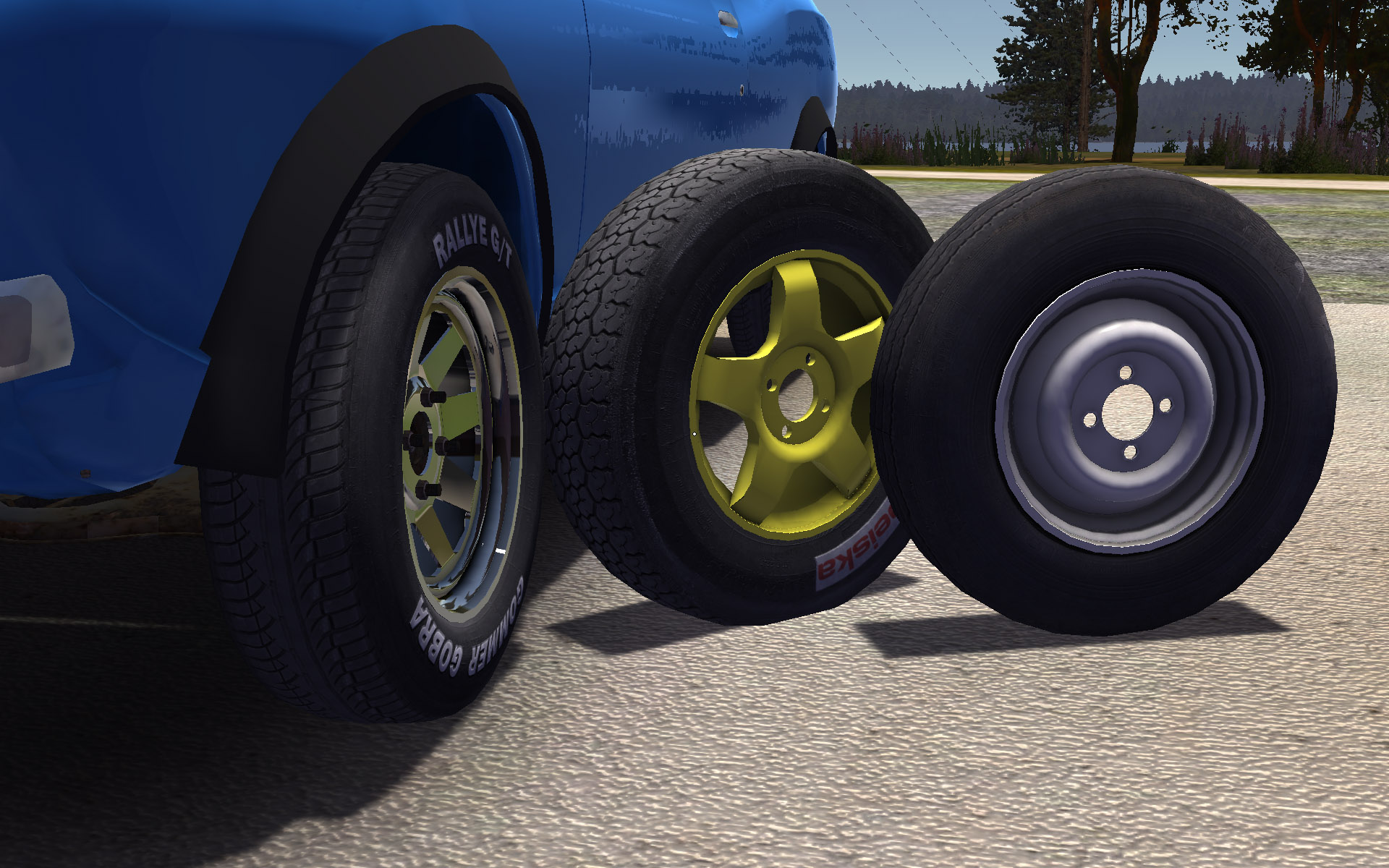
Different rims (which can be painted) are one of the many personalisation options available to the player. Similarly, a variety of tyre types provide different characteristics.

My Summer Car seems very much a project born out of your own passion as well as your own experiences (real and virtual). What have been the biggest challenges or surprises in making the transition from player/modder to creator/developer? You mention the complexity of adding modding support into the title at this stage, but are there any other lessons you’ve learnt during the process that maybe make you think if you were starting again, what you might do differently or at least take a different approach/mindset to?

“The biggest surprise might be that the whole game developing thing was easier than I thought. As I used to mod many different games, it was always constant struggle against restrictions and required a lot thinking to get around those. The difference is that now I am the one who is developing those restrictions. If they are not well though out, they show up later in most mysterious ways and then you need that modder thought process again. It is not exactly fun when making your own game. This game has big database of car parts and bolts. When there is a problem, the problem is always big.

So that is the biggest challenge, to be able to think out all the future scenarios before committing to some design choice. That I would do differently, full “technical scenario analysis” or something before planting down a single digital tree. Because of that, some things stay unfixable probably forever in this game. Of course game also grew to be bigger what it originally was supposed to be as it started only as experiment and a joke even. So I guess I need to learn contain the scope of the game. I believe many indie designers share this.”

The only other game that takes a remotely similar approach to vehicle maintenance and modelling, albeit in a very different context, is the recently Greenlit “Jalopy“. Have you followed that title at all, and if so does it do anything that has particularly caught your eye?

“Yes I have been following the game very closely all these years. We have kept contact with Greg (Jalopy developer) and it has been very fun to realize that we both started working on these types of games at pretty much the same time. I guess we both sort of got tired of what mainstream car games had to offer. In Jalopy I like how it uses RNG or procedural generation in how it creates the routes. For me personally that is something I would like to see more in car games. I believe Jalopy is first proper road trip game. It is odd how that genre has never been done before. I know I would’ve played such. Oh yeah, Desert Bus. I think we can accept that as well. In the end there are very few similarities between Jalopy and MSC. Both having the manual car maintenance and game being set in some specific cultural context and time.”

02

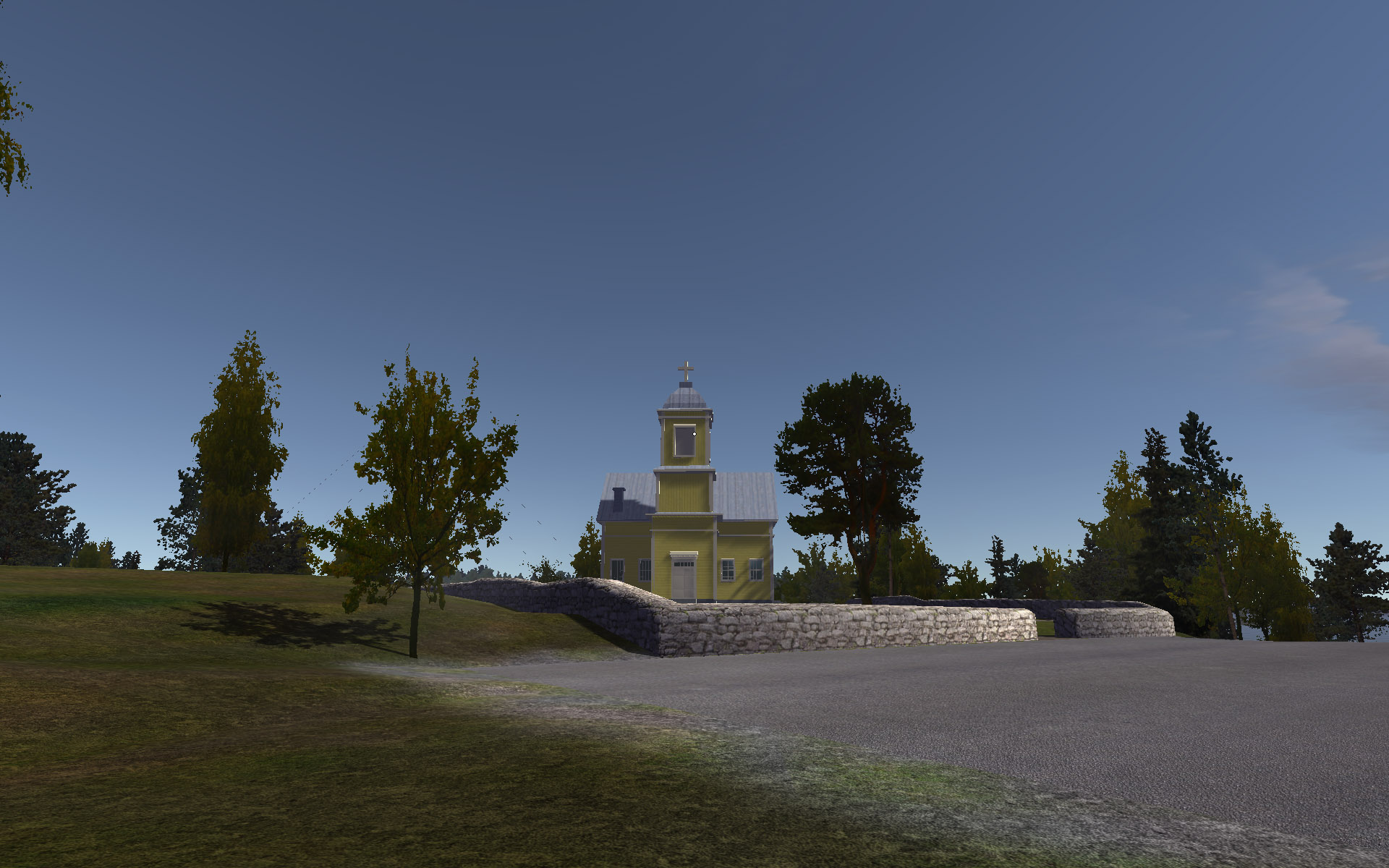
Not all is lost when the player meets their demise. A new gravestone will appear in the churchyard detailing the player’s name, date of birth (game start), and date of death (game over). Lovely stuff.

On a broader note, the real life influence in the game is clear from your previous answers, but have any other video game titles, perhaps from different genres, provided any tangible inspiration or learning for My Summer Car’s design and development?

“There are many inspirations for sure, some intentional and some not. When it comes to different genres, I think that Surgeon Simulator and Gone Home have inspired me to try doing this game. Surgeon Simulator having that idiotic approach on difficult job and Gone Home as it would be nice if player has a home to stay in. But the main inspiration is 90’s Finnish homebrew game culture, so called “Suomipelit”. I lost my teenage years on those games and they really are always here to stay with me. MSC shares the same humor aspect. I feel like I am finally giving something back to the scene, 20 years too late. Maybe I am just grown up kid stuck in the past. But I miss that, nowadays we do mostly sterile mobile phones and I don’t even know if there is homebrew PC game culture anymore.”

Thank you Johannes for taking the time to talk to us.

“Thank you, this has been very interesting to answer these questions and get my own head sorted as well.”


Today’s simulations give you little to fear, because there is little to lose. Failure to finish a race might be frustrating, but usually little else. Likewise, other consequences such as a few docked points on your iRacing safety rating, or the inconvenience of having to start your lap again from the pits, are not likely to provide long-lasting cause for concern. Can a simulation hope to change this? We certainly believe so and, thankfully, we’re not alone.

My Summer Car gives you something to fear because it gives you something to lose, with a mistake seeing potentially seeing many hours of work and effort wiped out. But it does more than this. In raising the stakes and giving the player so much to risk, it also has the potential to give you something truly rewarding to achieve. Think of sim-racing achievements, for example an 8 minute lap of the Nordschleife in Grand Prix Legends. Imagine how much more rewarding that feat would be were you not just able to reset and start again every time it went wrong, but rather you had to deal with the consequence of your actions and earn the ability to take another shot at it. Lives might not be on the line, but a lot less people would have managed it, and the virtual achievement would have been a significant step closer to the reality.

When released, what My Summer Car ultimately gives the player in terms of experience and challenge will certainly not be to everyone’s tastes. How all of the different components, from simulated car maintenance to lighter humorous moments, come together and hold together as an experience remains to be seen. It could be an engaging and entertaining title which sucks the player in and holds them from first grasp of a spanner to fatality against a tree; or it could be that the title works more as a technical demonstration and proof-of-concept pointer towards future directions for the genre. Time will tell. Either way though, it is hard to argue it is not pushing realism forward on a number of fronts with a big shove, and I personally hope Johannes leaves the option to disable player death on the cutting room floor. My Summer Car is, if nothing else, attempting to do something that some of us have long yearned for. That it will do so with a beer-fuelled sense of humour and a few lairy moments along the way may make it all the more fun and, for some of us, perhaps even more realistic yet.

iRacing’s McLaren-Honda MP4-30 Hybrid

Posted by shrapnel1977 on December 17, 2015
Posted in: iRacing.

“Fernando we’re not sure the fuel dash is working correctly. Can we have multi H13 position two?”

“Try purple C3 position three Jenson, exit diff locking.”

These words are typical of those we hear on pit-to-car broadcasts in Formula One (F1) racing in the modern era. Words of drivers who are making constant adjustments to their machines in order optimise the car’s performance, tyres, fuel, and now Energy Recovery Systems (ERS.).

In 2014, F1 introduced new rules to dictate that all cars must operate on Hybrid power units; a change that completely re-worked the way F1 cars were to function in a race situation, and would completely change the packaging requirements of the vehicle as laid down by the designers.

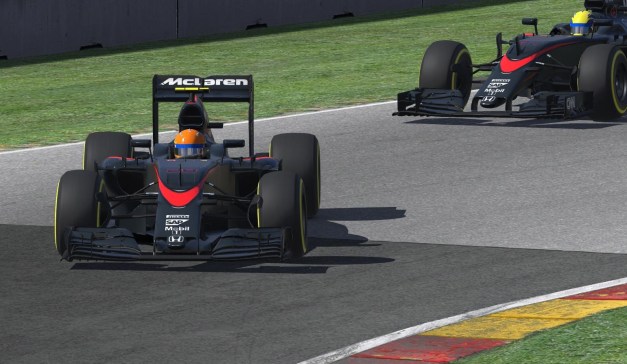
MP4-30 high speedIn 2015, McLaren commenced their relationship with Honda as a works engine partner with their new MP4-30 chassis that was mated to the Honda RA615H V6 internal combustion engine (ICU). This intricately engineered 1.6 litre lump did not come alone, however, as the hybrid rules dictate that an F1 car must run two ERS systems with an MGU-K (Motor Generator Unit-Kinetic) and an MGU-H (Motor Generator Unit-Heat) which recharge energy into a battery that can be deployed to the rear wheels adding an extra 160 horsepower (hp) to the 600-odd that the ICU is pushing out.

Some time ago, our good friends at iRacing announced that they would be modelling the McLaren-Honda MP4-30 within their venerable simulator.  This meant that us every day simracers would be given the chance to get to grips with the various controls and switches that Jenson Button and Fernando Alonso have spent the season with; a tantalising prospect at the time, but questions were there about exactly how much control we would have over the cars various systems.

We needn’t have worried:- iRacing’s history had given us a clue. Despite being considerably less complex as a racing machine, iRacing’s implementation of the 2009 Williams-Toyota FW31 covered all the bases admirably, with in car controls for various differential controls, variable brake bias and a few other “trick” bits of kit on the car. At RAVSIM we’re great believers in a car simulation being just that, if there is a switch in the real car, it should be in the sim, and you should be able to use it. Be it entry differential settings on an F1 car, or heater controls in a BMW E30, if the car has it, so should the sim. It’s not something most developers agree with, however.  Some sims don’t even trust us with controlling our own pit-lane speed limiter button, after all. Thankfully, iRacing’s view is a little more aligned to ours.

Last week the MP4-30 was released, and since then the bold and the brave of iRacing’s top drivers have been working day and night to understand the various settings and controls on the machine. With various in-car settings that can (and in some cases have to) be managed during a race, along with a few other settings and configurations that can only be worked with in the garage, it has been a minefield for some of the less technically minded simracers. As someone who has been fascinated with these controls since the car was released, I am going to try and see if I can decode some of the “magic” going on.

“Jenson default X5B.”
“You’re going to explain that one to me, I can’t find it.”

MP4-30 mid cornerSo to start with, let me skip back a little bit and try to explain what each of the components in the MP4-30’s power unit actually do.

First is the petrol engine, or ICU. I’d presume that if you’re a simracer and you’ve found your way to this site then you probably know what one of these is. In this case the Honda RA615H is a 1.6 litre V6 unit with the V set at 90 degrees, as dictated by the rules. The ICU is connected to a turbocharger allowing the engine to be more compact but produce similar power to the 2.4 litre V8 engines used in F1 prior to 2014. The turbocharger is a device used to efficiently utilise the energy stored with the engine’s exhaust gases, comprising of a turbine and compressor supported by bearings on the same axis.

Exhaust gas energy rotates the turbine powering the compressor, which in turn compresses and increases air fed into the engine’s combustion chamber, thus allowing for more fuel combustion and a higher power output.

In 2013, F1 engines were limited to 18,000 rpm, but from 2014, the rev limit was reduced to 15,000 rpm, along with a maximum regulated fuel flow of 100Kg/hour capped at 10,500 rpm. Thus, as power output increases proportionately with the amount of fuel burned, higher revs burn more fuel, and increase output, in a shorter time. By capping the maximum fuel flow at 10,500 rpm, the same amount of fuel flow is available with revs above this point, increasing mechanical resistance, and decreasing the merits of revving higher than 10,500 rpm. F1 engines of the past were designed to maintain higher revs to create higher output, but the new hybrid F1 shifts the focus to designing engines that use energy more efficiently.
In the cockpit this means that the driver has to be careful to shift up to the next gear at the right time in the rev range, rather than “run it to the limiter.” This efficiency is enforced yet further with a fuel limit in races of 100Kg, which often sees drivers having to use different engine modes for managing fuel consumption.

Within iRacing these settings can be adjusted in car by moving the “G” control between 0 and 9 (available on the in-car controls menu and visible on the gold thumb dial on the left of the steering wheel). The lowest setting, 0, gives 100% turbo boost pressure, with each increment upwards limiting the boost by 1%. Thus a setting of 9 gives 91% boost from the turbo. The higher settings provide better overall fuel consumption at the expense of ultimate power from the ICU component.

Whilst Honda’s ICU has come under some scrutiny for its performance in 2015, it’s fair to say that this is far from the weak link in the solution.  Honda’s experience in Japan’s Super GT with the hybrid CRZ GT300 machine, as well as their involvement in WTCC which operates with a similar “small-block allied to turbocharger” design, suggests that their engineering group have quite some experience in this area. Nevertheless, the RA615H was a completely new design, which facilitated McLaren introducing a new gearbox for 2015 to optimise the mating of the ICU and gearbox in the rear of the car.

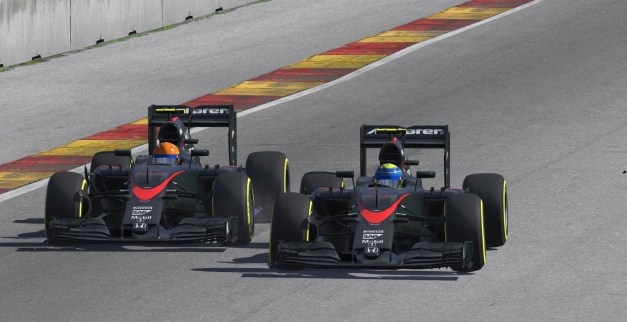
MP4-30 entry stability

Braking stability can vary widely with different MGU-K settings.

“Jenson this is fuel three, we need fuel six.”
“You would not believe how early I am lifting off.”

Next up comes the MGU-K. This unit is not dissimilar to the KERS systems that F1 has been running since 2009. This takes electrical energy harvested from the rear axle under braking, which is stored in the ERS battery, and deploys it to the rear wheels when under power. When powering the car using electrical energy stored in the battery, the MGU-K adds 160 hp (at maximum deployment) to the ICU’s 600 horses.

This is not unlike the systems used in road cars such as Honda’s “Fit”. Within the F1 rulebook, however, the electrical energy charging the battery from the MGU-K is limited to 2 MegaJoules (MJ) per lap, and the maximum energy used by the battery to power the MGU-K is limited to 4 MJ per lap, presenting a compromise in management of this energy over a lap. With the design restrictions ensuring that energy is harvested at a lower rate than it can be deployed, there is even more compromise to be built into the equation.

MP4-30 CockpitBack in the iRacing cockpit we have a number of controls for the MGU-K that can be manipulated by the driver on the fly, as well as a few that can only be set in the pit lane. Let’s take a look:

MGU-K Regen gain (TRQ – Gold dial to the right of the steering wheel): With settings from 0-9. This manages how aggressively the MGU-K harvests energy from braking events. With 9 being the most aggressive setting and thus harvesting the most energy into the battery at a given time.

MGU-K deploy mode: Set to either Fixed or Adaptive, this determines how the MGU-K deploys power to the rear wheels with settings managed via separate switches. Fixed mode applies a fixed deployment rate at all times, whereas Adaptive will automatically adjust the MGU-K deployment rate to work to a set ERS battery charge state.

MGU-K deploy fixed (MFC – dial on the bottom left of the steering wheel): This defines a fixed rate of MGU-K power output to the rear wheels under power that is adjustable between a range of 1 to 14. With 1 being maximum output at all times (which will heavily decrease battery) and 14 being no deployment (leaving the ICU to do all the work). This setting only applies if the MGU-K deploy mode is set to fixed with the above switch.

MGU-K deploy adapt (MFH – dial on the bottom right of the steering wheel): In adaptive mode the dial is also adjustable between 1 and 14. This manages the MGU-K deployment rate based on a target ERS battery charge state. Thus setting the dial to 1 will set the deployment rate to a more aggressive (more power) rate with a minimum ERS charge set at 20%, with 14 managing the available battery to a maximum charge rate of 85%. Conceptually thus, on a setting of 1, once the battery gets towards 20% the adaptive system will reduce MGU-K deployment to allow the battery to recharge, and then automatically increase deployment again when more battery is available.

MGU-K deploy ramp (F – only available in the garage): This sets how aggressively the ERS power is deployed to the rear wheels upon throttle. Adjustable between 0 and 9, with 9 smoothing out the power delivery for improved traction and 0 offering a heavily aggressive deployment

MP4-30 exit stability 2The MGU-H is the next piece of the ERS system puzzle, which adds to the overall efficiency of the power unit. The MGU-H converts heat energy from exhaust gases into electrical energy to recharge the ERS battery. ERS-H is yet to be used in road going hybrid cars and consequently is a major area of research that may eventually benefit the greater motoring world.

Unlike the MGU-K, the F1 rulebook does not place any energy usage restrictions on the MGU-H. Electricity generated by the MGU-H may be fed directly into the MGU-K, effectively bypassing the MGU-K regeneration restrictions and tapping the full 160hp.  This highlights the importance of developing a system to fully utilize the MGU-H, and any new F1 power unit heavily depends on how effectively the MGU-H performs. Within iRacing there are no controls for the MGU-H as it operates based simply on the exhaust gases escaping from the manifold. What can be seen within the iRacing MP4-30 is that, when one sets the MGU-K regen setting to zero, there is still charge being pushed into the ERS battery, coming from the MGU-H. Alas, the charge harvested from the MGU-H is usually negligible, as the MGU-H will be sending energy to the MGU-K on throttle, so the overall power delivery needs to be balanced alongside MGU-K deploy and regen settings.

So how does it all hang together on the track? At all times, as long as the driver sets the switches accordingly, energy is harvested into the ERS battery, or is deployed from the ERS battery in different ways depending on what the car is doing.

Under braking the MGU-K generates electricity from part of the kinetic energy lost when the car is braking, and stores that electricity in the ERS battery. As the MGU-K’s maximum output is 160hp (or 120 kiloWatts) and the amount of energy allowed to be stored in the battery is 2MJ per lap, the MP4-30 needs to brake for around 16.7 seconds per lap to reach this maximum charge.

Upon acceleration out of corners the car can accelerate faster by adding the power output of the MGU-K to the ICU’s power output, in the process depleting the charge in the ERS battery. However, concurrently the MGU-H is utilising the exhaust gases to recharge the ERS battery while the turbocharger uses its compressor to send compressed air into the engine. Under full-acceleration, the exhaust energy fed to the turbine can increase to a point where it exceeds the amount of air the compressor can handle to feed into the engine, in this situation the MGU-H converts this excess exhaust energy into electricity, which it then sends directly to the MGU-K for deployment to the rear wheels.

There are no rules on how much electricity the MGU-H is allowed to generate, so the MGU-K’s output can be added to the ICU’s output without worrying about the rules on the amount of electricity that the battery can charge or discharge. Thus, unused exhaust energy can be efficiently used to accelerate faster.

The MGU-H also solves the problem of turbo “lag” on power application by using an electrical motor to power the turbo’s compressor, saving the turbine from having to wait for the exhaust gas to do so.

“Can you have a look at the braking for the hairpin please. How many more laps on the red button?”
“Jenson we have 11 laps red button remaining.”

MP4-30 hard braking

At different stages of a race two cars can have very different braking performance due to MGU-K harvesting.

Phew! So anyone coming fresh to modern F1 technology may need a break after reading all that. But it’s not quite over. There are a few more tricks up the F1 driver’s sleeve in the cockpit of the MP4-30. Like the FW31 before it, this car is fitted with various settings for management of the active differential at the rear of the car, as well as dynamic brake bias settings. I am not going to go into depth on these settings, but looking at the newer options available with this car we note that buttons can be mapped to functions such as the “Push-to-pass” and DRS.

Push-to-pass, or the overtake button (OT on the steering wheel), is simply a button that allows the MGU-K deploy mode to switch to its most aggressive deployment rate (1) for the duration that the button is held down. Whilst this obviously brings about a noted depletion in the ERS battery charge, it can be extremely useful to pull off an overtaking move.

DRS (Drag Reduction System) opens a slot gap in the rear wing on certain denoted parts of the circuit that significantly reduces drag and increases top speed. This is freely usable in practice and qualifying sessions, but restricted in the race to being used only when within one second of the car in front. Opening of the DRS has to be engaged by the driver, with one green light on the top left of the steering wheel becoming illuminated when entering the DRS detection zone (the area on the track in which you must be within one second of the car in front), which increases to two green lights when the car enters the DRS zone, at which point the driver should press the DRS button as soon as possible to maximise performance through the DRS zone. When the DRS is engaged, there will be four green lights on the dashboard. Opening the DRS in the rear wing has a knock-on effect of reducing rear downforce and thus upsetting the front to rear downforce balance. This is something the driver must be aware of when the DRS is open.

Managing the various in car systems when driving the car at speed is a juggling act that any aspiring McLaren-Honda MP4-30 driver in iRacing will have to master if they are to achieve success. Each circuit will differ in configuration as battery re-charge is dependent on braking events and total deployment will vary based on the amount of time on throttle. The key to this setup is to find an optimum balance between deploy and regen on the MGU-K that you can work within, whilst using the push-to-pass button to increase power at required intervals.

Naturally, you want to maximise performance with the lowest possible deployment setting, if MGU-K deployment is set to fixed. If you perform a lap with a deploy rate of 1, and a regen rate of 0 then you may find on some circuits that the ERS battery is flat before the end of the lap, with the maximum deployment of 2MJ completed well before the end of the lap. Thus you need to start to dial in some regen. The assumption would be that maximum regen would be desirable, to always recover as much battery in braking events, but the compromise here comes in braking performance. As the MGU-K works to harvest energy from the rear axle, there is a an additional diff locking effect that not only increases braking zones, but also introduces understeer into the corner entry phase. It is distinctly apparent in tests that with the lowest possible regen settings on the MGU-K, the shortest braking distances can be achieved. As well as that, the feeling in the car on entry is “cleaner”, whereby the driver feels more in control of the car’s balance upon entry to the corner via their own foot pedals. As the driver adjusts the MGU-K regen and deploy settings the balance of the car on entry and exit can change notably, meaning a driver has to become adaptable to these changes on the fly. A qualifying run with heavily aggressive MGU settings will suit for one lap, but when given the balancing act that may be required to maintain efficiency over a full race it is not unlikely to see a laptime difference of up to 4 or 5 seconds between the two sessions.

To find the optimum laptime in the MP4-30 a driver must work to find a balance between MGU-K deployment and regeneration that suits the particular track layout and their driving style. All the while maintaining sufficient ERS battery charge when you need it for overtaking, keeping fuel consumption under control (day-to-day iRacing races are typically 50% of F1 race distances with a fixed fuel load), hitting the DRS button in the right places, managing brake bias and differential settings as fuel load changes, and, you know, not crashing a car capable of hitting speeds well in excess of 200mph very quickly.

“Ok Jenson so manage the temperatures. We want you to save as much fuel as possible and we need some hard braking events to keep the temperature in the front brakes.”

“And rub your tummy and pat your head? Alright we can do this.”

Many column inches have been written this year about McLaren-Honda’s relative lack of performance compared to the rest of the F1 field. This is not noticeable in iRacing, of course, because there are no Mercedes, Ferraris or William’s out there on the track. As such the MP4-30 seems really rather fast.  One area the iRacer will not have to worry about as much as McLaren’s incumbent world champion drivers is heat management. At the beginning of the 2015 season there were notable concerns in Woking about the reliability of the MP4-30 with regards to its various ERS components. With the McLaren chassis being designed around the “size zero” design concept: Whereby to optimise airflow over the car for aerodynamic performance the internal packaging of components was made increasingly tight. Since 2014, with two MGU’s, a V6 ICU, turbocharger, compressor and turbine to shovel into the space behind the bulkhead and in front of the 8 speed gearbox and rear suspension assembly this design concept has pushed F1 engineers to the limit.

With the turbine reaching up to 1000 degrees Celsius, you have torsion bar dampers, anti-roll bars and hydraulic system components, servo valves, wiring harnesses and the like only a few millimetres behind the turbine which all need to be kept relatively cool and protected from the heat being generated. Meanwhile the aero guys are asking for less bodywork and thus less space internally.

From what is documented, this caused considerable reliability headaches for McLaren-Honda in the earlier part of the season, and drivers were routinely having to manage temperatures where possible by staying out of the dirty air of other cars, and careful brake temperature management.

iRacing, as yet, still does not allow us to manage radiators or cooling ducts within car setup, and while brake and engine temperature are modelled in the sim, there is no real management of it from the driver’s point of view required. As well as this, only one of Pirelli’s tyre compounds has been modelled, the yellow-walled soft tyre, which on first impressions is quite easy to manage on wear (At Road America and Nurburgring GP testing sessions).

With that aside, iRacing’s McLaren-Honda MP4-30 is a masterpiece of systems modelling in a commercial sim, and by putting control into the hands of the player and refusing to dumb it down the team in Bedford, MA can only be commended.

Driving the MP4-30 is a joy, driving it quickly is a huge challenge that truly allows us to appreciate the work that goes into each and every F1 race for the men in the cockpit.

MP4-30 Exit stabilityWith thanks to Fernando Alonso and Jenson Button for their illuminating quotes taken from the 2015 season.

A driving title with a difference: Jalopy

Posted by spamsac on November 27, 2015
Posted in: General Simming.

[Note: at the time of writing, Jalopy went under the working title HAC. The article has been updated to reflect the new name.]

Although in recent times  I have alluded to sim racing as a whole being in pretty rude health, said health perhaps covers quality and quantity if not diversity. All of the big sim racing titles bring their own unique properties and qualities (along with faults and shortcomings) to the table, and are clearly different enough to divide opinion. But it could be argued that there isn’t a huge amount of variety right now within the sim market.

Predominantly, this is a by-product of the ever-increasing content rosters forcing overlap between titles. When Grand Prix Legends came out, it was completely different by virtue of featuring period content. That very same content (or at least a sample of it) now appears in a number of today’s titles, along with all the other usual suspects. We’ve seen that Reiza have been able to demonstrate the ability to tap into lesser known subject matter, though most sim racing titles are generally rather homogeneous on this front.

But a title isn’t just defined by its content; how it delivers that content, and what it allows you to do with it, is what shapes the experience. It’s true that all of the big titles certainly differ, but I don’t think it’s being unfair to say there is a certain lack of creativity or originality when it comes to driving sims. That isn’t as much of a criticism as it might sound; what creators are doing is developing and evolving a certain type of title, a certain type of experience, and there’s nothing wrong with that. But again, we see from the evidence a considerable level of uniformity across the board.

I have long craved  for some extra attention to be lavished upon the vehicles found within our simulations, and with it a shift in emphasis and direction from pure lap times to an element of existence and persistence within a virtual world.

One title taking the driving simulator and turning it on its head is Jalopy (formally HAC). Aside from the stylised visuals and presentation, Jalopy is doing something that few vehicle based titles to date have done: shifting the emphasis from getting from one place to another as quickly as possible, to the journey itself.

Time for a journey, not a race.

Time for a journey, not a race.

So what is Jalopy exactly? At first glance, a classical genre-centric, and perhaps slightly lazy, description of Jalopy would be a merging of RPG elements, A-to-B driving dynamics, and deep lying elements of vehicle simulation. For a better explanation, Jalopy’s developer Greg Pryjmachuk explains:

“I’d describe Jalopy as an immersive road-trip simulation game. There’s elements from RPG games like ‘Borderlands’ with the ability to ‘gear’ the car with improved components. There’s elements from survival games with scavenging for fuel, water, repair kits, etc. There’s procedurally generated elements from rogue-likes like ‘The Binding of Isaac’ with both town and the routes between them being generated at runtime. There’s also simulated elements in there, with the fuel consumption, tyre grip, component conditions, water level, battery charge, weight, etc. all defining how the car performs. And then there’s even a little narrative in there that you can choose to investigate further.”

Yes, that is a fully interactive cockpit. At last!

Yes, that is a fully interactive cockpit. At last!

As mentioned, Jalopy adds something unfamiliar to the driving sim: narrative. Whilst some titles have flirted with this to varying degrees (perhaps most notably in Codemaster’s career modes), the driving titles covered on this site typically start and finish with the car and a track, and not a lot else. netKar Pro’s “Doom mode” added an extra level of immersion by allowing the driver to exit the car and explore the surroundings on foot, but it was ultimately a fairly superficial, though not unwelcome, addition to the sim. But that is a long way short of providing a context, a story, a reason or a purpose to be driving in the first place. Jalopy is pushing the limits and boundaries we are used to seeing in driving games, though this wasn’t explicitly the goal for the title:

“I wouldn’t say I’m trying to define genre limits, the project originally started as me wanting to do something like ‘Gone Home’ in a ‘Euro Truck Simulator’ setting, and it’s gradually evolved into a big, comfy road-trip simulator.“

“Evolving” seems to be an important word when it comes to Jalopy’s gestation and development. From the way Pryjmachuk codes and implements ideas to the broader direction the title has taken, it has been one of natural evolution and change rather than meticulous planning and regimented execution.

“I’d say it’s all a pretty natural process, I don’t use paper design except for tracking statistical stuff and task-lists. Some of the really off the cuff design is my favourite, like recently I’ve started thinking about a gating system for scavenging, where different gates would require different tools to open, anything from a crowbar for breaking a lock or the car jack to lift a shutter to using the battery of your car to open an electrical gate.

The best additions to Jalopy have been stuff I’ve just bashed out and then refined later on. I think it was Kerouac who said “something you feel will find it’s own form” and I like that crazy bum, I mean he wrote ‘On the road’ which is like the travel bible so he must have done something right.”

A large part of this approach lies in stark contrast to Pryjmachuk’s past development career, which saw him work for a number of years at Codemasters developing their F1 series of games.

“The process of working on the F1 games, or any mid sized studio, is weird because you have so many ideas of what making games in team is like and it ends up mostly just being a whole lot of meetings and paper design. I’m not really one for paper design, I think it’s pretty worthless with how quick you can prototype stuff these days, but the thing with working in a corporate studio is you need to convince producers the value of something. That’s all paper design is for me, a big sales pitch, coders don’t ever read them because why would they when they can just walk up to you and ask how to implement something?”

No road trip is complete without a trip to the pumps.

No road trip is complete without a visit to the pumps.

Having the freedom to make games for himself, and not being solely motivated by the commercial requirements and deadline demands of a large development team in a big publisher, have clearly lead to a very different kind of game and player experience. Again, Jalopy as it stands wasn’t always the dream or the plan, but rather it is the result of a process:

“I wouldn’t say it’s the game I’ve always wanted to make, but I’m now finally making games with the sensibilities I’ve always wanted. I love road trips but I’d never thought about how that could be a game of sorts till I’d worked at Codies long enough to be desperate for a change.

And yeah, I guess Jalopy is very much an antithesis to those F1 games I was a part of. Rather than driving the premier in Motorsports engineering, your driving a scrappy little 2-stroke. Rather than throwing your engineering around the tax-dodging haven’s of Monaco, you’re pottering through the crumbling socialist states of East Germany, ČSFR, Yugoslavia, etc. On paper, Jalopy sounds so boring in comparison to F1, but I think the values in the execution of things, ideas are overrated.”

As I have read more about Jalopy and its development, and in speaking with Pryjmachuk, I find myself in the unusual but nice position of really not knowing what to expect from the experience. For all the developments and improvements over the years, if you look at any of the main driving titles the unanswered questions before driving for yourself is usually a simple “How good is it?”; there’s typically very little in the way of surprise or discovery but for at the level of subtle driving dynamics and performance. As someone who drives and enjoys driving, the simple fact is that the pleasure I derive from driving is not out on a track, it isn’t racing or trying to beat the clock. The pleasure comes from both the driving experience itself, but also from the context; where am I going, what am I doing, why am I doing it etc. These are notions that few driving titles ever really touch upon, and those that do are usually within the confines of a workplace scenario (for example the likes of OMSI and ETS2).

There is a love and care gone into the project which is hard not to applaud. Here we see the readable and interactive car manual (which you are probably going to have to consult!)

There is a love and care put into this project which is hard not to applaud. Here we see the readable and interactive car manual (which you are probably going to have to consult!).

Jalopy is clearly aiming to deliver on both of these fronts: the driving experience in itself, and also a broader, more holistic experiences of car ownership and making a journey. So first of all, what might the driving itself offer? If Jalopy is a journey simulator, is it also a driving simulator?

“The simulation stuff for the car depends on a bunch of factors. For example, we get the car’s fuel consumption rate from the quality and condition of the carburettor, the weight of the car the level of torque exerted and even the fuel mixture (The car is based on the old Trabants of East Germany which used 2-stroke engines).

Each component under the hood has a unique effect on the car. Some components don’t appear to have a direct effect on performance, like the air filter for example, which reduces the rate at which the engine will wear, but a mindful driver will know that the weight of each component also affects the car’s performance, and will keep a look out for a lighter air filter where possible.

The simulations aren’t all number based as such, I’m looking to put in components with unique properties in the future. Right now my minds drawn to typical travel gear; a roof rack which doubles your trunk and spare tyre space, or even something like mud flaps, which reduce the dirt accumulation on the car.

I’m keen to express this is a game about car travel, rather than car performance. While you can certainly develop your scrappy 2-stroke into a bit of a beast, it’s still a 2-stroke car, so expect some performance issues and constant love and understanding towards it. The joy’s in getting through the journey with your car, rather than just simply in it.”

Returning to the narrative element Jalopy adds to your journey, much of this is provided by your in-trip companion: your elder uncle. Anyone who has made a road trip will likely know that the most memorable and meaningful adventures include the company as a part of the context and experience. Pryjmachuk is no exception:

“I don’t think any road trip is complete without someone to share it with. I was originally worried the story would remove some agency from the game, I’ve actually embraced it and now found the opposite. So, the story is told entirely through your uncle, who you’re sharing the journey with, through dialogue and his letters. Rather than have a hard fail or win state, I wanted something more forgiving but equally reactive to a game over screen, which I feel is a bit of a hangover from the arcade era of games we’re still clutching onto. So, rather than saying at any point “game over, you ran out of fuel”, we use the Uncle, and change the relationship with him based on factors like this. Run out of fuel, then you’re uncle will leave you in the car and walk off to a petrol station, we flash time forward and have him bring back some fuel during the night. You can now resume your journey, but at the cost of the Uncle not opening up to you and cutting some narrative threads, and, more mechanically, arriving at the next town during the night, which will mean the shops and mechanics will be closed.”

57e002_330aac064d3948478ebde56395bb82cf

The title shows some great little touches and attention to detail.

The inclusion of a companion, and the role they play within the experience, is nothing new to computer games at large. In this respect, Jalopy is treading paths that aren’t necessarily ground breaking or novel in themselves. But within such a context, and within such an experience, nothing springs to mind which has attempted to deliver on such a scenario when it comes to driving a simulated car.

This is in stark contrast to the typical driving title experience. Outside the likes of the Grand Theft Auto series, it is usually a case of “you and the road”. How well this all works and holds together will remain to be seen, and despite the unusual setting, it’s the same sort of tweaking, tuning and balancing that any other game that provides a sidekick will need to deal with (Half Life 2 and Resident Evil 4 being two great examples where my feelings towards my in-game company have contrasted markedly – just piss off Ashley!). For those fearing that someone else imposing on your road trip might somehow spoil the experience, Pryjmachuk seems fully aware of the potential consequences:

As a developer, I think you have to be careful not to take control away and force something on players. I want to tell a personal story, but I fully understand that if it’s not working for someone, they can quite easily leave it at the sidelines.

As mentioned previously, the title and its content have seen significant changes over the course of its development (see here for weekly development updates that detail the changes and decisions behind them). When you start making a game following more a “feeling” than a concrete game design specification, that is not unsurprising. In terms of where the title now stands, the foundations are in place and no doubt other things will change as development continues:

“The core loop’s nearly there. You can get from A to B between each country easy enough, the problem now is adding in a comfortable enough level of challenge, and providing enough reason to be travelling between these locations. I’m pretty set on two solutions I have to make it worth your time, one being the narrative elements, the other being self-development of both in the car and another location I’m not ready to reveal just yet.”

Sit back and take it in.

Sit back and take it in.

Quite how the development pans out, and what that means for the player and the final experience, remains to be seen. Jalopy is certainly atypical of the content normally featured on this site, and for those wanting “<conventional sim> in open world setting”, Jalopy may not be that title. However, as a car fan (real world and simulated), and as someone who feels there are lots of directions with plenty of room for today’s crop of titles to expand into, I wholly welcome someone taking the driving genre and doing something novel and unique with it. I will certainly be keeping a close eye on developments. Oh, and it looks bloody gorgeous to my eyes.

I have no idea what getting into that 2-stroke Trabant and embarking on a journey will be like or quite what it will entail, but then that’s all part of the mystery, romance and adventure of a road trip.


Thanks to Greg for taking the time to talk to us. You can follow development progress, updates and other news on the game’s website, development blog, Twitter and Greg’s Twitter feed.

My Sim Is Bigger Than Your Sim

Posted by spamsac on October 23, 2015
Posted in: General Simming.

Rice vs Wheat. Beer vs Wine. Alien vs Predator. Mario vs Sonic. As long as man has walked the Earth, there has been opinion based conflict. Whilst some carry far more serious weight and consequences than others, typically they are petty and ultimately trivial and pointless. Sim racing is no exception, with adults reduced to insults and trolling with the aim of proclaiming their sim of choice to be better than another person’s. What does it achieve? Well, as an outsider to it all, not a lot more than causing moderators a bit of hassle cleaning up their forums, and normal people feeling inspired to stop frequenting said forums.

In the fifteen or so years that I would consider myself having been “serious” about sim racing, there have been lean times and rich periods. Right now, be it through coincidence or otherwise (I think in no small part due the success and propensity for alternative funding routes to the classic publisher/box on shelf model), we have a rich selection of sim racing titles available to own and play. One could argue that, with titles such as Assetto Corsa, rFactor 2, iRacing, Game Stock Car Extreme, Raceroom Racing Experience and Project CARS, we are in a golden age for sim racing software.

A great sim.

Assetto Corsa: a great sim.

Yet, despite the fact that there are more titles, cars, and tracks to drive than there is time to fully explore and experience, people use their time to bitch and moan and, in extreme cases, run what can only be described as hate campaigns against their favourite title’s “competitors”. Putting aside the fact these people must have too much time on their hands, for me it begs one simple question: why?

The best answer I can find is that they seem to have a misguided notion that such action is somehow helping their favourite sim win some kind of invisible war. It isn’t. If you love AC, posting about how much you think iRacing and rF2 are awful does not help AC gain sales. Likewise, if rF2 is your thing, waging some kind of vendetta against any other title is not doing ISI any favours. As much as these campaigns might frustrate the developers of the titles you target, I can assure you it annoys the developers of your chosen sim equally if not more.

A great sim.

Project CARS: a great sim.

But, let’s be honest here, if someone can and does behave in such a way in the first place, it is likely that they are not the sort to listen to a reasoned plea to change their ways. So what do we do? Just accept the old “Hey, it’s the internet” argument? Walk away, ignore it, and hope it will go away? Well, I suppose that’s what I have done. My response, to the reality that public forums for sim racing titles have become oft unpleasant places to be, has been to seclude myself from them and to instead talk about sims in cosy private circles. There is a better level of conversation, and no one barking at me telling me I am wrong. I can talk with people that are reasonable, and that might disagree with me but don’t berate me. Is that the best way for all of us reasonable people?   

Yeah, sure, in the short term. But it smacks a little of giving in. And what’s more, that doesn’t help sim racing developers or the community.

A great sim.

Game Stock Car Extreme: a great sim.

I buy most titles that come out (even ones I know I won’t play). I’ve donated to projects, Kickstarted, Indiegogoed, Early Accessed, Invested supported; with my wallet and/or with some words I support/have supported the development of numerous titles over many years. That’s all well and good, but am I guilty of turning away and ignoring community behaviour I don’t like? And whilst that’s not necessarily wrong per se, it is just leaving the mess for someone else to deal with? Ultimately, one way or another, that someone is often the developers themselves. For the time, effort, sweat and tears they heave into creating a comprehensive suite of eminently drivable racing simulators, is that in any way fair? Do they deserve to hear hateful, spiteful negativity when they put their money on the line to create niche video games that will sell less copies than Goat Simulator?

A great sim.

Raceroom Racing Experience: a great sim.

If I truly want to support them then perhaps I should also be a little more vocal in tackling problems in our community head on rather than avoiding them for an easy life. I’m in a position to be able to block it out, but if you’re the poor sod at the coalface and on the receiving end of the vitriol people throw, you can’t just keep ducking for cover.

What’s more, some of the bile will hit, and the potential effects of that loom large for all of us. Contrary to popular belief, video game developers are human beings, with feelings and emotions. When they are verbally attacked in a non-constructive, and sometimes downright cruel, way, just like the rest of us, they can be hurt. They can end up questioning why they do it. What’s more, I know for a fact that some do ask themselves the question.

Whilst I know little about the finances of any of the dev teams behind our most beloved and treasured titles, I can tell you that a number of the talented individuals who compose those teams could be making a lot more money and living a far easier life if they upped sticks and set up elsewhere. Prod them -make them question themselves enough about just why it is they are bothering- and we’ll soon lose them. When we lose the titles we hold dear, the development stops on racing simulators, and the community is left to ponder the mainstream offerings, will we then wish we’d acted? I’ll be damned if I’m going to sit by and watch us lose what we have.

A great sim.

iRacing: a great sim.

I can’t protect the guys at ISI, Kunos, iRacing, Reiza, Sector3, SMS and so on from the nonsense that people throw around all of the time, and neither can anyone else. However, we can remind them of why they bother. This doesn’t mean blowing smoke up their arses and telling them they operate without fault. It just means rejecting some of the dialogue that all too often passes for normal, and forcing a shift toward constructive criticism and productive discourse. They say you shouldn’t feed the troll, but you can call someone out for disrespectful behaviour. In a respectful manner, obviously.

A great sim.

rFactor 2: a great sim.

Will this happen? Will anything ever change? Probably not. But I know I’m fortunate to not just have a selection of great titles available, but also to know some of the great guys behind them. Right now, I don’t feel I can just sit here and say nothing. We as consumers may pay for these products, but these titles are the projects built from the passion of ordinary people. People will only take so much before they turn around and walk away. This truly is a great time to be a sim racer, and it’s in our collective power to keep it that way. It is arguably also our collective responsibility.

There’s no point me saying “Don’t be a dick” to the bile spouting imbecile; they won’t listen. I can, however, tell you not to tolerate them. Don’t let them ruin sim racing for the developers, because that will ruin it for everyone.

Ferrari 643: Ferrari’s troubled past comes to rFactor 2

Posted by shrapnel1977 on May 21, 2015
Posted in: ISI Simulators.

The first week of July in 1991 saw the papers full of talk about Axl Rose’s displeasure at a camera causing something of a riot in the Riverport Amphitheater.  Injuries were plentiful in an era when, unlike the modern day, cameras were something the rich and famous could control.  Of course, the rage of that one man was small fry compared to the rage in US congress when they granted permission for the first President Bush to send “Stormin’” Norman Schwartzkopf and his fighting force into Iraq only a few months earlier. In Formula One racing, meanwhile, things seemed relatively calm. As long as you weren’t in the Ferrari garage.

In the garage

The season had started surprisingly well, with team chief Cesare Fiorio opting to run with an adapted version of 1990’s Ferrari 641, itself a development of John Barnard’s stunningly beautiful 640.  Steve Nichols, joining Ferrari after Barnard’s departure for Benetton in 1990, had overseen the design of the 641 and, with reworked aerodynamics and a longer wheelbase, it proved strong enough for six wins in 1990. Prost was challenging for the title that year, until that moment we all remember at Suzuka.

For 1991, Ferrari were confident that they had things in order. The strong finish to the previous season had them convinced that they were in good shape to take the challenge to McLaren in ’91. When they rolled out the 642 at the season opener and Prost took it to the second step on the podium, it looked like they might be right. Except that Senna, in his McLaren-Honda, was some sixteen seconds up the road.

The 642 was not heavily revised from the 641, with a lengthened and strengthened sidepod design being its main differentiator, primarily inspired by the fiery crash that Gerhard Berger endured in 1989.  When it came to genuine performance enhancing design, many were wondering where Nichols’ genius was being spent.  After all, this was the man who had designed the legendary McLaren MP4/4.

Alain Prost, rarely one to be pleased with defeat, had been pressing the team management to accelerate the design of the new car as it became ever more apparent that their 1990-machine-with-a-new-name was fundamentally outclassed by McLaren’s MP4/6 and Williams’ new Renault powered FW14.  Cesare Fiorio, rarely one to be pleased with a driver telling him what to do, responded acrimoniously and the ill feeling that had commenced the prior season in Estoril grew yet stronger.

The second race of the season at Interlagos brought disappointment for the Tifosi, with the two cars coming home fourth and sixth. Prost was once again at odds with the team that had opted to revert the nose to the 1990 configuration without informing the Frenchman, inspiring an acute understeer that killed the front tyres and forced an additional tyre stop.  By Imola, the Tifosi were splaying anti-Fiorio banners in the grandstand opposite the Ferrari pits.  It was fair to say that the atmosphere in the team was getting close to that of the Republican palace in Baghdad.

Tracking Prost

The engineering squad, however, were still working on the car, and at Imola they brought a wholesale aerodynamic revision to the car and labelled it the 642/2.  A revised underbody and square-arch diffuser, Williams inspired front wing end plates with skirts, longer sidepods, a modified airbox and new front dampers were all introduced.  Prost, fourth on the grid and only four tenths down on Senna, and Alesi, seventh, were both smiling thanks to the upgrades.  There was rain on race day, and as the expectant Italian crowd watched the cars set off on the parade lap they were not hoping either for Prost to slide off the track, become beached and stall, nor were they expecting Jean Alesi’s Ferrari to end up stranded in the gravel trap at Tosa three laps later.   If Cesare was feeling any pressure before…

Monaco dawned, and with it a superb podium for Alesi. Owing more to attrition than pace, it failed to raise the spirits in a team that had become so used to rage and upset as their norm; he was nearly fifty seconds down on the leader.

Shortly before the Canadian Grand Prix, the decision was made to ditch Fiorio and establish a new management structure in a team that had become rudderless.  With Piero Ferrari, illegitimate son of il Commendatore, taking the reins along with Claudio Lombardi and Marco Piccinini, one had to wonder if such a cumbersome structure was going to improve matters.

The Canadian grand prix revealed new front suspension, Penske sourced shock absorbers, and new front wing end-plates; all focussed on addressing persistent issues with high speed understeer.  Alas, no salvation was found, and on the high speed sweeps of Montreal the 642/2 was once again outclassed, and to compound matters, unreliable.  Lacking in power to the Honda and the Renault, Jean Alesi’s V12 let go on lap thirty four, whilst Prost’s gearbox had given up the ghost some seven laps earlier.  Two more DNFs were to follow in Mexico.

Then, as we marched headlong into July, Axl Rose stormed off stage in St Louis and the Riverport riot kicked off,  and three days later Ferrari averted a similar reaction from the Tifosi when they arrived at Magny-Cours with the all-new work of Steve Nichols; the result of three months of intensive work, the Ferrari 643.

Alesi hustles his 643 around Silverstone

This is where we move our attentions to 2015, and to the ever expanding and magnificently detailed work of ASR Formula in the rFactor2 modding scene.  Since the beginning of the year they have released a series of classic Formula One machinery for ISI’s simulator, starting with the Ferrari 643, curiously the car that some would say marked one of Ferrari’s darkest moments.  Early beta releases cut a dash, with superb 3D models and wonderfully detailed cockpits, with perfectly realised liveries for both Alain and Jean’s steeds.

The release of version 1.5 presented a car that felt very nice to drive, but perhaps a little too, I wouldn’t say relaxed, but maybe comfortable.  With 740 horsepower being pushed out of the wailing V12 in the back of a 505Kg motor car, it can never be truly relaxed, but the rear end seemed very well planted and just a bit too easy to keep in check.  A quick look at rFactor 2’s obscenely detailed telemetry output in Motec revealed why: stratospheric downforce levels were keeping things a little more planted than they perhaps should have been, and with correct optimisation of underfloor aero it was possible to match the pole time of Rosberg’s 2013 Mercedes around Barcelona’s aero-centric track.

A few months later, and the final release of the 643 came to pass from ASR with version 1.6, and it is perhaps the finest third party add-on car to grace the sim.  A dramatic, and somewhat more realistic, cut in aerodynamic downforce has been allied to a slightly less grippy set of tyres, lengthier shift timing from the seven-speed semi-automatic gearbox, and a greater pitch sensitivity.  All of this partially goes against what some may find a greater desire to have a precise and smooth drive, because it goes some way closer to replicating the realism of what dear old Alain and Jean had to contend with.  Historical accuracy is trumping the desires of the player, just as it should be.

Running the 643 around aero circuits like Barcelona can be a joy, but the setup of the underbody and diffuser, as with any heavily aero-based car in rFactor2, needs to be precise to avoid a peaky downforce map.  Running around the tighter confines of Estoril becomes a far bigger challenge as balancing braking stability and high speed stability with low speed compliance can be very difficult to achieve.  Quick hands are a must, and it takes some time to truly understand the changes in grip over varying speeds.

Back to 1991, and at Magny-Cours, in a tight four-way battle for pole Alain sticks Ferrari chassis 643/128 on the front row alongside Patrese’s Williams.

As F1’s first race at the French “slot car track” got underway, Patrese’s gearbox refused to co-operate, and Prost took an immediate lead with a voracious Mansell snapping at his heels.  It looked like the 643 was going to win on debut as the race settled down, but on lap fifty-five, Prost was baulked heavily by a backmarker allowing Mansell to sneak around him at the Adelaide hairpin. The Frenchman was then held up for a few more laps by that same lapped runner, who clearly was suffering from blue-flag blindness, and this allowed Mansell to escape into an unassailable lead.  The backmarker?  By pure co-incidence it was the recovering Williams of Patrese…

Still, whilst it may not have been the win that Italy were praying for, second place, and a competitive fourth behind Senna for Jean Alesi, was by far the best result so far in 1991 for the Scuderia.  A glimmer of hope began to shine on Maranello.

The 643, despite being touted as a completely new car, was primarily focussed on aerodynamic modification from the 642/2.  Indeed, the suspension and running gear were mainly unchanged, which meant the car’s wheelbase and other dimensions mirrored the earlier model.  The monocoque, however, was completely new from the steering bulkhead forward, with bodywork fillets on either side running back to the sidepod leading edge to aid front end torsional rigidity under load, and a raised “undercut” nose.

ExhaustsMagny-Cours was to prove (throughout its tenure of the French Grand Prix) a very peculiar track that was very reactive to temperature variation, though Ferrari were not to know this with 1991 being F1’s first visit.  Despite Prost’s podium run to second place, the car continued to suffer an increasing level of high speed power understeer throughout the race.  Testing proved that the 643 worked well enough in high downforce configuration despite this issue, but in low downforce trim the front tyres could not hold on.  Prost believed the issue to be related to poor damping control, inherited from the 642/2, and Ferrari duly brought in shock absorber technician extra-ordinaire Hiro Tememoto to commence a development programme.  A fact that could not be ignored was that, Hungaroring aside, all of the remaining races in 1991 would be run on higher speed circuits.

High speed understeer and the associated tyre wear implications were not the only problems Ferrari had in their new car, as Paulo Massai’s sixty-five degree V12, designated the Tipo 291, that resided in the back of the 643 was also being regularly outclassed by the Honda and Renault motors on track.  Dropping around forty horsepower to the Honda and a little less to the Renault, the engine lacked drivability and torque in the mid-range. As a result, it could match the top-end speed of McLaren and Williams’s challengers, but would fall away on mid-range acceleration.  In an effort to alleviate this deficiency, modifications such as throttle-sensitive butterfly valves and variable length intake trumpets were evaluated, but the gap remained.

Silverstone, a track that was going to highlight just about every problem with the 643, was a hit to the team’s confidence after the promising performance in France.  Prost took another podium only after Senna ran out of fuel on the final lap and dropped out of second place. It was a good enough haul of points, but the one minute gap to Mansell’s Williams left only sad faces in the Ferrari garage as the ebullient race winner gave Senna a lift back to the pits.

Barcelona

Hockenheim dawned and with it the curious, and seemingly not very original, rumour that Audi were contemplating a move into F1. “Pure speculation” they stated.  Naturally, the press never mentioned it again.  Tyres were the discussion point as Goodyear suffered multiple punctures in practice, but at Ferrari the atmosphere could be cut with a knife.  Prost had been under fire from the Italian press for failing to win the French Grand Prix, meanwhile Fiat’s Umberto Agnelli publicly stated his preference for Ayrton Senna.  After Prost responded to press criticism, perhaps unwisely but, angrily, the moral tone changed, and the giornali demanded an apology.

On race morning Prost had, it seems, had enough:

“This is the last straw in a ridiculous sequence of events.  I don’t think it is possible to resolve the problems I have with the Italian press.  They are always criticising me, giving me a lot of shit.”

In the race Prost ended up  pitted in a battle with his old adversary Senna. The Brazilian’s typically robust defence causing even more ire from the Frenchman, who ended the race in a run off area with his car refusing to find reverse.  Once again enraged, Alain spoke out about the standard of Senna’s driving and FISA’s lack of curtailing action, to which Senna could only offer a shrug and a patronising grin whilst muttering: “I think we all know about Prost and his complaining about everything.”

On track, Alesi had executed a pit stop free race to bring the 643 to its third podium in three races, a pleasing result at such a high-speed circuit.

In Hungary Prost was issued a suspended one race ban by FISA for his comments in Germany, something that could only further darken his mood, though a private discussion and a public handshake with Senna seemed to suggest a road to potential armistice between the pair.  Mansell now led the championship and Senna was to fight back with pole and a lights to flag victory.  Despite the team’s hope that the Ferrari 643 would perform in higher downforce configuration, they could manage only fourth and sixth on the grid, with Prost once again ahead of his fellow countryman.  Warmup saw Prost at the top of the timesheets by nearly a second, but in the race the lack of overtaking opportunity had him mired in third place until his V12 was to give out on lap twenty-eight.  Alesi would come home a lonely fifth.

Cockpit detail

At Spa-Francorchamps, where the 643’s high speed understeer would prove particularly painful, Prost put in a momentous effort in qualifying to put his car on the front row for a race where both car’s engines were to fail.  Monza brought a switch to new dampers from Bilstein, the third damper manufacturer of the year, to combat the understeer problems.  Steve Nichols was rapidly coming to the conclusion that the problem was a fundamental aerodynamic issue.  With a rearward centre of pressure taking high speed grip from the front end, and troublesome pitch sensitivity in medium and low speed corners, the front suspension had to be run in an overly stiff configuration.  The Bilstein dampers were adopted for the rest of the season, a season that was looking ever more likely to be winless.

Horsepower was, as ever, king at Monza, and the Ferraris were third best in front of their home crowd; Prost ahead of Alesi on the third row.  With all eyes on Benetton’s newly signed wunderkind Michael Schumacher, the race saw one more V12 detonate while Prost came home what should have been a commendable third.  Not good enough for the Tifosi.

Back-to-back races in Portugal and Spain saw the third row become a familiar place as Schumacher would help Benetton start to get on terms with Ferrari.  Another engine blown for Prost and a podium for Alesi in Estoril was also becoming a familiar story, and the turmoil within the team seemed to be far from over with the rumour mill suggested that both drivers could be queuing at the job centre in 1992.

Meticulous 3D modelling

The Circuit de Catalunya saw host to a number of political wranglings in 1991, not just in the ever political environment of the Ferrari pit.  It was the final race for FISA president Jean-Marie Balestre, a position he had held for thirteen years, and he came under fire in the driver briefing as Senna and Mansell went head to head over on track tactics.  Their words were to later echo for us all as after a damp start, Mansell was dropped behind Senna and forced to pass the Brazilian in a move that has since gained considerable fame.  The two cars, mere inches apart whilst nudging two hundred miles-per-hour on the front straight, sparks flying.

Prost, seeing the damp-but-drying track, had wanted to start the race on slicks.  He suspected it was his only chance at victory from sixth place, given that it was clearly inevitable that the leaders would have to switch to dry rubber relatively early in the race.  Much to his consternation, he was overruled by the top-heavy Ferrari management.  Blocked heavily by his team mate Alesi on the opening lap (Alesi was later to receive a ten second penalty for weaving), Prost came in on lap three, first of the top runners, and ran a consistent race amongst chaos to come home second. Another podium, but still no top step.

Chucking it in

As we step back into 2015 and ASR Formula’s superb rendition of the Ferrari 643, I am given loan of Mr Alesi’s machine to drive around Interlagos in a test.  After sustained lappery, and considerable work on setup, I am reminded that this is really a car where you have to think things through.  The likelihood that you will leap into this car and be fast right away is low, as the variable track and weather conditions that rFactor2 offer present a number of challenges.  First you have to get the brakes working; those sensitive carbon discs needing to be up in a high heat range to operate at their best. Then, when you start looking at the aero balance, you could find some difficulty in judging whether brake balance or pitch sensitivity are your biggest issue in some of the bigger stops.

As was found with the real car, the mid-range torque of the evocative sounding V12 is distinctly lacking, but there is a peaky top-end that takes the screaming machine to some fourteen thousand RPM.  To the uninitiated the car is astoundingly quick, and can make ISI’s Dallara DW12 feel rather portly, despite the modern Indycar being faster over a lap.

The fast sweeps through the middle sector of Interlagos accentuate the high speed understeer problems that prove very difficult to quash no matter how much front wing you wind into the car.  However, once the diffuser is sorted out, the rear of the car is very stable in the high speed stuff.

There is a lot to think about with this car, and racing it over a sustained season would be a fascinating prospect.  On some circuits, and in some conditions, it feels genuinely delightful to drive, and the level of historical accuracy and depth of the vehicle modelling almost makes you want to fall in love.  Then you can take it somewhere else where, no matter what you do, you can’t make the thing work the way you want to.  You can pour over telemetry data for hours wondering why.  It’s a car of peaks and troughs, but when you see its beautiful lines and hear its demonic roar, it is hard not feel a warm glow for this virtual machine.

In 1991, the teams arrived in Suzuka to news of a huge earthquake in Uttar Kashi, but Formula One’s ever insular world was more concerned with its own brand of turmoil.  Ayrton Senna’s run to second place behind Berger clinched him a third world title, prompting another post-race monologue from the champion. Here he opted to give us his full and frank thoughts concerning outgoing FISA president Balestre, and openly admitted to causing the 1990 collision with Prost a year earlier.  Candour out of control?

Perhaps, but it was neither here nor there for Prost who, after qualifying fourth, would go on to finish in the same position, some eighty seconds down.  After a few laps of running, it seems, the front shock absorbers had collapsed on Prost’s 643, and this resulted in the steering becoming absurdly heavy.  The Frenchman, commenting on this subject after the race, was heard to say: “It was like a horrible truck to drive, no pleasure at all.”

The comment, innocent enough, referred to the weight of the steering as a result of the damper problem in the race, but went on to be famously misquoted by almost every publication the world over.  The quote was contorted somewhat to imply that Prost had implied that the car itself was like a truck, and this brought even more discontent within a team that was straining to stay in one piece.  Ferrari were in a state of pandemonium and, on the Friday after the Japanese Grand Prix in 1991, Alain Prost was advised that his services were no longer required by Scuderia Ferrari.

In Adelaide for the final race of the season, Claudio Lombardi was quoted as saying: “After deep analysis of Alain Prost’s behaviour during the present season, we had to take the decision [to terminate the contract]. We are always prepared to consider constructive criticism as a team, but Prost made too many critical comments outside the team.”

At the time, with forty four wins over ten years of competition, Alain Prost was the most successful driver in Grand Prix racing’s history.  That none of those wins came during the 1991 season spoke of a frustration that may have hinted that some words behind closed doors were more of a catalyst to his departure than his misplaced truck-based comments.  But still, that was the quote that stuck, and to this day that is the quote that is remembered.

As for the Ferrari 643, its tenth and final race saw entries for chassis 129 and 130, the third and fourth 643’s to roll out of the Maranello factory.  Twenty three year old Italian Gianni Morbidelli replaced Prost in the number twenty-seven car, having impressed many with his performances for Minardi throughout the season.  They occupied the fourth row of the grid and, upon race day, torrential rain saw a red-flag fall after fourteen laps, with Alesi’s Ferrari finishing, like so many, in a crumpled heap in the wall.  Morbidelli, on what would stand as his only Grand Prix for Ferrari, brought his car home sixth, scoring half a point for the team; his first world championship points.

As the sun set on the 1991 season, Ferrari’s tumultuous time continued and, before long, Lombardi was replaced at the head of the team, with Steve Nichols ousted for a returning John Barnard.  The 643 was never going to be remembered as one of the great cars from the Prancing Horse; whilst its tally of fifty-five and a half points over the season helped the team to third in the constructors’ championship, their tally was more than doubled by Williams in second place.

Torsional fillets on the front bulkhead

ASR Formula have nonetheless brought us a piece of Motor Racing history, a car that, while no pace-setter, was a car that was embroiled in controversy in a Ferrari team that seemed intent on tearing itself to shreds in the early 1990’s. After challenging for the title in 1990, the 1991 season marked an era of darkness for Ferrari that would last for many years until Jean Todt arrived to commence their return to the front of the field.

As we move on through this year ASR have released 1991’s McLaren MP4/6 and have a Williams FW14 in beta. Despite some question marks concerning performance equivalency, this is a breath of fresh air for the motor racing enthusiast in sim racing; the more cars we can gather that have a history and a story to tell, the better.  Let us hope that the Ferrari 643 is just the start of a series that can help breathe passion and soul into the rFactor 2 scene.

The Ferrari 643 is a car which never excelled on track, indeed in many respects was considered a failure, but as a piece of machinery it offers a unique driving experience that brings with it a unique history.  It might not be the flagship car of its era, but in its own right it merits its place in the history books for its real world exploits and history, and merits a place in our sim garages as an opportunity to sample that history and be a part of it.

With increasingly fractured car collections delivered by sim developers, it is often the case that we rarely get a chance to sample some of the “has beens” and “also rans” of motor racing’s past.  But just as they have their place in the history of motorsport, they also have a place as a part of recreating and capturing the essence of their era within sim-racing.

Wheel to wheel with Prost

Redefining the Nordschleife.

Posted by shrapnel1977 on March 20, 2015
Posted in: Kunos Simulazioni.

Downhill, snatch fourth, turn in, the front right is bouncing, but I am in, okay, power. A kink left.  In third now, power again, she’s sideways, back with me now, brakes again, left, right, left again down to second, powering out trying to keep traction in check,  brakes again for Hocheichen, aaah, turn, turn, turn, over the kurb, dancing on the pedals as I flick her left and finally I can open the taps…

The first time I rolled a car onto “The Green Hell” in a racing sim was back in 1998, with the venerable Grand Prix Legends.  The track, in its 1967 representation, headed out into a sparse hedgerow lined forest where it initially seemed that every other corner was consciously placed to catch out the unwary newcomer.

This was not the case, of course, but crash after miserable crash resulted in me giving it up and heading back to the more comfortable circuits that Kaemmer’s landmark sim offered; it was difficult enough to get around those after all.

Aremberg

Since then, many racing sims have come and gone that have offered representations of the Eifel mountain track built around the medieval village of Nurburg. From GTR to Gran Turismo, if one thing has stood out it is that this incredible track always finds the tiny flaws in the physics modelling of sim after sim.  Be it the downhill sweepers towards Wehrseifen highlighting skittish rear end load sensitivity, the “ice skate” inducing suspension compression at Ex-Mühle, or a mysterious amount of air at Sprunghugel, you never quite found that you were getting the true picture of the experience of throwing a car around “The ‘Ring”.

That is, until now.  The chaps at Kunos Simulazioni have finally released their magnum opus, a laser scanned version of the Nurburgring Nordschleife, into Assetto Corsa as part of their dubiously named “Dream Pack 1” DLC, and it is magnificent.

Into fifth before Flugplatz and whoop, I am back on the ground, only the fronts lifted a little and thankfully my lunch stayed in.  No time to rest, a dab of brakes into fourth and right, hold the line, make the apex for the second right and now hard on the throttle as the track sweeps flat out left and left and left through Schwedenkreuz. Up into sixth and I’m pushing 280 kilometres per hour so I don’t have much time to think about what a Swedish Cross has to do with life.  The road falls away to the left, fast, in fifth but the car is skipping over bumps as I hold tight to the inside to keep a stable braking line into Aremberg.

Simone Trevisiol, track maker extraordinaire, has been working with Stefano Casillo since the very early days of the Italian’s exploration into racing sims. His first track, a scratch made Lime Rock for Namie (The free first released “netKar” sim that Casillo built before netKar Pro), got him noticed and subsequently onto the payroll for netKar Pro where his talents were clear to see in some of the stunning proprietary tracks.  Since Assetto Corsa (AC) started production, Simone has worked on laser scanned track after laser scanned track.  It is fair to say that if you’ve enjoyed any of the beautifully represented circuits in AC, then you have  sipped from the cup of Simone’s artistic genius.

Fuchsrohre

With the Nordschleife, Simone has excelled himself once again. Working almost non-stop for two years to create three versions of the iconic track,  not a kurb, warning sign or daisy is out of place.

Running the track in any of AC’s exquisitely modelled cars is a delight that has to be sampled to be believed.  Unlike previous incarnations of the track, the Nordschleife in AC accentuates not the failings of the vehicle physics modelling, but rather how superb it really is.

Shock absorbers jouncing over bumpy sections, tyres skip-hopping under duress as they scrabble for grip under the stress of aerodynamic loads, and the deft loose motion of a shimmying rear end in sharp downhill braking echo through the delicate force feedback of the wheel. It can easily lure a driver into a trance-like state as corner after corner flicks past, the focus always on the next challenge.

We appreciate speed at an unprecedented rate on the run down Fuchsrohre and the compression feels crushing as the car whips into  ascent.  Flicking left and using the kurb, I fear for the re-appearance of my lunch once again as I try to keep the car left under heavy braking into Adenauer-Forst, one of the slowest sections of the track but with no  chance to rest as the rear steps out on entry and I have to give a generous arm full of opposite lock to keep her on the road.  I wonder if Gordon Murray imagined such tomfoolery when he conceived this machine.  The McLaren F1 may or may not be the ultimate driving machine, but it’s futile to let my mind wander onto such things as I push too deep on the brakes out of Metzgesfeld and almost understeer off the road into the sharp left that drops downhill to the right.  It’s time to lose seventy metres of altitude…

If, like many simracers, you have never taken on The Green Hell, now is the time to take the plunge.  Never has the track been so superbly modelled and, with every elevation, camber, corner radius and bump in the right place, there can be no better training for a real world pilgrimage in your personal weapon of choice.

Metzgesfeld

The track can lure you in, and learning it is no easy task.  With all too many blind crests and sharp corners at the end of fast sections, the frustration of another chassis in the hedge and going back to square one can mount up.  I am sure many of us have rage quit on the Nordschleife in our time, but as you find yourself learning that first sector more and more, confidence grows and the “oh just one more try” feeling kicks in.

I made it through Wehrseifen without spinning on the brakes, every time that happens it feels like a personal triumph!  I calm myself after excitable second gear throttle moments over the bridge and up the hill at Ex-Mühle, almost getting into a nasty tank-slapper on the bumpy climb.  Now I am opening her up again, fourth, fifth, clutch leg in overdrive as I bounce through the left kink and then back on the brakes for Bergwerk, a corner I both fear and hate equally.  It tightens and drops downhill, but the exit opens out making you think you can throttle it hard, but the grip isn’t there and you find yourself loosening the lock and letting the car move to the left of the track. Time to really pile on some klicks through Kesselchen as we once again climb gently through this majestic valley.

“Is this the pinnacle of Simone’s track making career?” I ask him, is it now time to calmly commit ritual Seppuku using the hallowed mouse cable?  “No, there’s never a pinnacle” he states calmly “we always try to improve with each new track.”  The perfectionist’s quest never ends.

Braking again over the blind crest into Steilstrecke, over half way now. The off camber right hander feels incredibly slow after the obscenely fast previous section, but powering on there is slower still to come as we hit the famed Karussell.  Inside front wheel cocked in the air, she tips into the “bowl” of the turn and I am ever-patient on the throttle waiting for the moment I bump out back onto flat, honest, tarmac before getting on the throttle and heading even further into the skies.

Karussell

There has been talk around the community that in the time Kunos have put into creating the Nordschleife they could well have created up to three more conventional tracks, and as well as this, complaints that the Nordschleife is not a great track for racing, is hard to learn, and affords very little wheel to wheel opportunity.  There is a certain truism to some of these words, but what this ignores is that this track is simply one of, if not the, greatest race tracks ever created. For anyone excited by motor racing, motor cars or motor cycles, this place has to plant a tingle in the spine.  It’s testament to the passion and commitment to enthusiasts everywhere that Kunos opted to push their efforts into this fine work, for it is a work of art.  And, dare I say it, in a few years’ time a simulator may be the only way that we can drive this venerable track.  As such, this piece of laser scanned perfection may stand as a lasting monument to a track that has seen victory for greats such as Nuvolari, Caracciola, Rosemeyer, Ascari, Fangio, Moss, Surtees, Clark, Brabham and Stewart.

The tyres are starting to melt in this section, mainly in third gear I scale back the attack level to keep her on the road.  Hohe-Acht almost catches me out, but we’re trouble free in the switch backs through Wippermann and Eschbach. Whilst understeer threatens to destroy me on the exit of Brünnchen I seem to keep the beast on the road through force of will.     

Powering over the blind crest of Pflantzgarten, I start to relax as the end of the lap feels like it is almost upon me.  Second gear into the mini-karussel and up and over the hill into Galgenkopf, where many a rogue met the gallows, I am more fortunate as I power out in fourth gear onto two kilometres of straight track pushing me up to three hundred kph. 

Kunos should be proud to have created this circuit, and the superb simulator they have built around it. For a pawltry price, this DLC offers not only a track that could give you hundreds of hours of driving pleasure alone, but also ten new cars to delve into.  It’s more than value for money: it’s a steal.

“I’m always most proud of the last track I produced, but then it is always time for the next one. Even now, Barcelona is on my mind!”

Kunos Simulazioni and Simone Trevisiol, we salute you.

Kesselchen

gRally: The dare to dream.

Posted by shrapnel1977 on May 8, 2014
Posted in: Independent Racing Simulators. 17 Comments

Early 2005 was a fascinating and turbulent time in the world of simulated racing for many reasons.  A new company called Simbin had transcended the modding world and released a demo of GTR, making everyone wonder if finally they might be stepping away from GPL, a new and exciting online magazine called AutoSimSport  had started expertly reporting on the genre, and the greatest Rally sim of all time, Richard Burns Rally (RBR) was starting to be broken open by modders everywhere.

For me, an intrepid reporter for the aforementioned magazine, this was all I needed to hunt down high adventure and before long I was involved in the beta of the most fascinating mod of them all: RBR-Online.  Upon delving into the early beta forums I found I had to brush up on my Italian and was soon talking with the development team with whom I remain in touch with to this day, looking back, it’s remarkable to think that simracing can build such friendships, but then, some of the rallies we enjoyed were epic!  Chatting with Luca Giraldi, head developer Paolo Ghibaudo and community manager Luisa Ghibaudo (who became a writer for AutoSimSport herself) excitedly in the forums and discussing the depth and ambition of RBR-Online as we put together magazine articles to spread the word seems like only yesterday.

Stratos1

RBR-Online took the base sim of RBR and pulled it away from its console inspired interface and allowed drivers that were registered on their website to compete alongside one another across a number of stages, cumulatively scoring on an overall leaderboard, as in, you know, Rallying.  Even though one would drive the stage alone, as one does in rally driving, the tension built up in advance of a stage, and then watching the times come in at the finish easily counts as some of the most heart rending online racing I have ever done.  There’s something about being separate from your competitors in these environments that adds a little more to the thrill of it all, you can do nothing to influence their driving, it is not a matter of driving defensively, your only choice is to be as quick as you can.

And therein lies the challenge, RBR was difficult, achingly difficult.  As simracers that had got used to track driving over the years, a serious rally sim came as a shock to us all.  Addressing the “track to stage” mindset is not an easy leap.  On the track you know where you are going, this means that you can practice for a bunch of laps and then find yourself able to push at 100%, pushing at 100% means leaving no spare brain capacity and so once we jump in a rally car we instinctively want to push to that level, but we can’t because some spare brain needs to be left behind to listen to the poor bastard who foolishly volunteered to sit next to you and bark out directions.  No doubt a decision he began to regret the first time you careened into a ravine/rolled into a river/smashed into a copse/rolled end-over-end an improbable amount of times.

This first hurdle goes hand-in-hand with a remarkably different driving technique on loose surfaces, the fact that the surfaces are, indeed, loose, and the fact that roads are inevitably barely wide enough for your car.  Enough time in RBR would result in one developing heroic pace and sweating behind your force feedback, but all too often a stage would end with you proceeding directly to the scene of the accident.

Thus, in online rallies in RBR, there would often be non-finishers, but that was part of the excitement.  There may be some fast guy ahead of you that you are worried about, but you’d soon be ahead of them when they spent 30 seconds reversing out of a hedge.  It led to a tactical way of driving, just getting to the end was an achievement, doing it quickly doubly so.  RBR-Online went on to establish the WIRC (World Internet Rally Championship) and crowned many champions before eventually closing its doors.

By now the courageous reader is wondering why they are bothering reading about my trip down memory lane: “Come on Denton, that was nearly ten years ago, you old fart, no one was even alive then!”  And you may have a point, but if you could forgive my overtly amative expositional opening paragraphs I’d like to tell you about something happening right now that you really should be aware of.

Out with the old...

Out with the old…

After many years of operation, RBR-Online was shut down, and talk of a new project was seen here and there from Paolo Ghubaudo, who some of the keen among you will remember talking at length to Simon (spamsac on RAVSim) about back in 2011.  Then in its nascency, the talk was of an all-new scratch built sim that would be the spiritual successor to RBR, and would take the dream of RBR-Online even further.  Three years on, they are ready to talk about gRally.

I sat down with Luca Giraldi over a glass of smooth Sangiovese last week to talk about where the gRally project is now and what we can expect from the sim.

Jon Denton: So, Luca, firstly, it’s been a while since we spoke, how have things been going?

Luca Giraldi:Very well, thank you! Of course, in the team we all have our personal life, our respective families, sons, and some other hobbies… But as soon as we were able to find some more spare time, we have been working hard on gRally.

Jon Denton: Other hobbies?  I’m not sure the simracing community will accept this!  It’s great to hear that the project is still being worked on,gRally has been under development for a few years now, as it has not been a full time job, how much of a challenge has it been to keep working on it alongside “real life” jobs and commitments?

Luca Giraldi:Well, this is where we can find the real essence of gRally; it’s born out of our passion for the racing sim and for the vehicle simulator in general, but unfortunately we can only build it in our free time, and we don’t have that much free time, really. We’re a small – very small- group of people with one common dream: To build an excellent rally sim. But gRally is and remains a completely home-made product, and this, I suppose, is also one of the most fascinating aspects of it. We started the simulator from scratch and now we see something coming to fruition, and this is the reason why we keep saying that everything is possible…

Jon Denton:  Is gRally independently funded or do you have backing? Dare I say it, even from a publisher?

Luca Giraldi: It’s currently funded by us, no one is giving us money for anything. We pay everything we need to develop it, also in terms of the time needed to do something. We hope that soon gRally will be supported by fans, which would help us a lot!

Jon Denton:I suppose that means I should pick up the bill for dinner then!  The website www.grally.net went live a few days ago, in case anyone was thinking of throwing a donation of either money or skills in the direction of the team.  One question though Luca, what does the “G” stand for?

Luca Giraldi: Oh that’s an easy answer: “G” stands for “ghiboz”, the nickname of Paolo Ghibaudo, the main programmer of the sim.

Jon Denton: Yea, I should have guessed I suppose.  How are you going about collaborating on the sim, do you all live near to one another or do you work over the web?

Luca Giraldi: We live in different towns many kilometres apart, so we work using the web with many new technologies.  Sometimes we all meet up together for a weekend spending time in heavy development, and some fun. In these occasions we get to see that it would have been easier to produce the sim working closely with one another in an office, but it’s not really possible.

Fiat131

Jon Denton: Is gRally built completely from scratch in all areas? Graphics engine, physics, audio, and all that?

Luca Giraldi: To develop gRally we started from the scratch with everything, but we decided to use external, existing open source libraries to accelerate the creation of the game in some areas. With regards to the physics, I am sure this is something we will discuss more, but the physics engine has been absolutely developed from the ground-up, but using all our knowledge and experience in order to simulate the maximum possible level of realism.

Jon Denton: Right, well let’s get into the nitty-gritty of it all then…

At this point, rather helpfully, a waitress arrives with our dinner, initially Luca’s gnocchi di spinaci in salsa di zucca which I try to keep my eyes off before my strozzapreti con ragu alla bolgnese sormontata con pecorino arrives.  We take a brief moment to utter superlatives about our dishes, and take a sup of wine before continuing.

Jon Denton: So, can you give us some detail as to the content planned for the “V1.0” release? Tell us about what gRally is and what it is going to do.

Luca Giraldi: Okay, <puts down his fork>, I hope you’re sitting comfortably <slurps some wine>, you have a drink, so relax and I will begin…

<I don’t put down my fork>

It will take me some time to explain what we have in mind for gRally but… I hope you’ll like what we’re going to tell you. gRally. A dream. But a special kind of dream. A dream made into reality.  We started from our RBR-Online motto that was “Dream. Experience. Believe.” And then we started dreaming ourselves.  Our dream is to develop simulation software that is free for those who want to play it. gRally, indeed, will be free software. We will provide it for download and everyone will be able to play it without paying a single penny, in offline mode. For those who want to be part of the multiplayer experience, we will ask a small amount of money, as we did with RBR-Online. In this case, the money will cover the cost of the setup and management of these multiplayer events and championships.

So, championships like WIRC (World Internet Rally Championship), EIRC (European Internet Rally Championship) and CIIR (Campionato Italiano Internet Rally) will be started up again, using the new simulator and connectivity software.  But the software will be and will remain free. And on this decision we are building our hopes… That people will understand this, will appreciate it and will support it, not only with money but also with new content. Basically, we would like the community to play a strategic role in the development of the software.  gRally, ideally, will be a platform to be used for modding and creativity – mods that will be selected and approved by the gRally team – and thanks to tools and guides for the creation or the import of contents users can create new cars, new rally stages, new audio, etcetera… In this way, we will be able to have a bigger development team, as a true community effort, and that will keep the game alive for a long time, and we hope, eventually gRally will become the essential product for any rally sim enthusiast.

If we are honest, we don’t have any wish to become rich with this project. We want to prove that a dream can be turned into something real. We’re not competing with any software house because we’re not a software house. We were born as modders of the amazing Richard Burns Rally, and we still are.

Fiat131-2

Jon Denton: From modders to developers of a scratch built sim is a dream that deserves to be realised, especially as it has been over ten years now since RBR was released.  Rally simmers are thirsty for something new. What is the timeline for release?

Luca Giraldi: Time to market… Well, we have a roadmap that will bring us to the eventual release of the game but at the moment it is something that is currently more a draft than a final plan, because we have to have the spare time to work on the sim and spare time can suddenly, sometime, disappear…  This makes it very hard to work in absolutes with timescales.

We’re working hard, building and destroying what we’ve done several times because we’re implementing solutions sometimes to improve the game that affect the entire code base.  But step by step, we’re reaching the point where we are ready to release the beta.

Jon Denton:  Do you plan to provide support for a wide range of controller peripherals, for each driver’s various “rig” set-ups?

Luca Giraldi: We’re planning to provide full support to as wide-a-range of controllers possible. We’re investing a lot of time by doing this. Our aim is to provide to the players with the most accurate feedback possible from the car. The driver will be able to fully customize the force feedback and there will be a very refined and rich set of options for this. More importantly, it will be possible to work on these parameters directly within the sim, while you are driving. So you will be able to tailor your steering wheel reactions to your heart’s content.  We are in contact with some hardware companies and we will contact more of them, so that we will be able to provide the beta-testers with an entire set of options specifically developed for each peripheral.

Jon Denton: Physics of the tyre are very different in rally sims when compared to track sims. As so many different road surfaces and tyre choices exist. How have you worked with this to develop the optimum feel?
Luca Giraldi: The tyre model took inspiration from the acclaimed “Pacejka model” but we “tweaked” with some interesting features that we’ve added with the aim of improving the force feedback feeling. This has been done in order to better simulate the varying situations that the different road surfaces present, especially in the case of gravel. We have also worked on the model to avoid the well-known issue of the Pacejka model at low speed.

The real challenge here is to simulate a rally tyre on cars that are more than 30 years old.  To simulate a car on a track is a relatively easy task to perform, and is really a very different thing. It is not easy, however, to simulate the reaction of a car – let me say the 1980 Audi Quattro S1 – that uses more than 500hp on an irregular surface that changes inch-after-inch. It’s damn difficult!

We have worked with telemetry data, and in some cases we have spoken with drivers that were at the wheel of the beasts in question in order to understand what the difficulties were while driving such cars. We’re still working and refining this, but we think that we have achieved a very good result. To be honest, we’re proud of what we’ve achieved. All of us, before all of this, are passionate driving simmers, and we’ve spent a lot of hours driving on Richard Burns Rally, iRacing, rFactor and Assetto Corsa because we enjoy all of these sims. We think that we’re not that far from the feeling that these sims are providing. When we asked a few friends to try our sim, the most common comments we received was: “This is serious stuff!” We have been able to get rid of the “soapy” effect that often cars have in a sim and the feedback you have on the steering wheel, even at slow speed, is amazing.

We’re not talking about an arcade or a console game here, for sure.

Stratos-2

Jon Denton: How much of the vehicle is being simulated in the physics engine? Will details such as brake fade with excessive temperature, clutch wear, mechanical failures through abuse, or even on the stage repairs be modelled or possible in the sim?

Luca Giraldi: It’s on the to-do list, but at this stage we need to be sure that the basics of the simulator work and are appreciated by our beta-testers, and then by the public. Some of the things you’re suggesting are, in any case, not so easy to be implemented with the time and budget we have.

Jon Denton:  I do apologise, I am a tyrant when it comes to these things!  How about the graphics? Modern graphics are reaching very high levels when it comes to genuine artistry. What have been the challenges to developing, what could be, an entire forest to drive around?

Luca Giraldi: This is a strategic decision that we need to take. The biggest challenge is making the graphics widely usable on a range of PC’s. You can have the state of art sim, where you struggle to understand what is real and what is not, but then you need to have a PC used by NASA to send a satellite into space in order to have a satisfactory frame rate.  We think that we’ve reached a good compromise between quality and realism, thus preserving a good frame rate for most.  It’s not easy to develop a scalable sim.

Jon Denton: Indeed, appealing to a broad range of simmers is nigh on impossible when it comes to the thousands of configurations that are out there. Tell me about the sound engine, rallying is noisy, but at the same time requires a keen ear to listen to pace notes. How much work has gone into the various creaks, moans and bangs of a rally car chassis?

Luca Giraldi: When talking about racing and rally cars, we can say that they are not making noise, but creating music and symphonies. We love the sound of racing cars so we’ve tried to make it as good as we can on gRally. We’ve recorded onboard, internal sounds moreso than sounds from the outside, because the sound you hear when driving is very different from what you hear when the car is passing by. Again, it’s not easy to do, but we’re happy with what we’ve got now.


Jon Denton:  What about the pace notes?  Drivers can be very particular, you know, some people feel better with numbers for corners and some with words, some prefer the sharper turns to be higher numbers and some lower, and some like to have the notes called out three or four corners in advance.  How much variance in the configuration of pace notes do you plan to put into the sim?

Luca Giraldi: There will be standard calls but the player will be able to fully customize the notes.

Jon Denton: And in which languages in the initial release?

Luca Giraldi: English for sure, at least at the beginning. But we’re still evaluating how many languages we will be able to support, at the beginning. It will also depend from the collaboration we will get from the community.

Jon Denton: Indeed, I suppose with the limited amount of samples to make it would not be hugely difficult for the community to create many language packs, this really seems to be becoming “the people’s rally sim.”

Luca Giraldi: That is our dream.

Jon Denton: Thanks Luca, it has been a pleasure, as always.  More wine?


Stratos-top

rFactor 2 virtualises the kart.

Posted by shrapnel1977 on April 11, 2014
Posted in: ISI Simulators. 5 Comments

It’s the smells I miss.  The crisp scent of an early morning track walk, the alluring aroma of bacon wafting in the air as the trackside van gets itself started for the day.  And then, when the first motors fire up, the sweet, acrid miasma of two-stroke oil starts to fill the air; a distinctive smell that always gets me in a wistful mood.

These Sunday mornings were part of my routine for many years; first in my teenage years, and then more recently as I indulged in the Club100 national championship for those of a slightly more adult age.  Once the smell had set in, and any additional weight saving garnered via a troublesome visit to the lavatory (fireproof overalls not recommended), heading out onto track for the first practice session remains, to me, the best way to “blow out the cobwebs” of a morning fug.  Two-stroke 125cc karts are simply joyous to drive, direct drive and no drivetrain lag, relatively light-weight, and with the right cogs the motor will sing all the way to 15,000 rpm.  Chugging at lower revs, the driver must develop a technique of feathering the top end of the throttle to avoid flooding the engine before the power band arrives and the kick in the back with it.  Once the engine is on-song, the corners arrive quickly, and the grip level on fresh tyres can be immense. As you crank it from turn to turn, an almost zen-like state takes precedence, and there can be no better meditation.

Denton captured at Bayford Meadows, meditating.

Denton captured at Bayford Meadows, meditating.

That is, of course, unless you’re new to it, in which case you can jump into the thing and wonder why you bothered!  Everything is violent, the brakes are snatchy and don’t seem to work when they are cold, if you give it too much throttle at lower revs in a corner it bogs down horrendously and other karts fly past you like you’re standing still, if you take the brakes too deep into a corner it can spin on a sixpence, and you can’t work out why it’s understeer one second, and oversteer the next.

Plenty of times I would see the first-timers in Friday practice, wrestling around, frustrated and angry at the wilful beast beneath them. Many, of course, had run the traditional “let’s do karting” session, with work-mates or friends, down at some indoor hangar where the lawnmower roar of twin-engined four strokers filled the air. Heavy at the rear, light at the front, a centrifugal clutch and the throttle response of a Transit van (if you’re lucky). It was easy to beat Gladys from accounts. Those old lumps pull 40mph at best (usually exaggerated by the overly self-important race steward in the briefing), and respond only to hustling and throwing around.  Winning in these events can make one feel special, and make one think of stepping up to another level.  Then, one Friday, one ends up in a 125cc kart that clocks 60mph in 4.5 seconds and pulls 3-4 G in the turns.  It’s another world.

And it’s a world that has never been convincingly built into a racing sim,  hence why I was rather intrigued to see what ISI made of it with their recent release of exactly the vehicle I have raced more of than any other for their eternal beta of rFactor 2.  With their “Kart F1” vehicle I was able to try something similar to the Birel N35 I knew so well, and with a fixed weight of 158Kg (driver included) I didn’t have to live on lettuce leaves for a week before the race.

My first concern with karts in a simulator is that of the driver feel and balance in the chassis, something that comes very much down to the inner ear.  As with a motorcycle, the movements the driver makes in a kart can affect the balance and handling in itself, the driver is, after all, the heaviest “component” of the vehicle. However, this can be overblown, as it tends to be the case that one may lean a little on a given “cheek” to push a little extra grip to the outside tyres in some turns, but there is no real clambering around to be done.  Karts, of course, have no suspension, at least in a “springs, dampers and roll bars” sense, so the movement in the chassis comes from hubs, and steering mounts, as well as the flex of the tubular metal frame.  As with any four wheeled vehicle, the balance of the chassis on corner entry is crucial, optimally marrying longitudinal grip with the lateral load on turn in is the difference between a clean entry and a messy one.  In the remarkably stiff and unrelenting chassis of a kart, this becomes very clear with more and more laps in real life, as what seem like small errors can amount to a lot of laptime lost.

Curse you number six!

Curse you number six!

Whilst a simulator can give you a very good idea of front end lateral grip via the force feedback, understanding the front to rear weight transfer is not as intuitive. When in a kart, you may be working with very short braking areas with a critical turn in point that, if missed, can make for a very different corner and a lot of time lost.  If you brake too deep you risk overloading the front tyres with the amount of weight that is pushed forward or, worse still, unloading the rear so much that the rear axle locks and sends you into the hedge.  Concurrently, if you release the brakes too soon there may not be enough weight over the nose to generate the grip needed for a perfect turn-in, leaving the front tyres scrubbing as the driver increases the slip-angle, and an apex missed.

Seat time in a real two-stroke kart will give a skilled driver a feeling for this delicate balance that allows them to become as smooth as they can be, for it does not take long in these vehicles to realise that smoothness is key and that, as Carroll Smith once said: a sliding tyre is a slow tyre. Once a driver’s perception of this front to rear balance is established, they can start to work out where they may wish to use more yaw on entry, or where they want to keep the kart more planted.  For many it is an almost subconscious relationship, as the man (or woman) and machine meld more than in any other four wheeled vehicle.

Of course, a similar relationship exists in all car racing, but in a kart those balance decisions have to happen far quicker, as the lack of any suspension makes the driver’s feeling the most crucial aspect of the grip balance. This does not come from the steering force, or visual cues, but rather from a combination of the inner-ear and “seat of the pants”.  So how can a simulator hope to relate this feeling using on screen visual cues and, erm, steering force?

Let’s take a look shall we, by taking to the track in the 125cc “grown-ups” kart (the other option is the Junior kart, with a smaller chassis and less beans; it’s what you see 8 year olds driving down at the local kart track!).  ISI have built a track named “Quebec” (bearing a remarkable resemblance to this place) that comes in four configurations of varying length. To get to know the kart, I opted for the “medium” configuration which features a combination of different corners that should give a good idea of the overall handling.

Now, the first rule of thumb with every sim, and every car within a sim, is that it is important to get your driving right before starting to obsess about setup.  The sure fire way to go the wrong way on setup is to have failed to get yourself completely comfortable driving the car before you start to change things.  Once you have settled down to a consistent laptime that you can replicate every time out, then start looking at how to improve the car (or kart in this case).

One of rFactor 2’s biggest enemies as a piece of simulation software is also one of its biggest assets, that being it’s open and customisable nature.  Setting up your own controllers for the optimum feel can take some time, and anyone new to the sim could find it a bit of a minefield.  The fact is that once you have it set, you should not have to play with it again.  One change I would recommend, however, for everyone with a high end wheel, is to ensure to set up the “Steering Torque Minimum” setting in the controller.ini (more information on FFB settings and feel can be found here

If we assume that we all have a good feeling on the wheel, the first thing to notice with the Kart is how stiff the steering is. The steering ratio is very low, meaning that a very small movement will give a lot of “turny”, this technical term is important to note, because if you’ve spent the last few months driving some other sim car the natural response is to be doing far too much turny everywhere for a few laps.  Once you get used to it you should find yourself feeling the force from the tyres more and thus using ever more delicate steering inputs. With a high-enough-end wheel you may find that you’ll need to open a window too, as it can be hard work!

Whilst, personally, immediately at home when it came to steering input, I was having some problems with the brakes. My natural feeling from real-world experience is to use a relatively heavy foot on the brakes in one of these karts, usually with an initial “thrapp” on the pedal that once applied I ease down as temperature builds in the brake pad.  Being delicate with a single disc rear (I was never rich/fortunate enough to enjoy a kart with front brakes) would have it achieve just about nothing, but a good firm kick gets it working and, with enough seat time, achieving ample braking performance with no lock-ups.

It's slippery out on the marbles.

It’s slippery out on the marbles.

Of course, no one wants a locked rear axle, and I do not have a pressure based brake pedal on my sim rig, so my natural feeling to hit the pedal hard is not helping matters.  This is especially true on the big stop into turn four, so I start to modify my driving to a more “sim-like” touch on the brake pedal.  rF2 models the throttle reasonably accurately, however, although the kart never seems to stall when stopped (Presuming that it is a direct drive machine which it may not be), it does bog down notably in lower rev ranges, and a gentle foot to tickle the motor into its power band is required.  Once up there, the throttle is nicely responsive but you sometimes feel that there should be a little less longitudinal grip coming from the axle, as when exiting under power you rarely feel too much by way of yaw at the rear helping the kart out of the turn.  This could be down to setup though. Hmm, may soon be time to have a look at that.

One of the tenets of driving a kart optimally is that we’re told that we should always either be on the brakes or the throttle, and never coasting.  Now, I will be the first to admit that I raced against many people who were much better at this than I am, but it is always something in my mind when I am thinking about how to improve my lines in a corner or where I could be losing speed.  The fact is, that when coasting you can lose half a tenth in every corner; if the space in between being off the brakes and into the throttle is delayed, then that delay costs time.  The default setup, I am finding, is far more aggressive than what I am used to. The kart is too sharp on entry, with notable camber thrust and front end instability under brakes, and this is meaning that I cannot brake as deep as I may wish, or feel confident with the throttle early on; chances are this setup was designed by someone who is a very quick kart driver. I think it’s time to take a look…

You may think that setup in a kart should be a relatively straightforward affair, but in reality it is just as much of a compromise as in a full sized car.  Another area where rF2 lags behind some of its rivals is that setup is not calculated within the engine there and then, thus, where you would find, for example, that changes to ride heights may affect static toe and camber, there is no real time reading from the vehicle “resting” in the setup screens.  This essentially makes for a bit more hard work, as it is inevitable in a kart that, without anything to “soak it up”, the alignment of the front wheels will change with any changes to weight distribution or ride height.  The good news is, however, that any changes you make on these areas are changes you are likely to stick with from track to track, though it is conceivable, given the complexity of the rFactor 2 simulation, that changes to track conditions could result in you searching for a different balance.

When it comes to weight distribution, this setting is usually not something to work with too much. In a real kart there has to be a reasonable amount of concentration on seat placement, as this obviously affects weight distribution considerably, as does the drivers posture in the seat.  In the simulator, we will have to assume that our driver has impeccable posture, and that his hands are in the right position on the wheel.  The default setup presents a weight balance front to rear of 42%/58%, which is reasonable enough. I tended to run more like 43.5% front end, but with a different chassis so the numbers probably would not tie up (not to mention different tyres).  Changes to this setting can adapt the way the front end behaves considerably, as more rear bias gives much more push in the corners, whilst naturally the opposite happens with the weight further forward.  For now, whilst my focus is on making the front end a little less reactive, I am going to leave the weight balance as it is, and look at alignment.

alignment

The default setup had the negative camber set a bit too high for my liking at the front, so I dropped that a few clicks, and made the front toe neutral, something I’ve always done for reasons that my memory cannot recall from the distant past. I remember once being told how negative toe at the front end may give dividends on turn in, but it creates drag on the straights as the fronts push against one another.  Where the benefit truly is I’ve never been sure, but I do prefer the steering feel and turn in balance with neutral toe, so that’s what I am doing.  And screw it, I am dropping the tyre pressures a bit too, a bit more than that bit at the front.  The anti-roll bar, as it is termed in the GUI, is a torsion bar that sits in the front grill; wide and flat in appearance, it gives more stiffness mounted vertically than horizontally, usually meaning a tighter and grippier front end when vertical (in case you were wondering). I’m leaving it horizontal.  Time to head back out.

Much better.  Now I can feel the front end more precisely, and can thus play with the mid corner balance a little.  Whilst I still have a relatively sharp turn-in, there is a touch of mid-corner understeer that serves to stabilise things, especially when arriving into the corner a bit too hot.  With more and more laps the kart comes to me and with it the lap times. For areas in real life driving where I may “feel”, in the sim it takes time to adapt to the balance; the feeling comes, but it takes time.  Laps are frenetic and apexes arrive very quickly, flicking from turn to turn, but with every lap I get smoother, feeling the front to rear balance on entry, it may not be seat of the pants but it’s certainly a lot of fun, and before long I am able to “twist” the kart into the corner with minimal steering input, inspiring the kart into the corner on the brakes.

More seat time allows me to slow things down in my head, growing ever more used to the limited steering movement and the tight envelope of performance in the tyres.  Delve into too steep a slip angle and the tyres catch too much lateral grip and things start to get out of shape, shedding tenths in every corner. But get it just right, and the as the rear comes around on entry you get back on the throttle and smoothly carry speed though the turn.  Since build 494, rFactor 2 has calculated the force feedback directly from the modelled steering column force; it makes a notable difference and really allows the driver a much more tactile feel in the steering. At the same time, the throttle sensitivity is dependent on available engine torque, making smoothness ever more important.  It’s no use just banging the throttle down on the exit of corners, as at lower revs the motor will bog down, so when getting back on the throttle mid-turn one has to take into account the current rev range that the engine is in, slowly applying more throttle as the revs rise; it’s tricky, but still much easier than it is when you’re trying to do it in a real kart, where your feet are being bounced around constantly by the various G forces and bumps.

Modern racing simulators are very complex, and model vehicle controls in such detail, that I find it imperative to put in the time to learn a car.  Anyone that thinks they should be able to just jump in anything and be fast and clean and perfect the first lap out is deluding themselves.  Even the most talented driver has to put in time to come to terms with the delicate balance of each and every race car without the inner ear and “through your arse” feeling that, in real life, allows one to adapt so much more swiftly to a vehicle.  This is exacerbated in a kart, where the tolerances are so low, and the speed penalty for getting out of shape so high.

GRAB_007

It’s time to race the AI. rFactor 2 has, I believe, some of the best AI available today; it really allows you to feel like you are racing against different personalities, and they can be real trouble to deal with at times.  Having run practice for an hour with 22 AI at 100% and aggression at 75% I decide, after setting the fastest time by five tenths, that I will start from 18th place and see how everyone gets on in a thirty lap race. By lap ten I am sweating, and still only in seventeenth place; I’d managed to climb higher but then an over ambitious move on an AI chap, that I had rashly assumed would be much nicer to me, had me pushed onto the grass and I lost three positions.  Running in the middle of the pack in kart races like this is frenzied, and almost feral.  You can easily end up lapping three seconds slower than you could manage on your own, as the defensive position of the kart in front of you slows you up, in turn allowing the inevitable pack of karts behind you to close up and start snapping at your heels.  Finding a way past can be a real struggle, and an attempt to make up one place can go wrong and see you losing three.  One thing is for sure: if there is one place to develop racecraft, this is it.

Once I find a gap I am able to put in two fast laps and rapidly close the gap to the four karts battling ahead of me. The back two are side by side as I arrive upon them, slowing me down through the final complex of corners as they slip through the chicane side by side.  I drop back a little, take a clean run through the final turn and pass them both, dispatched.  That’s it Denton old son, strike while the iron’s hot, and all the other clichés you can think of.  By the exit of turn five I am up on the next victim, kart number six.  He’s slow through the long radius of turn six, so I try to line him up into seven but the door is closed, he baulks me through the turn and I lose speed by avoiding a rear-end bump. I glance back; those two are still dicing with each other and there’s a bit of a gap. Okay, breathe.  I’m fairly sure number six just brake tested me into the chicane, but maybe he just likes to brake early.  Either way, he screws up my run and I get a bit sideways on entry to the final corner. Chasing him down the start finish straight, I whip through turn one and I am right on him, he covers the inside into two and I dart to the outside. I should have him here, the bastard. But hang on, he’s compromising his own apex to push me wider; he’s hanging me out to dry, ARG!  I drop back in behind him and a glance back realises that the lads behind me are now right on my tail. DAMN YOU NUMBER SIX!

WOAH! I am sure he could have braked later than that, he’s trying to destroy my mind. By once again being caught out by his early brake test I am compromised on the exit and the red kart behind me ducks up the inside coming out of the hairpin at turn four. I’m having none of it; I hold the outside through five but he hangs on into turn six, where the green rear bumper of kart six is filling up the inside, red is coming around me and I have nowhere to go! I have to yield to red into turn seven, then he is alongside green number six as they approach the chicane.  Six pushes red up onto the kerb and he slows, I pass him, then end up on that damn green bumper again through the final turn.  By now the next kart is a few seconds up the road, I have no idea what position I am in, but I doubt it is within the top ten.  It’s not fair! I am the fastest kart on the track in clear air but these guys are, well, far too realistic.

I eventually pass kart six; he takes his now standard defensive line into the long right hander at turn six, I dive to the outside and carry the speed though, then block pass into turn seven. This time he’s the one with nowhere to go.  I pull away by a second a lap on the swine, and eventually finish the forty minute race in thirteenth place, sweat dripping from my brow.

I am working on Eliot to get a server setup for some racing online, which hopefully should be just as much fun once everyone is used to the vehicles.  The splendidness of rFactor 2’s racing environments cannot really be doubted; the sim gets a harsh press due to its graphical style but, for me, when you are in the cockpit it looks superb.  The lighting and shadows are perfect, the “real-road” technology has been refined and gives a great feel for the changes in a track over a race weekend, the weather can be adapted in any direction you please (I ran another 30 lap race in Quebec that was interspersed with two rain showers, the track becoming moist, then a dry line emerging throughout), and racing the AI can be truly rewarding.  It’s only a shame that the karts don’t come with the “visor mod” that can make the view from the various single seaters in this sim so pleasing.  Regardless, this is the best example of two stroke karts I have tried in a simulator. There  are aspects of reality that it cannot replicate, and it will  never be quite the same as being out there on track for real, but one thing is for sure: it’s a lot of fun, and a lot less bruising to the ribs.

There’s nothing better for blowing out the cobwebs.

Got the bastard!

Got the bastard!

Posts navigation

← Older Entries
  • Recent Posts

    • Mercedes-AMG W13 E Performance – iRacing December 23, 2022
    • Grand Prix Legends is 20, a legacy that created a genre. December 8, 2018
    • “I have a car simulator project that might spark some interest”: My Summer Car August 26, 2016
    • iRacing’s McLaren-Honda MP4-30 Hybrid December 17, 2015
    • A driving title with a difference: Jalopy November 27, 2015
  • RAVSim on Facebook

    RAVSim on Facebook
  • Follow us on Twitter

    Tweets by RAVSimulations
  • Categories

  • Post Archive.

  • RAVSim Authors

    • bobsimmerman's avatar bobsimmerman
      • Simbin RaceRoom Racing Experience Interview
      • F1 2012
    • Eliot's avatar Eliot
      • Forums: A Survival Guide
      • Volvo the Game – Review
    • ljmagyar's avatar ljmagyar
      • Taking a seat in the HumanRacing GT Chassis
    • shrapnel1977's avatar shrapnel1977
      • Mercedes-AMG W13 E Performance – iRacing
      • Grand Prix Legends is 20, a legacy that created a genre.
    • spamsac's avatar spamsac
      • “I have a car simulator project that might spark some interest”: My Summer Car
      • A driving title with a difference: Jalopy
  • Feeds.

    • Create account
    • Log in
    • Entries feed
    • Comments feed
    • WordPress.com
  • Enter your email address to follow this blog and receive notifications of new posts by email.

Create a free website or blog at WordPress.com.
Privacy & Cookies: This site uses cookies. By continuing to use this website, you agree to their use.
To find out more, including how to control cookies, see here: Cookie Policy
  • Subscribe Subscribed
    • Race and Vehicle Simulations
    • Join 49 other subscribers
    • Already have a WordPress.com account? Log in now.
    • Race and Vehicle Simulations
    • Subscribe Subscribed
    • Sign up
    • Log in
    • Report this content
    • View site in Reader
    • Manage subscriptions
    • Collapse this bar